"Debs Goes to Prison,"
by David Karsner. [May 1919]. Text of a pamphlet privately published in New
York in May 1919, probably compiling material previously published
in pages of The New York Call. Author David Karsner was
the editor of the Call's Sunday supplement and a biographer
of Debs. He traveled to Terre Haute to make the trip with Debs
to Cleveland and thenceforth to prison in Moundsville, WV. Karsner
was one of four friends of Debs making the journey with the Socialist
writer and orator to the prison gates -- along with J. Louis
Engdahl (who published a similar memoir), Alfred Wagenknecht,
and Debs' brother-in-law, Arthur Bauer. Includes a number of
direct quotations of Debs and other interesting and historically
valuable observations about the trip.
"Debs Goes to Prison,"
by David Karsner. [May 1919]. Text of a pamphlet privately published in New
York in May 1919, probably compiling material previously published
in pages of The New York Call. Author David Karsner was
the editor of the Call's Sunday supplement and a biographer
of Debs. He traveled to Terre Haute to make the trip with Debs
to Cleveland and thenceforth to prison in Moundsville, WV. Karsner
was one of four friends of Debs making the journey with the Socialist
writer and orator to the prison gates -- along with J. Louis
Engdahl (who published a similar memoir), Alfred Wagenknecht,
and Debs' brother-in-law, Arthur Bauer. Includes a number of
direct quotations of Debs and other interesting and historically
valuable observations about the trip.
"Debs in Prison: The Story
of Convict No. 2253, Eugene Victor Debs," by J. Louis Engdahl.
[May 1919]. First
section of a pamphlet published by the National Office of the
Socialist Party in May 1919, almost certainly reprinting material
which first appeared in the pages of The American Socialist,
which Engdahl edited. This is one of two first-hand accounts
of the transfer of Eugene Debs from custody in Cleveland, Ohio,
to prison in Moundsville, WV, a cloak-and-dagger operation involving
a high-speed automobile chase and multiple train transfers as
the authorities sought to elude Socialist protesters. Includes
a number of direct quotations from Debs' last day of freedom,
including his last message, "Tell my comrades that I entered
the prison doors a flaming revolutionist, my head erect, my spirit
untamed, and my soul unconquered."
"Left, Right, and Center,"
by Dennis E. Batt [May 1919] Michigan Left Wing leader Dennis Batt analyses
the ideological schism in the ranks of the Socialist Party of
America. He frankly attempts to view the American party in the
light of European experience and in that means to "profit
by the events which have taken place" and "understand
which groups in our own movement represent counterrevolutionary
tendencies." The "Right" Batt sees as exemplified
by Victor Berger, Seymour Stedman, and National Secretary Adolph
Germer -- reformists with the sole aim "to make the conditions
of the workers' slavery a little more endurable." This they
have attempted by building a "great vote-catching political
machine" and "consciously and deliberately obscured
the class character of the socialist movement" by forging
alliances with the petty bourgeoisie. The "Center,"
on the other hand, is held to be "an even greater problem
than the Right," according to Batt. He states that the Centrist
socialists accept a part of the program of the revolutionary
wing, but possess a "natural tendency to compromise"
and attempt to build "harmony and unity" with the socialist
Right. This forced compromise of "fundamental principles"
represents a grave danger to the socialist movement, in Batt's
view. The Left Wing of the Socialist Party was experiencing great
growth; whatever its limitations, "the trend is in the right
direction and unless we allow enthusiasm to get the best of our
heads we will succeed in placing the Socialist Party upon a sound
basis," Batt predicts. The greatest error of the emerging
Left is a tendency to predicate its program "upon the idea
that the revolution is just around the corner" -- an event
for which Batt sees no evidence in current American capitalism.
He advocates the establishment of study groups by every Socialist
Party Local to assimilate the enthusiastic new members into the
socialist movement.
"Manifesto and Program of
the Left Wing Section Socialist Party, Local Greater New York.
[pamphlet version, circa May 1919] The
main programmatic document of the Left Wing Section, Socialist
Party, was the "Left Wing Manifesto," authored in January
or early February by Louis C. Fraina, Bertram Wolfe, and others.
The text of the document evolved slightly over time, eventually
taking final shape as the content of this pamphlet issued by
Local Greater New York. This is the full text of the Left Wing
Manifesto and Program as published in the May 1919 pamphlet.
"May Day 1919: A Challenge
and a Greeting," by Rose Pastor Stokes [May 1, 1919] Facing an onslaught of prosecutions
by the Wilson administration for alleged violations of the so-called
Espionage Act, the Socialist Party launched a counterattack on
May Day 1919, holding hundreds of May Day meetings across the
country to build membership in the party and support for its
objectives. This speech by Rose Pastor Stokes was part of the
centrally prepared program for these meetings, published in a
pamphlet by the SPA's Department of Organization and Propaganda
and dramatically read to meetings by local party members along
with shorter statements by other prominent party defendants.
Stokes lauds the day as sweet-scented, declaring that "from
far lands in the old world is borne to us the new odor of the
flowers of our long-awaited Springtime -- the Springtime of Humanity."
"We have allowed the Church, State, Press, Bourse, to drug,
suppress, confuse, and swindle us," states Stokes. However,
the artificially-divided working class was gaining class consciousness,
and Stokes militantly declares "soon we shall have done
toiling and starving, fighting and dying for you. Against your
industrial chaos we shall oppose our industrial order; against
your social rottenness we shall oppose our social sanity; against
your war-breeding imperialism we shall oppose the fraternal interdependence
of our Socialist Republics; against your Dictatorship of the
Bourgeoisie we shall oppose our Dictatorship of the Proletariat."
"1919 May Day Speech,"
by Kate Richards O'Hare [May 1, 1919] Facing an onslaught of prosecutions by the Wilson
administration for alleged violations of the so-called Espionage
Act, the Socialist Party launched a counterattack on May Day
1919, holding hundreds of May Day meetings across the country
to build membership in the party and support for its objectives.
This speech by Kate Richards O'Hare (not included in the book
of O'Hare's writings published by Philip S. Foner and Sally Miller)
attempts to advance the idea that the American working class
had the power within itself to end the imprisonment of conscientious
and political objectors if only it would "DEMAND" the
same: "There is a vast difference between petitioning or
begging and demanding. Our old Colonial forefathers went to the
King on bended knees with a petition, and every time they went
on bended knees they were kicked out. Workers who have petitioned
and begged have not fared any better. There is power in workers
that are organized, and organized workers can DEMAND, have the
power to DEMAND. When once organized workers learn how to demand,
there is nothing they want that they cannot have." Also
includes an interesting discussion of the evolution of the main
slogans of the American bourgeoisie: from "He kept us out
of war" to "War to make the world safe for Democracy"
to "Americanism" to the bogey of "Bolshevism."
O'Hare states that "whether or not blood is spilled"
in the achievement of Socialism "depends upon the tyrants
of today."
"1919 May Day Speech,"
by Eugene V. Debs [May 1, 1919] Facing an onslaught of prosecutions by the Wilson
administration for alleged violations of the so-called Espionage
Act, the Socialist Party launched a counterattack on May Day
1919, holding hundreds of May Day meetings across the country
to build membership in the party and support for its objectives.
This speech by Eugene Debs was the keynote speech in the centrally
prepared program for these meetings. The speech was published
in a pamphlet by the SPA's Department of Organization and Propaganda
and was dramatically read to meetings by local party members.
Debs acknowledges here that the doors of federal prison "yawn
wide for me and my comrades" but he firmly asserts that
prison holds no terror for him, that rather his only concern
is "to preserve to the last the integrity of my own soul,
and my loyalty to the only cause that is worth living for, fighting
for, dying for." Debs likes the state oppression and bile
spewed towards the Socialist opposition to three previous movements:
the early ministry to the poor and downtrodden by the "Bolshevik"
Jesus Christ, the American revolution (during which Washington,
Jefferson, Henry, and Sam Adams were vilified), and the movement
against chattel slavery led by Lincoln and Wendell Phillips.
In all of these cases, the vilification proved fleeting, and
the movement for liberation proved powerful and lasting. So to
with the Socialist movement, Debs implies. "Great movements
are shaking the foundations of all the countries of the world,"
Debs states, noting a process of radicalization in England, Italy,
France, Hungary, and across Central Europe. The Bolshevik Revolution
is the beacon for this vital movement, Debs asserts, noting "What
they are calling 'Dictatorship of the Proletariat' simply means
'no work, no vote.' Unless one serves society he cannot enjoy
the protection and comfort of society. Let us as workingmen establish
the absolute rule that since Labor creates all wealth, all good
things of right belong to those whose labor has produced them."
"First Authentic News of
Cleveland May Day Demonstration," by Hortense Wagenknecht
[event of May 1, 1919] Valuable
first-hand account of the May Day 1919 Cleveland Riot -- the
result of an unprovoked attack by Cleveland police and ultra-nationalist
"patriots" against a peaceful procession and assembly
of thousands of working class Clevelanders held under the auspices
of the Socialist Party. Hortense Wagenknecht -- at the time the
temporary State Secretary of the Socialist Party of Cleveland
-- contends that the police attack was made against the assembly
of supporters gathered in the Cleveland town square, rather than
the more committed (and potentially more aggressive) marchers.
"No more than 200 of the marchers in the parade ever entered
the Square," Wagenknecht states. Mounted police and army
trucks drove straight into the crowd, swinging drawn clubs. Fist-fights
erupted and gang violence was practiced by the forces of so-called
"law and order" against the demonstrators. "Those
who attacked the marchers in every instance we can learn of,
were not the bystanders, but police, detectives, APLs, soldiers,
sailors, and hoodlums, who were selected for the work beforehand.
These last were in the main youths from the ages of about 14
to 25 years, and many were drunk. Soldiers stood about in groups
in many sections, pointing out to these ruffians who were willing
to do their bidding, any who appeared to be 'Reds' or who had
on red ties or badges. These were torn from the persons wearing
them, and if protest was made by the wearer, the soldiers rushed
to the spot and a free-for-all fight ensued. Hundreds of men
were without hats and collars, and showed the marks of having
their ties removed by these defenders of DEMOCRACY. Streets and
sidewalks were strewn with bits of red cloth, with here and there
spatterings of blood." Two were killed and hundreds hurt
in the riot.
"Who is Splitting the Party?
An Editorial in the New York Communist," by John
Reed [May 1, 1919] In
this editorial published in the New York Communist, editor
John Reed asserts that the revolutionary Socialist Left Wing
of the SPA had long endured the epithets of the ruling faction
of the party. Now, however, the Left Wing represented the majority
perspective among the rank and file of the organization and would
no longer be cowed. "We have no intention of being forced
out of the party by the Right Wing. We have no intention of 'splitting
the party;' not because we are afraid of a split -- for on a
question of principle it is better to split and keep on splitting
rather than compromise with reaction -- but because we intend
to capture the party machinery and mold the American movement
into an effective weapon with which to fight the battles of the
working class," Reed insists. In answer to the legitimate
attempt of the Left Wing to win control of the party, the Right
Wing in control of the Executive Committee of Local New York
makes use of "brutal strong-arm tactics," according
to Reed. "Who is splitting the party," asks Reed: "we,
the Left Wing, who have announced our open intention of capturing
the party by means of the majority vote of the delegates of the
rank and file in Party Convention assembled? Or the Right Wing
in New York, which is disrupting branch after branch, disenfranchising
hundreds of comrades, by illegal action of the Executive Committee?
The Executive Committee has indefinitely suspended the meetings
of the Central Committee, a superior body, because the branches
were electing a majority of Left wing delegates to that body.
And behind closed doors the Executive Committee functions, hurling
bulls of excommunication against all branches in which a Left
Wing majority appears."
"Constitution of the Young
People's Socialist League: Adopted by 1st National Convention
-- Chicago, May 1-4, 1919." This seems to be the first formal constitution
of the Young People's Socialist League, the youth section of
the Socialist Party of America. Inspired by the experience of
European Socialist parties in the field of youth organization,
Young People's Socialist Leagues (under various names) began
to spontaneously arise in the United States from about 1907.
The movement was particularly strong in such cities as Los Angeles,
New York, Chicago, Philadelphia, and Pittsburgh. It was not until
mid-October 1913 that a Young People's Department was established
by the SPA National Office, with the YPSL national organization
headed at first by a Secretary appointed by the National Committee
of the SPA (J.A. Rogers, Jr.). Elections for National Secretary
were held by referendum in 1915 (Bill Kruse), 1917 (Bill Kruse),
and 1919 (Oliver Carlson). The first National Convention of the
YPSL was held May 1-4, 1919, in Chicago -- at which this constitution
was approved. Adoption of the YPSL constitution marked a de facto
leap towards organizational independence, as no mechanism for
SPA control was included in the specified framework. The YPSL
was to issue its own dues stamps and collect its own funds, handle
its own finances, elect its own officers, issue (or revoke) its
own charters, and conduct its own propaganda. The organization
was to be open to young Socialists between the ages of 15 and
30 without regard to gender, race, or creed. Governance was to
be by a relatively powerful National Secretary, elected to a
2 year term. The National Secretary was subject to the control
of a National Committee which was to consist of 1 member for
each state organization or unorganized state with at least 100
average paid members, plus an additional delegate for every 500
average paid members. Supreme authority was to be vested in a
bi-annual convention; elections to be held by referendum. Dues
were established at 5 cents a month per member to the National
Office (plus whatever state or local dues might be collected);
2 cents a month per member for Junior YPSL, open to children
ages 12-16.
"Berenberg Resolution is
Socialist Espionage Act: Letter to the Editor of the New York
Call," by Charles W. Gasser [May 2, 1919] This brief letter to the New
York Call by a New York Left Winger sharply criticizes David
Berenberg's resolution to the New York State Committee (passed
24-17) which banned the Left Wing Section and began a purge of
the Socialist Party of New York. Berenberg's resolution is nothing
more than a Socialist Espionage Law, Gasser insists. The founding
member of the Socialist Party continues: "If the constitution
(either state or national) of the Socialist Party has been violated,
why the Berenberg resolution? Why a referendum? Any one voting
aye on the resolution adds to the constitution the power to expel
any member or local advocating anything disagreeable to those
in control. If the present constitution is being violated, said
resolution is unnecessary."
"Fight Capitalism: Letter
to the Editor of the New York Call," by J. Lederer
[May 2, 1919] J.
Lederer, a 30 year veteran of the socialist movement in America,
writes to the New York Call with a sanguine view of the factional
war within the Socialist Party. Between the Left and Right Wings
of the Party "there is hardly any difference as to fundamentals,"
notes Lederer, "but as to tactics, or the question 'How
to get there' in the quickest and surest possible manner, that
was always, more or less, the bone of contention." Lederer
remarks that "the old SLP split up on this question, and
it seems to me that the present Left Wingers are almost identical
with the old SLP, and if DeLeon were alive today he certainly
would be a very happy man. After all, the time has come to admit
that DeLeon was a master mind, and if not for some petty unfortunate
personal and temperamental qualities he would have remained a
great leader in the American socialist movement. But he made
very much the same mistake as most of the present Left Wingers
and some of the Right Wingers are doing today. Intolerance was
his mistake, and above all I implore all comrades to learn to
look upon each other with kindness and with tolerance."
Lederer pleads that members of both factions should "remember
there is nothing perfect in this world, and even the sun has
its spots, and the Socialist Party, no doubt, has its faults,
and always will have some, but be fair, be reasonable, and use
common sense and comradeship in your discussions."
"The Left Wing Manifesto,"
by David P. Berenberg [May 2, 1919 and subsequent]. David Berenberg, an instructor
at the Rand School of Social Science, was one of the leaders
of the anti-Left Wing movement in the Socialist Party of New
York. He started a weekly newspaper in response to John Reed's
New York Communist called the New York Socialist.
(Reed later returned the favor by issuing a parody issue of the
New York Socialist and sneaking a stack into the Rand
School bookstore for distribution!) t was in the pages of the
NY Socialist that this lengthy analytical critique of
the "Manifesto and Program of the Left Wing Section"
was published in serial form. Berenberg's critique was doubtlessly
influential among party regulars in the hothouse that was Socialist
Party politics in New York city during the spring and summer
of 1919.
"The Emergency Convention:
An Editorial in the New York Communist," by John
Reed [May 8, 1919] John
Reed acknowledges the launch of the "organ of the reactionary
machine in Local New York," David Berenberg's The Socialist,
and observes that this publication had urged sympathetic members
to support the call for an Emergency National Convention of the
Socialist Party. "The change of heart which The Socialist
note would seem to indicate would therefore be welcome if it
was inspired by honest conviction," says Reed, but he notes
the change of position on the convention "indicates that
the "leaders" are up to their old game -- apparently
accepting the will of the membership while relying upon their
control of the party machinery to carry out their own purposes."
The situation is clear to Reed: "The attempts in New York
to disfranchise the Left Wing through 'reorganization' schemes,
and the New York State Committee resolution calling for the expulsion
of Left Wing branches and locals, through which it is hoped to
suspend the revolutionary section of the membership while the
voting for delegates to the convention is taking place are a
part of the general plan to control the coming convention."
"Circular Letter to the Members
of Local New York, SPA, from the Executive Committee of Local
New York, SPA." [May 8, 1919] This is an official communication from the Executive
Committee of Local New York about the purge it was engaged in
against branches and individuals endorsing the manifesto of the
Left Wing Section. "Your Executive Committee is compelled
to take unusual and vigorous measures to combat the disruptive
efforts of an internal faction, which seeks to dominate the party
by undemocratic and unsocialistic methods," the circular
letter declared, adding "The so-called 'Left Wing Section'
has a definite organization, with white membership cards, with
branches within the party branches (wherever it has been able
to form such), with a Central Committee, officers, treasury,
and press, parallel with and in opposition to those of the party."
This constituted a "party within the party," the communication
of the Executive Committee declared. Such a situation was deemed
a menace, for "openly ridiculing all ideas of democracy,
they have sought to impose their will upon the party by the systematic
use of machine methods utterly inconsistent with majority rule
or party unity and self-discipline." The Left Wing Section
was said to make use of dilatory tactics and rowdyism to disrupt
meetings and to make use of factional discipline and unit voting
to win majorities in ill-attended branch meetings. The situation
necessitating the reorganization of the 17th Assembly District
Branch is discussed in detail. While the assertion is made that
there was "no intention on the part of the Executive Committee
to censor opinions or to prevent free discussion of party questions,"
a decision had been made to cancel the scheduled May 13 meeting
of the city Central Committee and to reorganize the whole of
Local New York. "This committee will begin with such branches
as are affiliated with the "Left Wing Section." No
one will be excluded because of his opinions, but no one can
retain a double membership, in the party and in the so-called
'Left Wing Section,'" the communique ominously declares.
"The Executive Committee's
Statement: A Response to the Communique Issued by the EC of Local
New York, Socialist Party," by Maximilian Cohen [May 8,
1919] Lengthy
reply by Left Wing leader Max Cohen to the May 8 circular letter
of the Executive Committee of Local New York which vilified the
Left Wing Section and announced a party purge in the form of
"reorganizations." Cohen states that the Executive
Committee, headed by Julius Gerber, "is absolutely without
any authority to reorganize any branches in New York, until the
referendum issued by the State Committee has been passed."
He indicates that the rush to suspend various Left Wing branches
is little more than an effort to manipulate the result of this
pending referendum. The assertion that the city Central Committee
had ceded its authority to its Executive Committee and instructed
that body to reorganize Local New York is called by Cohen "a
deliberate lie," complete with falsified meeting minutes
published in David Berenberg's organ, The Socialist. Cohen
gives his first-hand account of the pivotal April 22 meeting
of the Central Committee of Local New York, and the heated debate
there over the reorganization of the 17th AD Branch -- the largest
single branch of Local New York. The so-called "Right Wing's"
position that adequate opportunity existed for alteration of
party policies within the structure of the party organization
is dismissed by Cohen as the illusory promises of a political
machine intent on holding power: "They do not wish to revise
the party's policies and tactics if they can help it; certainly
they are not for the abolition of social reform planks; they
are not for repudiating the Second International, they are not
for affiliating with the Third International, called by the Communist
Party of Russia (Bolsheviki). They are not for making revolutionary
industrial unionism a part of its general propaganda." To
the claim of the Regular faction that the Left Wing had formed
"an organization within the organization," Cohen responds
not with a denial but with an accusation that the Regulars had
themselves formed "an organization outside of the organization,"
consisting of quasi-party institutions such as the New York
Call and the Rand School of Social Science over which the
rank and file had no control, these being controlled and carefully
guarded by the SPA's ruling clique. Cohen calls for the recall
of the Executive Committee of Local New York and Secretary Gerber
and for a "no" vote on the pending party referendum
to expel the Left Wing Section.
"Division That Weakens: Letter
to the Editor of the New York Call," by Charles Hardy
[May 9, 1919] This
letter to the editor of the New York Call is presented as a bit
of a horror story, the tale of a paper member of the 3rd Assembly
District Branch, Bronx, attending a meeting of his organization
and being met with a $100 assessment towards new headquarters,
which Hardy states he was able "through hard bargaining"
to reduce to $25. Hardy states that he read the Left Wing Manifesto
and found it uninspiring; for example, it endorsed industrial
unionism as if that were a major step forward, even though this
was "something that the Socialist Party has done long before
they dreamed of it; but that is only a display of ignorance on
their part, and we can readily forgive them since they are so
short a time in the Socialist Party." Local Bronx subsequently
held a general membership meeting on the Left Wing Manifesto
which was addressed by Ben Gitlow for the Left, Moses Oppenheimer
for the Center, and Louis Waldman for the Right. "The only
one who spoke on the subject properly was Waldman, for he has
spoken on the issue and left out personalities. He has shown
conclusively that we are being separated by a little egotistic
group of men who are carried away with the enthusiasm of what
is happening in Europe, overlooking the present economic conditions
and the psychology of the workers in America," Hardy says.
At two further meetings of Local Bronx, "the behavior of
the Left Wingers was uncouth and disgusting," says Hardy.
"They came to the meetings organized and prepared to cram
into the throats of those assembled their manifesto at any price
and without discussion." Chairman of the 3 meetings was
Julius Hammer, a man who "disregarded all parliamentary
ruling procedures," in Hardy's opinion. Hardy asserts that
the Left Wing's "slogan that dooms them to fail" is:
"We have organized within the party to capture the party,
and if we cannot capture it, we will smash it." Hardy declares
that the forthcoming Emergency National Convention of the Socialist
Party "shall provide the necessary equipment for the party
that will prevent a few disrupters in the future from organizing
within the party, which naturally leads to a division that weakens
our forces and defeats our purpose when facing our real enemies
-- the capitalist class."
"The Cleveland May Day Demonstration,"
by C.E. Ruthenberg [May 10, 1919]. A disturbing tale of the crude and premeditated
exercise of force and violence by a coordinated circle of conspirators
against a law-abiding citizenry. On May 1, 1919, the Socialist
Party of Ohio sponsored a massive May Day parade, in which a
goodly number of unions and thousands of individuals participated.
Despite disruptions by right wing provocateurs, including one
wildly brandishing a handgun, the carefully-planned assembly
was completely peaceable. This calm was shattered by the premeditated
action of the Cleveland police department and their conservative
vigilante allies, who violently attacked the marchers, crushing
them with horses and beating them with clubs. In the melee which
followed, two marchers were murdered by the police and scores
arrested, and the headquarters of the Socialist Party of Ohio
was vandalized under the winking eyes of the Cleveland constabulary.
C.E. Ruthenberg, Secretary of Local Cuyahoga County, Socialist
Party, was charged with "causing a disturbance" in
connection with this violent episode of state savagery, which
he ably chronicles here.
"Minutes of the Borough Committee
of Local Kings Co., New York, SPA, Meeting of May 11, 1919."
May 1919 was a
month of heated factional activity in the Socialist Party of
New York. These minutes of the Borough Committee of Local Kings
County detail the form that the struggle took in a meeting attended
by over 800 members of the party, including such prominent Left
Wingers as Edward Lindgren, Will Weinstone, Morris Zucker, and
Bert Wolfe; and such prominent Regulars as William Feigenbaum,
David Berenberg, and Abraham Shiplacoff. Lengthy and heated debate
over adoption of the Left Wing Manifesto resulted in time running
out, a hasty adoption of a motion by Weinstone pledging financial
and moral support "to the Left Wing propaganda and organization"
and resolving "that all delegates, committees, and officials
of Local Kings adhere strictly to this manifesto and program."
But the time for rental of the hall was exhausted, "a general
confusion and obstruction on the part of some members,"
and "the meeting had to be disbanded without finishing the
order of business before the house."
"Dr. Aronson's Plea for Unity:
Letter to the Editor of the New York Call," by M.
Aronson [May 12, 1919] A
desperate plea for reason from the New York Socialist Party factional
war of April-May 1919. The Centrist Aronson enumerates the transgressions
of "the administration of Local New York," headed by
Julius Gerber, which had taken steps to make the non-factional
New York Call into a factional organ; bypassed democratic
proposals to resolve the conflict, such as a New York city convention,
in favor of the methods of power politics; acted in caucus to
use the State Committee to adopt "the most monstrous proposition
of excluding from the party whole locals, branches, and groups
containing any member or members having views not in accordance
with the fanatical pharisees of the Right Wingers;" and
seized the records and assets and reorganized the dissident 17th
AD Branch without legal authority. "Still not satisfied,
the administration announced from the headquarters that it is
going to apply the same measures to all the branches not liked
at. No more waiting for the report of the elected committee of
7, no more waiting for the results of the referendum concerning
the Albany State Committee resolution, no more discussion. The
iron is hot; we are in power; might is right; arbitrary rule
is our life! Justice, solidarity, brotherly comradeship to the
wind -- imagination, idealistic phrases!" Aronson writes.
"Why all this terrific prosecution in the midst of our ranks?
The so-called Left Wing printed a leaflet, a manifesto."
Although he does not associate himself with this manifesto, neither
is it a crime against the party, Aronson notes. Neither the dues
collected by the Left Wing Section nor the membership cards "foolishly"
issued by them constitute insurmountable barriers to party unity,
in Aronson's view. "The world is aflame, capitalism is working
with great intensity to create the real iron heel, the hopes
of world peace and abolition of war are getting more and more
illusory...; militarism to be adopted by the most civilized nations.
Hunger and death, epidemic and desolation, prevail in most of
the European countries, and in the United States the profiteers
only are prosperous..." Yet, in this critical moment, the
American Socialist movement was tearing itself apart. "Comrades,
it is not too late yet. Drop this rubbish; let us be all united.
We are so few and the enemies are so many. Amicable discussions
and decisions. No disruptions, no closing up of branches, no
State Resolutions! Forget and forgive... In unity there is strength,"
Aronson implores.
"A Statement," by Max
S. Hayes [May 17, 1919] Published
statement by long time Socialist stalwart Max Hayes explaining
the thinking behind his decision to resign from the Socialist
Party on May 7, 1919. Hayes lists three principle reasons for
his decision: 1. A disagreement with the strongly anti-militarist
St. Louis Resolution of 1917; 2. A fundamental disagreement with
the Left Wing platform, a document which Hayes states was "foisted
upon Local Cleveland largely by an element who were in the party
organization less than 3 months and many of whom are not voters
and who are admittedly anarchistic in their tactics"; and
3. A disagreement with the "foolish tactics" displayed
at the May 1, 1919 parade in Cleveland, an event which culminated
in a riot ending in 2 deaths and the ransacking of Socialist
offices in the city by Right Wing mobs. "The SP officials
seem to have deliberately invited trouble that might have been
avoided by the use of ordinary tact," Hayes states, noting
that civil liberties had been curtailed by the local regime in
response to the troubles. "I am not an apostate and have
not recanted my principles and ideals. The Socialist Party, and
certainly not the Left Wingers, control no patent or copyright
on socialism, which philosophy I shall continue to advocate most
sincerely," Hayes declares. Includes a short biography of
Max S. Hayes.
"Chicago Turns to the Left!"
by I.E. Ferguson [events of May 17-18, 1919] Participant's account of the Socialist
Party convention of Local Cook Co., Illinois by a prominent leader
of the Left Wing Section. "This convention meant a decisive
conquest of a local party unit of over 6,500 members," Ferguson
trumpets, noting that the convention was held on "the basis
of what is perhaps the most carefully and completely elaborated
statement, in terms of platform and resolutions, of the Left
Wing movement in this country." At the convention Left Wing
candidates had received between 400 and nearly 450 votes to well
under 200 for supporters of the Regular faction. The Left Wing
triumph had led to a bolt of about 10% of the delegates, led
by "Napoleon" Seymour Stedman. "This handful of
delegates, who had been insistent for half a year that somebody
was trying to split the party, when faced with the realization
that the party was reorganized right under their eyes, without
a murmur about a secession, decided to prove there was a desire
to split the party by trying a little splitting on their own
account," Ferguson ironically notes. "If anything further
is heard of party-splitting in Chicago, Stedman and his dozen
or so of official lieutenants will stand convicted of a pre-calculated
design toward that end; at least, the deliberate raising of the
vanity of personal opinion, or lack of basis for intelligent
opinion, above the level of devotion to the socialist movement,"
Ferguson declares.
"Socialist Party in Swing
to the Left," by Robert M. Buck [events of May 17-18, 1919]
This short news
snippet from the Labor Party of Cook County's official organ
documents the heated proceedings at the recently completed convention
of the Socialist Party of Cook County. The gathering had been
dominated by a Left Wing majority, Buck states, with "William
Bross Lloyd, multimillionaire" presiding and "Isaac
E. Ferguson, lawyer" steering "the radical element
to their triumph." The gathering had nearly erupted in a
riot the first day of the gathering, Buck observes, "but
the Sunday gathering was peaceful and orderly, after the withdrawal
of the moderate delegates, led by Seymour Stedman." "There
was talk of a dual organization during the heat of the conflict,
but so far as could be learned no definite steps have yet been
taken," Buck notes.
"The Socialist Task and Outlook,"
by Morris Hillquit [published May 21, 1919]. One of the seminal documents of
the 1919 internal political struggle in the Socialist Party of
America, first published prominently on the back page of the
New York Call on May 21, 1919, This, Morris Hillquit's
so-called "Clear the Decks" article, has been (wrongly)
characterized by historian Theodore Draper as a directive for
a party purge. Hillquit, one of the leading figures of the SPA
and an individual with an enormous amount of personal influence
within the organization, weighed in on the faction fight between
the "Left Wing" and their opponents here, stating that
a split of the SPA was inevitable owing to the establishment
of the "Left Wing" as a "schismatic and disintegrating"
movement within the party. Instead of conversion of their opponents,
this group refused cooperation in favor of an effort to "capture"
the party organization in a sort of "burlesque on the Russian
Revolution," Hillquit stated. As a result, it would be "better
a hundred times to have two numerically small socialist organizations,
each homogeneous and harmonious within itself, than to have one
big party torn by dissensions and squabbles, an impotent colossus
on feet of clay." Hillquit called for the Left Wing to split
"honestly, freely, and without rancor."
"Minutes of the State Executive
Committee of the Socialist Party of New York, Special Meeting
of May 21, 1919." Special
meeting of the New York SEC called for the purpose of canvassing
the vote on pending party referenda. State Secretary Walter Cook
submitted a number of samples of ballots submitted by Ukrainian
and Russian party branches for the inspection of the committee
indicative of ballot box stuffing. Votes were cast, according
to Cook, "entirely out of proportion to the dues stamps
purchased by such locals during the last three months, but also
showing that the individual ballots on their very face were either
signed by one or a group of persons, or marked by the same person.
The same mark appears on about fifty ballots in ink from one
language local, while the signatures were mostly in pencil."
In another case, ballots were submitted by a Russian language
branch without an electoral meeting of that unit having been
held. "In view of the above it was decided that the Secretary
should correspond with the different locals having language branches,
demanding a tabulation of the vote on the national referendums
by branches, English as well as foreign languages; and also arrange
to have all locals turn into the State Office the individual
ballots from all their branches," the minutes indicate.
In addition, "a statement should accompany same, explaining
that the tabulation so filed was but tentative and that a final
tabulation would be filed later, as soon as all the facts in
connection with the irregularity of the vote on both referendums
have been gathered together."
"Minutes of a Special Meeting
of the Workmen's Cooperative Publishing Association: New York
City -- May 22, 1919." The Workmen's Cooperative Publishing Association
was the legally mandated corporate ownership entity behind the
New York Call, the daily organ of the Socialist Party
of Greater New York. These are the minutes of a special meeting
called by the association to determine the paper's line in the
increasingly turbulent factional war that was splitting the Socialist
Party of the state. The gathering voted in favor of a recommendation
by the paper's Board of Management "That The Call take
a definite stand against the organization within the organization,
such as the 'Left Wing' Section," by a vote of 29-17. The
decision followed the State Committee of New York's decision
to "practically outlaw" the Left Wing Section at its
meeting held the previous day. The formerly non-factional Call
was thus drawn into the ideological war as an explicit vehicle
of the Regular tendency; thereafter, debate was tilted in favor
of that faction at the expense of the Left Wing Section. The
paper was wedded to the Regular SPA and inevitably followed the
fortunes of that organization as imploded amidst a vast party
purge, splits of entire federations, and defections of a mass
of disillusioned rank and filers.
"Letter to the National Executive
Committee of the Socialist Party of America preferring charges
against Alfred Wagenknecht from Victor L. Berger, Member of the
NEC, May 22, 1919." With
this letter, Socialist NEC member Victor Berger officially prefers
charges against his fellow NEC member, Left Wing leader Alfred
Wagenknecht, for "willfully and maliciously using the position
to which he was appointed in order to promote the organization
and propaganda work of our party -- for the satisfaction of his
own petty and contemptible personal hatred and for the purpose
of injuring and sabotaging the good name" of Berger himself.
Berger also additionally charges Wagenknecht with "willfully
and maliciously sabotaging the Socialist Party in behalf of the
so-called 'Left Wing' and of using his position as National Organizer
perfidiously for that purpose." He calls for an investigation
of Wagenknecht by the NEC and his removal if he is found guilty
of said charges.
"Report to the NEC,"
by Adolph Germer [May 24, 1919]. The "nationality card" is played here
for the first time by the National Executive Secretary of the
Socialist Party of America, Adolph Germer. In the face of the
overwhelming defeat of the old and familiar faces in the 1919
elections for the SPA's National Executive Committee, and with
barely a month left in the lame duck outgoing NEC's constitution
term of office, Secretary Germer sounds the alarm, noting that
over half of the party's paid membership is affiliated with foreign
language federations for the first time and declaring this "an
abnormal and unhealthy condition." Germer further cries
fraud on the part of the language groups, citing a 70% rate of
growth in five carefully selected Slavic and Baltic language
federations between dues stamp sales in April 1919 relative to
December 1918. Germer charges that the members of the five mentioned
federations (Russian, Ukrainian, South Slavic, Lithuanian, and
Latvian) "do not vote, but are voted by the 'leaders' --
voted en bloc, with mathematical uniformity -- and all
one way." Germer states that the question of whether the
Socialist Party is to become the tail of its constituent language
federations "must be frankly faced and wisely solved"
by the outgoing NEC.
"Clearing the Decks: An Editorial
in the New York Communist, May 24, 1919." Editorial reply to Morris Hillquit's
"The Socialist Task and Outlook" from pages of the
New York Communist, edited by John Reed. The "clever
politician" Hillquit is said to have "emerged from
his long retirement" to issue this "semi-official declaration"
in the New York Call. "Now as ever, Hillquit is attempting
to carry water on both shoulders; he flirts with the revolutionary
sentiment that is now dominant in the movement; he coquettes
with Proletarian Dictatorship in Russia and Hungary, while spurning
it nearer to home; he implies a mild reproof to the majority
socialists of Germany; he mentions the St. Louis platform and
immediately sheers away, fearful of this test if applied to the
'leaders' of the party," the editorial states. In the postwar
world, Hillquit is said to have seen the United States the strongest
capitalist country in the world, with its liberal regime having
become reactionary and the reformist protest movement having
collapsed. To Hillquit, "it appears that the failure of
peace, the governmental persecution and repression, the obscurantism
of the capitalist press, terrorism, unemployment, and intensified
exploitation will soon awaken the American workers;" he
sees the Socialist Party's task as propaganda and organization,
awaiting an awakening of the American working class, the editorial
indicates. After years of advocating "unity," Hillquit
and the SP leadership are said to have moved to advocacy of a
split: "After months of agitation the Left Wing has broken
down the opposition and succeeded in having a referendum taken
on the necessity for a National Emergency Convention. The present
attitude of the rank and file forecasts that such a convention
will be another St. Louis, and Comrade Hillquit and the other
'leaders' doubt whether they can weather another storm. The only
thing left is to split the party before the convention."
According to the editorial, the Regulars were engaged in a conscious
attempt to "disfranchise the revolutionary section of the
membership, expel its spokesmen" and thereby make the party
safe for its "official junta." But the Left Wing was
in the driver's seat: "we refuse to split the party, that
is not our purpose. We will capture the party and if the Right
Wing wants to split, it must do the splitting, it must break
away from the party. The rank and file is behind our position,
we are the party, and when the time comes for clearing the decks
we will handle the mop."
"Discussing Hillquit's Article:
Letter to the Editor of the New York Call," by John
J. Kallen [May 26, 1919] This
rather temperate letter by a supporter of the Left Wing Section
to the editor of the New York Call demonstrates that within
the radical wing of the Socialist Party there were those who
sought to avoid the catastrophe of an acrimonious split. With
Hillquit's modest conclusion in his (wildly misinterpreted) "The
Socialist Task and Outlook," that "there had better
be a divided socialist house instead of one squabbling movement,"
Kallen thoroughly agrees. "But, if Comrade Hillquit truly
expresses the opinions of the vast majority of 'non-Lefts,' I
see no necessity for such a split," Kallen declares, noting
that the Left Wing did monolithically seek the abolition of all
social reform planks from the party platform. "Have we not
here a basis for discussion and reconciliation? Had the 'leaders'
been willing to permit honest discussion in the first place,
no 'reconciliation' would now be necessary," Kallen asserts.
Kallen tweaks Hillquit for inconsistency, noting that "If
on Comrade Hillquit's own testimony, the American 'revolt' is
near, why not be consistent and prepare for it with the thing
he scorns as utopian and anti-socialistic? Why not, if 'revolt'
and awakening from hypnosis is near, prepare for the one method
of steering it on the highways of socialism: namely, the 'dictatorship
of the American proletariat,"'the institution of the 'Soviet'?
Were the "revolt" very distant, no revision of party
tactics would be necessary. But Comrade Hillquit thinks differently,
but fails to see the necessity of preparedness."
"Michigan Charter Voided
by NEC: Socialist Committee Charges Members Have Violate National
Constitution." (New York Call) [event of May 26,
1919] This unsigned
news account from the pages of the New York Call notes
the May 26th decision of the Socialist Party's National Executive
Committee to expel the entire membership of the state of Michigan
from the party in a single stroke by revoking the charter granted
by the NEC to the State Committee. Reporter preferring charges
was Executive Secretary Adolph Germer, who asserted this provision
of the Michigan state constitution to be in violation with the
national constitution: "Any member local, or branch of a
local, advocating legislative reform or supporting organizations
for the purpose of advocating such reforms, shall be expelled
from the Socialist Party. The State Executive Committee is authorized
to revoke the charter of any local that does not conform to this
amendment." Although balloting on this provision had not
yet been completed, Germer asserted, and the NEC found by a 7-3
vote, that the mere submission of this provision to referendum
constituted a violation of Art. 2, Section 5 of the national
constitution of the SPA. "The majority [Regulars] holds
that the minority [Left Wing] is willing to connive at the breaking
of the constitution in order to control the party and deliver
it to the Left Wing. It also holds that the Michigan situation
is only one phase of a systematic campaign for this purpose that
will probably come up in other sessions," the article asserts.
"Indicting the Left Wing:
A Speech to the NEC," by James Oneal [circa May 27, 1919].
On May 28, 1919,
the lame duck National Executive Committee of the Socialist Party
of America unilaterally suspended the entire memberships of seven
constituent language federations, consisting of over 20,000 dues-paying
rank-and-filers. This is the lengthy speech of NEC member James
Oneal of New York to the gathering -- which included Translator-Secretaries
of the affected federations and Left Wing NEC members Alfred
Wagenknecht and L.E. Katterfeld. Oneal provides a brief history
of previous "Left Wing" movements within the Socialist
Party (all of which came to grief, often with leading participants
jumping to the other side of the barricades). Oneal also sharply
criticizes the current "Left Wing" Section for a lack
of patience, a dictatorial attitude and an unwillingness to adhere
to the spirit of the Socialist Party, a failure to follow the
constitution of the party, and a pattern of destructive behavior.
Oneal cites several articles of the SPA constitution in making
his case -- none of which seem particularly germane to the actual
factional situation existing in the party. The constitutionality
of NEC action to put aside election results and to suspend entire
federations is discussed not at all, it should be noted. Regardless,
this is one of the most intelligent and extensive discussions
of the thinking by a NEC member with regard to the insurgent
Left Wing Section. The speech was taken stenographically at the
meeting and reproduced in the pages of the factional weekly The
New York Socialist at the behest of members of the NEC.
"NEC Suspends Defiant Groups
of Foreign Born: Seven Language Federations Cut Off from Party
Affiliation for Violation." (New York Call) [May
28, 1919] This
unsigned news account from the pages of the New York Call
notes the May 28th decision of the Socialist Party's National
Executive Committee to unilaterally suspend 7 Language Federations
of the Socialist Party -- the Russian, Lithuanian, Latvian, Ukrainian,
Hungarian, Polish, and South Slavic -- for their endorsement
of the Left Wing manifesto. There was no constitutional authority
for such an action. The motion was carried by a vote of 7 to
2, with NEC members Ludwig Katterfeld and Alfred Wagenknecht
voting in the minority. "Charges against offending federations
included 11 counts, including frequent violations of the national
constitution," according to the news report. Joseph Stilson
of the Lithuanian Federation handled the defense for the language
groups, the debate over which occupied most of two full days,
May 27-28, 1919. The resolution adopted read in part "That
for violations of the party constitution the National Executive
Committee, fully conscious of its grave responsibility, herewith
suspends the federations, together with such privileges as affiliation
with the party gives them; that this decision, with the documentary
evidence upon which it is based, be transmitted to special national
convention, and that Secretaries of the federations affected
be accorded full opportunity to present their case to the convention;
that those members of federations who are not in agreement with
defiant policies of their federations be welcomed as members
of party by locals and branches of the several states."
"Jersey Socialist Convention
Names Farr for Governor; Harwood Offers Resignation: Resolution
Introduced to Condemn Expulsion of Slavic Language Federations
-- New International of Left Wing European Parties Endorsed."
[May 30, 1919] This
is a news account of the 19th Annual Convention of the Socialist
Party of New Jersey, held May 30, 1919 in Newark. The convention
was characterized by State Secretary Fred Harwood as a Left Wing
gathering, moderated by organizational influences. Harwood resigned
the post of State Secretary at the convention due to an excessive
workload, and the body elected Walter Gabriel of Newark as his
successor. A resolution condemning the action of the NEC of the
Socialist Party for expelling the state organization of Michigan
and suspending 7 language federations for having endorsed the
Left Wing manifesto was deferred in view of the lack of definitive
information on the situation. A resolution proposing the election
of the state committee by lower party bodies rather than by at
large balloting of the membership was passed and referred to
the State Committee for study. Another resolution proposed "the
formation of shop committees, organization by industries, and
election of industrial councils to prepare for taking over the
large enterprises now in capitalist hands," according to
this news report. The body seems to have walked a fine line between
the factions, formally approving the principles of the Left Wing
manifesto but condemning "a white card and separatist organization"
within the Socialist Party.
"Clear the Decks! An Editorial
in The Revolutionary Age, May 31, 1919." by Louis
C. Fraina Left
Wing leader Louis Fraina offers his perspective on the party
controversy and Morris Hillquit's seminal article, "The
Socialist Task and Outlook." Fraina observes that "Branch
after branch of Local New York, affiliated with the Left Wing,
has been expelled; and now the National Executive Committee,
in session in Chicago, expels the whole Socialist Party of the
state of Michigan, with threats of other expulsions." He
states that these actions are "partly a criminal attempt
to steal votes from Left Wing candidates, in order that the moderates
may be 'elected'" as well as "a desperate attempt to
'isolate' the fires of revolutionary socialism." Fraina
alleges that these actions are part of an orchestrated plot which
is "formulated by that master strategist of the moderates,
Morris Hillquit." Fraina accuses Hillquit of cleverly appropriating
revolutionary socialist language -- but with an ulterior motive,
for "every statement has a reservation." Fraina calls
this "a sinister maneuver to mobilize indefinite revolutionary
sentiment in the party for the moderate representatives"
of the party leadership. Fraina accuses the SP leadership of
hypocrisy: "They stigmatized the Left Wing as a secessionist
movement, as working to split the party; but now, realizing that
the Left Wing is conquering the party for revolutionary socialism,
for the Bolshevik-Spartacan International, the moderates are
adopting the policy they malignantly ascribed to the Left Wing
-- split the party!" Fraina states that the Left Wing is
perfectly willing for the SP Regulars to secede and join the
ranks of the Labor Party; this, however, is not the intention
of the waning leadership, as "they wish to retain control
of the party, even if it is necessary to expel the bulk of the
membership." These individuals are characterized by Fraina
as "social-gangsters and traitors to socialism," practitioners
of the same tactics as those used by the Ebert-Scheidemann pro-war
socialists in Germany. "Clear the decks! Clear them -- Clean,"
Fraina implores organized the Left Wing of the Socialist Party.
JUNE
"Scuttling the Ship: A Statement
of the Seven Suspended Language Federations, June 2, 1919."
This is the joint
protest statement of the 7 affected Language Federations of the
SPA (Russian, Lithuanian, Ukrainian, Polish, Hungarian, South
Slavic, and Latvian) in response to the May 27 action of the
party's National Executive Committee to unilaterally suspend
the entire memberships of these organizations. The "autocratic
7" members of the National Executive Committee who approved
this action on "over 30,000 dues payers" are rebuked
for failing to provide notification, time for preparation, or
a trial. In addition, the NEC bloc of 7 suspended the party elections
and expelled the Michigan organization of nearly 6,000 without
trial, locked up the party headquarters in the hands of a private
holding company outside of party control, and arbitrarily threw
the Translator-Secretaries of the affected federations out of
party headquarters without allowing time for them to locate new
quarters. "In short, this group of seven National Committeemen,
drunk with power they assumed, feeling aggrieved because these
federations dared to criticize the National Executive Committee,
made themselves guilty of an act which will discredit them forever
in the International Socialist movement," the joint statement
charged.
"Letter to Morris Hillquit
at Saranac Lake, NY, from Adolph Germer in Chicago, June 2, 1919."
Very illuminating letter from
the National Executive Secretary of the Socialist Party to leading
luminary Hillquit, then convalescing from tuberculosis at a sanitarium
in upstate New York. Far from being the puppeteer behind the
seminal June 24-30 plenum of the SPA's governing National Executive
Committee, the disabled and out-of-the-loop Hillquit is here
informed of the results after the fact. Germer sees Russian Federation
Translator-Secretary Alexander Stoklitsky as the chief mover
behind the Left Wing movement within the federations, with Joseph
Stilson of the Lithuanian Federation his chief accomplice. "I
had a private talk with the Translator-Secretary of the South
Slavic Federation [George Selakovich] and I concluded from what
he said that he regretted having become involved in this controversy,"
Germer notes, adding "the others, I believe, were drawn
into it without fully realizing what the result would be."
Alfred Wagenknecht of Ohio is portrayed as the chief protagonist
for the Left Wing among the Anglophonic element.
"Circular Letter to Michigan
Locals and Branches of the Socialist Party of America from Adolph
Germer, Executive Secretary. [June 3, 1919] With this letter, Executive Secretary
of the Socialist Party Adolph Germer notified the primary party
organizations of state of Michigan of their having been expelled
from the SPA by the governing National Executive Committee on
May 24 for actions measures adopted at the state party convention.
"The National Office will proceed at once with the reorganization,
so that you will have representation at the National Convention
of the Socialist Party to be held in Chicago on August 30th,"
Germer coyly notes. "At once call a special meeting of your
Local or Branch...and inform us, without delay, whether you repudiate
the section of the Michigan constitution above referred to and
accept the present National Platform and Constitution as your
guide until it is changed in the regular way," Germer demands.
"Keep in mind that whenever a movement like ours grows and
is on the verge of triumph, discordant elements creep into it
and play into the hands of the enemy. This has happened time
and time again. We have weathered it all. There is nothing surprising
or disheartening about it," Germer notes.
"The National Executive Committee
Acts," by David P. Berenberg [June 4, 1919]. Unsigned editorial in the New
York Socialist, presumably penned by editor David P. Berenberg,
reporting the decision of the National Executive Committee of
the Socialist Party to revoke the charter of the organization
of the Socialist Party of Michigan, thus effectively expelling
the state from the party. This decision was made on Saturday,
May 24, 1919, by a 7-3 vote, ostensibly on the grounds that the
insertion of a plank in the state constitution instructing the
Michigan State Committee to revoke the state charter of any local
or branch "advocating reforms" put the entire state
organization in violation of the national constitution of the
Socialist Party. Michigan was a hotbed of the Left Wing section,
and the purge of the Michigan organization was the first of a
number of countermeasures taken by the NEC in response to the
growing Left Wing movement in the party.
"The National Committee Meeting,"
by James Oneal. [June 4, 1919] The
Socialist Party's most aggressive anti-Communist member of the
NEC explains the actions of that body at its seminal May 24-30
plenary session, a riotous meeting which saw the expulsion of
the entire Socialist Party of Michigan and the suspension of
the party's Russian, Ukrainian, Hungarian, Polish, Lithuanian,
Latvian, and South Slavic Language Federations -- a majority
of the members of the entire organization. "Filled with
an emotional ecstacy over the Russian revolution," these
groups had formed a coalition intent on establishing "a
dictatorship within the party," says Oneal. Citing examples,
Oneal notes that election fraud in the 1919 SPA election was
rife and the NEC justified in terminating the election and taking
action against the Left Wing. "What is facing the Socialist
Party is an anarcho-syndicalist revival that should play into
the hands of capitalist reaction and give our enemies an opportunity
to outlaw any socialist movement. Where the 'Left Wing' has developed
it has driven out many members through sheer disgust," Oneal
observes.
"Call for a National Conference
of the Left Wing." [Published June 4, 1919] This is the call for the holding
of a National Conference of the Left Wing Section of the Socialist
Party, issued jointly by Local Boston, Socialist Party (Louis
C. Fraina, Sec.); Local Cleveland, Socialist Party (C.E. Ruthenberg,
Sec.); and the Left Wing Section of the Socialist Party of New
York City (Maximilian Cohen, Sec.). The call indicated that all
locals (or minority groups of locals, should a local refuse to
participate) should elect 1 delegate for every 500 members, with
no group to elect more than four delegates. Acceptance of the
Manifesto of the Left Wing of the Socialist Party of Greater
New York was provisionally to be the acid test for participation.
The meeting was to discuss the crisis in the Socialist Party
and to agree upon action thereon, to discuss ways and means to
prevent the SPA from affiliating with any international organization
other than the "Bolshevik-Spartacan Communist International,"
to establish some sort of "national council or bureau"
to receive and disseminate information. A declaration of principles
was also to be drafted -- although the actual meeting did not
accomplish this latter task. Maximilian Cohen handled the formal
correspondence related to this meeting, which was held in New
York City.
"Debs on Prisons and Prisoners,"
by David Karsner [event of June 7, 1919] New York Call journalist and future Debs biographer
David Karsner provides an account of his 4th and final visit
to the imprisoned Socialist leader at Moundsville penitentiary
in West Virginia. The genial warden, Joseph Z. Terrell, accompanied
Karsner to meet Debs in his room inside the prison's two story
hospital building, exchanging heartfelt pleasantries and sheepishly
accepting a fistful of cigars from the generous Hoosier. Debs
was wearing his own clothing, rather than prison garb and had
a small shelf of neatly arranged books and a bouquet of flowers
next to his writing table, while a magazine picture of Jesus
Christ was tacked next to his bed. Debs seems to have transformed
imprisonment into a practical test and ultimate confirmation
of his socialist faith. His perspective of his fellow convicts
glows in a quasi-religious light. As for the guilty among him,
Debs declares to Karsner: "What sinless, spotless saint
among us may pronounce them wicked and sentence them to hell?
The very lowest and most degenerate of criminals is not one whit
worse than I. The difference between us is against me, not him.
All of my life I have been the favored one, the creature of fortune.
We both did the best we could and the worst we knew how, and
I am the beneficiary of society, of which he is the victim."
The zeal and passion of a religious martyr burns within Debs.
"I belong in this prison," he says. "I belong
where men are made to suffer for the errors of society. I have
talked about this thing and these social conditions all of my
life, and now I am glad to have the opportunity to live out in
practice the words I have spoken so many, many times. I belong
to this stratum of society. The roots of the social system are
here. They are nowhere else. These men - and I know many of them
by their first names now - were workmen. For the most part they
have been used and exploited. When they had nothing more to give,
when they had given their all, when they strove to make the very
best of a bad bargain and erred, society put them out of sight."
Debs asks Karsner to convey to his comrades that he is "all
right here" and living an active and fulfilling life in
service to his fellows. Includes photo of the Moundsville prison
hospital in which Debs lived and worked.
"Forty Thousand Expelled
by Seven," by L.E. Katterfeld, Alfred Wagenknecht, and Louis
C. Fraina [published June 7, 1919] An
"official" Left Wing perspective of the May 24-30,
1919 plenum of the Socialist Party's National Executive Committee
-- written by the two "minority" members of the NEC
along with Left Wing leader Louis Fraina. The decisions and motivations
of the "Willful Seven" are outlined, including the
expulsion of the Michigan state party without trial, the arbitrary
suspension of seven language federations in an effort to control
the tenor and outcome of the forthcoming Emergency Convention,
the locking up of party assets in a factional "holding company"
not subject to party recall, and the unconstitutional abrogation
of the SPA's 1919 referendum vote for officials. The statement
indicates that "the 'moderates' on the National Executive
Committee show no realization of the problems of the International
Revolution. They do not see the need of reconstructing the Party
policy in accord with the experience gained by our comrades in
Europe, or, at any rate, do not act toward that end." Party
members are called to stay in the party and to "build, build,
build," since the "sabotage" of the "Willful
Seven" is intended to cause the Left Wing to desert the
party.
"The Counterrevolution in
the Party: Report of the NEC Sessions in Chicago," by I.E.
Ferguson [June 7, 1919] The definitive
account of the seminal May 24-30 plenum of the Socialist Party's
National Executive Committee which expelled the Socialist Party
of Michigan and suspended the entire memberships of the Russian,
Ukrainian, Polish, Lithuanian, Latvian, Hungarian, and South
Slavic Socialist Federations. Ferguson, one of the principles
of the Left Wing movement, is scathing in his review of the machinations
of the outgoing NEC. Ferguson sees the NEC as an accumulation
of frightened and vindictive officeholders, spurred into frenzied
and thoroughly unconstitutional action by the sudden realization
that the reins of control of the party were slipping from the
hands of the Right and into the hands of the Left Wing movement.
The list of objectively illegal actions is impressive: Michigan
expelled before e a pending referendum confirmed the action of
its state convention, the Hungarian and South Slavic Federations
suspended based on the signature of a single official (the Translator-Secretary
of each) on a document protesting the action of the NEC. At root
is a transparent effort to control the forthcoming Emergency
National Convention of the Party by expelling political opponents,
Ferguson indicates, the dirtiest of power politics.
"Italian Federation Endorses
NEC Action: Resolution on the Expulsions and Suspensions of the
Left Wing Section, June 8, 1919." At its June 8, 1919, meeting the Executive Committee
of the Italian Federation passed a
resolution on the crisis in the Socialist Party, which was already marked by the
suspension of the entire state organization of Michigan and the
suspension of seven of the Slavic, Baltic, and Finnish federations
of the party. While on the one hand the suspensions and expulsion
were seen as justifiable for fairly clear violations of the party
constitution, the actions of the NEC were called "too drastic
and very unwise" since they were taken by a retiring NEC
which was itself called to stand down by the very same constitution.
"In justice to all concerned and to show that the Socialist
Party plays fair at all times and in all things it could, we
believe, have found a less drastic way of disciplining these
organizations and put the whole matter before the coming national
convention for final solution," the resolution stated. The
resolution was mailed out to the members of the NEC and the parties
concerned by John LaDuca, the Translator-Secretary of the Italian
Federation.
"Letter to Adolph Germer
in Chicago, from Ludwig Katterfeld in Dighton, Kansas."
[June 10, 1919] In
this brief communication, Socialist Party NEC member L.E. Katterfeld
requests Executive Secretary Adolph Germer -- a factional foe
-- to poll the newly elected members of the NEC with a view to
their holding an organizational meeting on July 1, 1919, the
first day of their term of office under the party constitution.
"I urge a meeting of the new NEC at this earliest possible
date so that without loss of time we may call a halt to the party
wrecking activities of the expiring committee," Katterfeld
notes in the comment section attached to his motion. Knowing
full well that Germer would be unlikely to circulate this motion
to a group of individuals whose election had been recently abrogated
by the seated NEC, Katterfeld asks for Germer's immediate notification
if he did not poll the members of the newly elected committee.
"Speech at a Mass Meeting:
Madison Square Garden -- June 10, 1919," by Dennis Batt
The Lusk Committee
of the New York legislature was immediately active in building
a case against radical political and labor organizations with
a nexus in that state. Surveillance was conducted at public meetings
-- including stenographic reports of speeches, such as this one
by Left Wing leader Dennis Batt, made at a mass meeting held
at Madison Square Garden (probably held in protest of military
intervention in Soviet Russia). Batt brings down the house when
he exclaims: "We cannot expect, and neither do we expect,
anything but a fight, and a very nasty fight from the capitalist
class. We do not expect anything from them, except their iron
heel, if they will give it to use, because we know...that there
is only one thing that the capitalist class of this or any other
country understands, there is just one argument that they can
listen to -- and that is power. You can appeal to them and to
their sense of justice. You can argue about right and wrong,
but until such time as the working class of America has generated
the force to overcome the position, until such time we will have
to put up with such outrages as the raid upon the Bureau of the
Soviet government, as the imprisonment of Eugene Victor Debs."
"The Enemy Within,"
by Abraham Tuvim [June 11, 1919]. The bitterness of the faction fight between the
Left Wing section and the Socialist Party regulars in New York
state is made clear in this article from the New York Socialist
by adherent of the SP Right Abraham Tuvim. Tuvim details the
actions of a June 2 meeting of the New York City Committee in
repudiating the New York Call as a Socialist newspaper
and deciding to move forward to the holding of a New York "City
Convention" in contradiction of the instruction of the New
York State Executive Committee on the matter. The meeting, which
included at least two non-members of the SPA, according to Tuvim,
voted 12 to 3 in favor of repudiation, leaving the question of
recognition of the New York Communist as an official organ to
the forthcoming City Convention. Tuvim calls the Left Wing Section
a "counterrevolutionary and disruptive group" bent
on "destroying our Party and its institutions" and
states that "there must be no quarter" in the fight
between Socialist Party loyalists and the insurgent Left Wing
faction.
"Why the Foreign Language
Federations Were Suspended," by David P. Berenberg [June
11, 1919]. While
accompanied by brief editorial comment in support of the decision,
this article presents the full text of the landmark resolution
of the Socialist Party's National Executive Committee to suspend
seven of the organization's Language Federations for a list of
specific alleged violations of the party's constitution. Includes
footnotes containing the complete text of each cited constitutional
section so that the reader may better determine the merit or
lack thereof of each particular charge levied by the NEC.
"Foreign Federations,"
by David P. Berenberg [June 11, 1919]. Unsigned editorial in the New York Socialist,
presumably penned by editor David P. Berenberg, attempting to
justify the action of the Socialist Party's National Executive
Committee decision to summarily suspend the entire memberships
of seven language federations from the party ultimately due to
the endorsement of the Left Wing Manifesto by leading officials
or sections of each. "These federations are made up of people
who have had no experience whatsoever in political life at home.
Being composed of a disfranchised group, and exercising no suffrage
here, they naturally feel that the ballot is a useless scrap
of paper, and that nothing can be accomplished by political action,"
Berenberg states, adding that such individuals provided a fertile
field for syndicalist and anarchist propaganda. The suspension
of the seven federations was a strong measure necessary for the
preservation of the party, according to Berenberg, who adds that
the party would have the capacity to ratify or overturn this
decision at its forthcoming Emergency National Convention.
"Immediate Demands,"
by Louis Waldman [June 14, 1919]. Prominent New York Socialist Louis Waldman (later
one of the "5 Expelled Assemblymen of 1920") takes
on the Left Wing's call for the elimination of immediate demands
from the platform of the Socialist Party. Waldman notes that
only nine months previously, at the NY Socialist Party State
Convention, such Left Wingers as Bertram Wolfe, John Reed, and
Eadmonn MacAlpine had voted in favor of immediate demands as
part of that state's platform; now, despite no changes on the
domestic or international front to merit such a shift, immediate
demands were bitterly opposed. Waldman asserts that the antipathy
of the Left Wing to immediate demands was misplaced, and that
partial victories in the struggle for the improvement of the
lives of the workers -- when the ultimate goal of complete emancipation
through Socialism is maintained -- actually served to increase
the class struggle and by implication the class-consciousness
of the workers. Waldman dismissed the charge that immediate demands
were inherently conservative, noting that the construction of
revolutionary industrial unions by the most revolutionary segment
of the union movement, the IWW, made extensive use of small actions
for limited demands as part of their program of organizational
development.
"Stevenson's 'Personally
Conducted' Raid: An Editorial in the New York Call, June
15, 1919." This
editorial from the New York City Socialist Party daily declares
that "responsibility for the raid on the Soviet Bureau rests
squarely on the shoulders of just one man" -- Archibald
Stevenson. "He headed the band of private detectives and
state constabulary that invaded the Soviet office. They all took
orders from him directly. Every detail of the raid was under
his specific direction," the editorialist asserts. Stevenson
is revealed as a zealous member of the Union League Club in New
York, which had moved that group to action pushing for a broad
investigation of radicalism in the state. Stevenson had been
appointed chairman of a special committee of that club established
for that purpose and had parlayed this position into fame through
testimony before the Overman Committee of the United States Senate
and a decisive place in the Lusk Committee established by the
New York legislature to investigate radicalism in the state.
Stevenson had gained a measure of infamy (and a rebuke from Secretary
of War Newton Baker) by reading into the testimony a list of
60 names of individuals which he, in his own judgment, proclaimed
to be "pro-German," "even though he knew this
act would damage them, no matter how false the allegation."
The editorialist declares that "What is needed today is
not so much a public investigation of the Soviet Bureau -- it
has never shunned legitimate investigation -- but a thoroughgoing
probe of Archibald E. Stevenson and his underground activities."
"Letter to Ludwig Katterfeld
in Dighton, KS from Adolph Germer in Chicago." [June 17,
1919] Socialist
Party Executive Secretary Adolph Germer responds in no uncertain
terms to Ludwig Katterfeld's attempt to convene a meeting of
the disputed "new" National Executive Committee of
the SPA: "With reference to your motion to call a meeting
of the new National Executive Committee on July 1st [1919], let
me say that I cannot submit this constitutionally or otherwise.
Even if the election had not been attended by the worst kind
of corruption and fraud, the new National Executive Committee
would have no authority to make any motions until July 1st. Of
course, I am not at all surprised that you would submit such
a motion and when you did so, you knew that it was entirely out
of order and that I had no right to send it out by wire or by
mail. It is further evidence that you have no respect for the
party laws - at the same time charging others with violating
the constitution. Your motion is indeed suggestive but it will
be well for you to know that your game with miscarry. There will
be no meeting of what you may consider the 'new' National Executive
Committee at party headquarters on July 1st."
"Letter to the Editor of
the New York Call," by Irvin D. Cline [June 17, 1919]
This letter to
the New York Socialist Party daily expresses strong indignation
over the National Executive Committee's decision to expel the
Michigan state organization and to suspend 7 language federations
from the party, while the New York State Executive Committee
took parallel action against Locals Buffalo, Rochester, Bronx,
Kings, and Queens. "Just think of it! One-half of the membership
of our party thrown out or suspended because they dared think
otherwise than the officialdom of the party!" Cline declares.
The debate over the philosophy and tactics advocated by the Left
Wing was a manifestation of an international controversy, Cline
observes, and the matter "should be thrashed out by the
coming National Emergency Convention and its recommendation submitted
to a referendum vote of the membership." However, the Regular
faction of the party had chosen to intervene. "The rank
and file has been for a long time more radical than its leaders,"
Cline notes. "The Left Wing crystallized this sentiment
into an organization for the purpose of making a more efficient
effort to bring about a change. The rank and file began to flock
towards them. The politicians in our party, those holding office
and those aspiring to hold office, those employed by the party
or the party-endorsed institutions, began to see their grip on
the party machinery slipping and have resorted to drastic and
in some cases questionable tactics far worse than those of which
the Left Wing are alleged to be guilty." Cline states that
he is not one of those affiliated with the Left Wing. "I
agree with them in many things. In some I disagree. But I believe
that it is unjust, undemocratic, unfair, and unsocialistic for
one side which controls the machinery of the party to throw out
the other side before the entire matter has been thoroughly discussed
and the membership of the party given an opportunity to vote."
"'The Willful Group of Seven,'"
by David P. Berenberg [June 18, 1919]. Unsigned front page commentary from the New
York Socialist, presumably penned by editor David P. Berenberg.
Here Berenberg responds to an article in The Communist by
L.E. Katterfeld and Alfred Wagenknecht concerning the hearing
of the seven federations prior to their suspension by the National
Executive Committee. Berenberg contends the hearing was fair,
conducted over a two day period, with Translator-Secretary Joseph
Stilson of the Lithuanian Federation answering the charges seriatim
on behalf of the other federations, who advised him and contributed
to his arguments. Berenberg also defends the decision of the
National Committee to place the Chicago headquarters of the Socialist
Party in the hands of a nine member private holding company to
place this asset out of reach of the Left Wing Section in any
subsequent "capture" of the organization. Berenberg
denies that there is any sort of "tidal wave" of the
rank and file membership of the Socialist Party on behalf of
the ideas of the Left Wing Section and describes an alleged model
by which a Local of 1,000 members is captured by a small handful
of "fanatics" through insinuation and disruptionist
tactics. "Socialist Party members might as well recognized
that there can be no compromise with these factionalists,"
Berenberg states, noting "if the Left Wing is successful
it will drag the Socialist Party underground where it will disappear."
"Present Party Officialdom
Overwhelmingly Repudiated by National Referendum. (A Tabulation
of the 1919 Socialist Party Election)." [June 18, 1919]
In the spring of 1919, the Socialist
Party of America conducted a referendum vote to elect new officers
for the organization, in accord with the constitution of the
group. The term of office of the outgoing National Executive
Committee, International Delegates, and International Secretary
was set to expire on June 30, 1919. The Left Wing Section organized
to elect its slate to the open positions and thus shift the line
of the Socialist Party from the "constructive socialist"
Center-Right that had historically dominated the party's high
offices to the "revolutionary socialist" left. When
the results of the election began coming in, National Executive
Secretary Adolph Germer and the outgoing NEC quickly cried fraud,
arbitrarily invalidated the vote, and instructed State Secretaries
not to tabulate the results. A series of suspensions and expulsions
of ideological opponents followed. Knowing full well that they
had swept the elections, the Left Wing Section through its Cleveland
organ The Ohio Socialist independently polled the various
State Secretaries as to the vote in their state and published
the results. While the State Secretaries of the large states
of Illinois and New York refused to comply with the request of
the Left Wing Section, enough states did send in their tallies
for a very telling summary to be published. This document lists
the vote for International Delegates and International Secretary
by individual states, showing a massive defeat for the candidates
loyal to the outgoing NEC. Numbers have been retabulated by computer
for publication here, correcting a substantial published undercount
of the vote for Morris Hillquit for International Secretary.
"The Crisis Within the Party,"
by Jack Carney [June 19, 1919] Carney, the Editor of Truth, a radical
weekly from Duluth, Minnesota, believes he has isolated a problem
in the Socialist Party -- lawyers and intellectuals. "Seymour
Stedman, John M. Work, Victor L. Berger, and a few more of the
NEC seem to think that it is their special duty to lead the rank
and file. Now that the rank and file are alive to their policy
of opportunism, they are in danger of being ousted at the coming
election of a new NEC. Therefore in order to ensure their re-election,
they expel all those that are in any way opposed to their opportunistic
tactics," Carney declares. "The Social Revolution will
never be achieved by simply electing a mayor in Dubbtown,"
Carney asserts. "The revolution will be a success when we
have the workers organized and conscious of their strength to
run industry. Therefore it naturally follows that the workers
must work to set themselves free. That means that there is no
room in our movement for lawyers, intellectuals (?), and other
unnecessary beings that capitalism has created." Carney's
opinion on the worthiness to the movement of the intellectuals
Karl Marx and Frederich Engels or the lawyer Vladimir Ul'ianov
is not recorded. "If the Left Wing wins out, then there
is no room for Stedman, Hillquit, Berger, and their hangers-on,"
Carney declares. "Let us not be sentimental about this matter,
but act like men and women and for the sake of the revolution
let us act straight. The surgeon who shoves in the knife and
digs down deep, soon heals the wounds."
"Circular Letter to the National
Executive Committee of the Socialist Party of America from Adolph
Germer, Executive Secretary." [June 21, 1919] This short letter from the Executive
Secretary of the Socialist Party of America to the sitting members
of the National Executive Committee (whose terms were constitutionally
set to expire on June 30, 1919) passes along the content of a
telegram from Left Wing NEC members Ludwig Katterfeld and Alfred
Wagenknecht to the Socialist Party of Massachusetts charging
the NEC with "flagrant procedure and violation of the party
constitution" in excluding "40,000 members of our party."
The aid of the Massachusetts party is solicited. Secretary Germer
adds the remark that "in all the propaganda sent out by
Katterfeld, Wagenknecht, and Fraina" the claim is made that
"nearly 40,000 members were expelled." Germer states
that "according to our records" the action recently
taken by the NEC "involves around 27,000."
"Minutes of the New York
State Executive Committee, SPA: New York City -- June 21, 1919."
Official published
record of the June meeting of the governing body of the Socialist
Party of New York. The minutes make clear that the split of the
Socialist Party in New York state was already an accomplished
fact: the Central Committee of Local Bronx "decided to notify
all branches that they must withdraw all delegates to the Central
Committee who are members of the 'Left Wing,' and all branches
affiliated with the 'Left Wing' section must withdraw or stand
suspended." State Secretary Cook stated that he had attended
a meeting of Local Queens "at which Organizer Paul was very
bitter in his denunciation against the State Executive Committee.
Paul did not submit a single letter of the State Executive Committee
to the party meeting." The State Executive Committee, summarily
and without charges, hearing, or trial, "empowered"
State Secretary Cook "to use all efforts to reorganize Local
Queens." Similarly, minutes of Local Buffalo had been received
by Cook indicating the adoption of the Left Wing manifesto, which
was met by immediate passage of a resolution "that the State
Secretary be instructed to proceed to reorganize Local Buffalo
as soon as possible." Cook was also instructed to reorganize
Locals Utica and Rochester, the minutes note. Some 16 branches
of Local Kings County had been reorganized, according to Cook,
in addition to Local Bronx. National Secretary Adolph Germer
had been informed of these reorganizations and asked to contact
branches affiliated with non-English federations still not suspended,
"particularly those of the German and Finnish, that they
must affiliate with the locals recognized by the State Committee,
and that they must withdraw their delegates and recognition from
the 'Left Wing' locals, and should they fail to do so, these
branches be suspended from their respective federations."
"Rand School, IWW Headquarters,
and Communist Victims of Raids: Lusk Raiders Seize Letters and
Documents of Local IWW: Search Warrant is Served on Rebel Worker
- Union's Central Body Named: Trooper Draws Gun on Man Who Tries
to Escape from Meeting Hall." [June 22, 1919] Unsigned news report from the
Socialist daily The New York Call detailing the June 21
Lusk Committee raids on the New York headquarters of the IWW
and The New York Communist. Primary attention is paid
to the IWW raid, which was conducted by 20 state and local law
enforcement officers, armed with a search warrant. The raiding
party took assorted documents, providing a receipt to the IWW
for materials taken. In the course of the raid, an IWW member
attempted to escape through a back window, which was stymied
by an officer drawing a gun.
"Frameup of Radicals Laid
to Lusk Probers by Resigning Aide: Official Translator Quits
Post, Asserting Committee Does Not Seek Truth But Tries to Influence
and Arouse Public Opinion -- British Secret Service Chief Examined
Papers, Is Charge." [June 22, 1919] This article will be of interest to specialists
in espionage and counter-intelligence -- a news report from the
Socialist Party's New York Call reprinting the press release
of Feliciu Vexler, a Romanian-born linguist who abruptly resigned
his post as a translator for Lusk Committee over what he characterized
the "methods of the former Tsars of Russia" being pursued
by the committee in their self-proclaimed attempt to "bust
up the whole Socialist and radical gang." Vexler charges
that British intelligence was working hand in glove with Archibald
Stevenson, the driving force of the raid on the Russian Soviet
Government Bureau. According to the news report, members of the
raiding crew told Vexler frankly that "their purpose in
making the raids was not to find the truth, but to 'frame up'
a case against all radical groups in New York through the public
press, and to show as plausibly as possible that a coordinated
movement for the 'overthrow of the government' of the United
States exists." Includes Vexler's complete press release
and an account of a brief interview conducted with Vexler personally,
during which Vexler stated "it appeared to me to be an attempt
to 'frame up' certain persons for public obloquy.... Stevenson
told me it was his purpose to link together all the various radical
movements in an attempt to show that a widespread conspiracy
existed by which it was intended to overthrow the government."
"St. Louis and the Left Wing:
Statement of Local St. Louis," W.M. Brandt, Secretary. [June
23, 1919] The
Left Wing controversy took a rather different form in St. Louis,
being fought out at two meetings of the General Committee [City
Central Committee] held on June 16 and 23, 1919. This lengthy
discussion of the Left Wing controversy was approved by the gathering
and sent out to the Socialist press for publication. The statement
declares that during the tumultuous years of the war there was
not talk of "Left" and "Right" Wings of the
Socialist Party -- that the entire organization had acted as
one against the European war and for the cause of international
Socialism, suffering as one grave persecution and draconian punishment
for its principled stand. Only three months after the armistice,
in February 1919, did this split develop. "What has the
Socialist Party of the United States done to necessitate or justify
such deplorable effects? Where and when has the Socialist Party
become so hopelessly reactionary or "right wingish"
to necessitate or justify the creation of an underground organization
in the party?" Local St. Louis asks. Michigan's actions
clearly lay outside of the constitution and rules of the Socialist
Party, the statement declared, and the only conscientious way
to deal with the allegations against the language federations
and the action of the NEC against them would be to let the forthcoming
Emergency National Convention of the party, with national representation,
sort the matter out. In short: "We cannot see any good reason
for the so-called 'Left Wing' movement in our Socialist Party.
To charge our national officers with being Scheidemann-Socialists
and 'Right Wingers' is ridiculous. The only class that can gain
by the Left Wing disturbance is the capitalist class that is
organizing a nationwide campaign for the disruption and destruction
of the Socialist Party."
"Minutes of the National
Left Wing Conference: New York City," by Fannie Horowitz
[events of June 21-24, 1919] These rather skeletal minutes only hint at the
great controversy that gripped the June National Conference of
the Left Wing in New York City, but still managed to provide
a rough outline of the factional conflict. Division first took
place over the question as to whether the various language federations
would be allowed their own voting delegates, in addition to those
federationists already elected through regular channels. The
federation delegates were seated with voice and vote, yet remained
in the minority at the Conference. A "National Council of
the Left Wing" was elected, none of the 9 members elected
being a Federationist. This body replaced an "Emergency
National Council" elected earlier that same day, which had
included no fewer than 2 Federation representatives. The evening
of the second day the main bone of contention became clear --
the tactical question of whether the organized Left Wing Section
should continue its fight to enforce its victory in the abrogated
1919 party elections by fighting out the matter at the forthcoming
Emergency National Convention of the party (reporter in support
of this idea being would-be Executive Secretary Alfred Wagenknecht);
or whether the Left Wing should immediately declare itself "the
Communist Party of America" and endorse the already existing
Michigan call for a September 1, 1919, founding convention to
formalize the organization (reporter being Nick Hourwich). A
resolution proclaiming the establishment of the Communist Party
of America was hastily drawn up by C.E. Ruthenberg and Hourwich.
After lengthy discussion, this resolution was defeated and the
the tactic of continuing the fight within the Socialist Party
thus endorsed. Contrary to popular belief, the Federationists
and Michiganders did not immediately bolt the conference over
the issue, however; nor, truth be told, did they technically
bolt the convention at all. Participation continued briefly,
with Michigan partisan Dennis Batt resigned from the Manifesto
Committee on the afternoon of the third day. Only at a later
session that night did the Federationists Hourwich and Alex Stoklitsky
resign their committee posts and was an announcement read indicating
that 31 Federationist delegates had "decided to withhold
their activities from the Conference until such time as they
see fit to resume them." The Federationists remained present
throughout -- perhaps in an effort to ensure their travel expenses
would be covered, perhaps in hopes that the tactical decision
causing the split would be reconsidered. It was only at the end
of the session held the 4th day that Latvian Federationist John
Anderson [Kristap Beika] resigned from the Organization Committee.
At the conclusion of the Conference, a formal split was looming
rather than an accomplished fact.
"'Report of the National
Left Wing Conference (Extracts): New York -- June 21-24, 1919."
The unity of the Left Wing Section
of the Socialist Party was shattered by the coup of the outgoing
NEC of the Socialist Party in the late spring and summer of 1919,
suspending and expellling tens of thousands of party members.
These members thrown outside the organization were less inclined
to remain steadfast to a strategy of winning over the organization
through normal internal processes of party decision-making, instead
seeking immediate establishment of a new Communist Party. This
material, published in the August 2, 1919 issue of the organ
of the Left Wing Section, The Revolutionary Age, provides
a range of perspectives on the situation facing the left wing
from the time of relative unity of purpose. Includes the speeches
of Louis C. Fraina, Dennis Batt (Michigan Party), I.E. Ferguson
(Sec. of National Left Wing Council), John Ballam (Massachusetts
Party), Alexander Stoklitsky (Russian Federation), and Harry
Hiltzik (Jewish Left Wing Federation). Most interesting of the
group are the perspectives of Ballam and Ferguson, who at this
time were still staunch advocates of conducting the fight within
the SPA. These two later became founding members of the Communist
Party of America.
"Manifesto of the Left Wing
National Conference: Issued on Authority of the Conference by
the Left Wing National Council." [adopted June 21-24, 1919]
This lengthy document
is the second of two "Left Wing Manifestos" -- not
to be confused with the earlier and better known "Manifesto
of the Left Wing Section of Greater New York." This second
manifesto was issued on behalf of the June 1919 National Conference
of the Left Wing, held in New York City, and it attempts to provide
a theoretical analysis of the situation facing the Revolutionary
Socialist movement in America in the midst of the rapidly changing
events of the summer of 1919. It was this explicit document --
not the earlier manifesto -- that was published in the pages
of The Revolutionary Age and which was cited as the basis of
the prosecution of the editors and leaders of the Left Wing for
purported violation of the so-called New York "Criminal
Anarchy" law. The manifesto posits a dichotomy between "dominant
Moderate Socialism" and "revolutionary Socialism."
As for the former, "Moderate Socialism is compromising,
vacillating, treacherous, because the social elements it depends
upon -- the petite bourgeoisie and the aristocracy of labor --
are not a fundamental factor in society; they vacillate between
the bourgeoisie and the proletariat, their social instability
produces political instability; and, moreover, they have been
seduced by Imperialism and are now united with Imperialism."
By way of contrast, "Revolutionary Socialism does not propose
to 'capture' the bourgeois parliamentary state, but to conquer
and destroy it. Revolutionary Socialism, accordingly, repudiates
the policy of introducing Socialism by means of legislative measures
on the basis of the bourgeois state.... As long as the bourgeois
parliamentary state prevails, the capitalist class can baffle
the will of the proletariat, since all the political power, the
army and the police, industry and the press, are in the hands
of the capitalists, whose economic power gives them complete
domination. The revolutionary proletariat must expropriate all
these by the conquest of the power of the state, by annihilating
the political power of the bourgeoisie, before it can begin the
task of introducing Socialism."
"The National Left Wing Conference,"
by Louis C. Fraina. [events of June 21-24, 1919] Originally an unsigned report from the pages of
The Revolutionay Age, attributed to Fraina based upon
his editorship and content. This article details the First (and
only) National Conference of the Left Wing Section of the Socialist
Party, held in New York City from June 21-24, 1919. The session
was attended over 90 delegates hailing from about 20 different
states. The opening address was given by Fraina, who said that
"the proletarian revolution in action has modified the old
tactical concepts of Socialism; and the inspiration of the Bolshevik
conquests, joining with the original minority Socialism in the
Socialist Party, has produced the Left Wing." Includes a
discussion of major issues at the Conference, first and foremost
the question of whether to proceed immediately to the formation
of a Communist Party or to continue the struggle for control
of the Socialist Party's Emergency National Convention in the
face of mounting expulsions, reorganizations, and suspensions.
Interesting mention of a dismissed alternative in which the Central
Committees of the Language Federations would have each been entitled
to a seat on the governing National Council of the Left Wing.
Defeated on the question of immediate formation of a party and
a federative National Council, 31 delegates of the Federations
and Michigan caucused and declined further participation from
the third day, thus moving towards a factionalized movement in
September.
"Letter to Marion Sproule,
State Secretary of the Socialist Party of Massachusetts from
Adolph Germer, Executive Secretary of the Socialist Party of
America." [June 25, 1919] In this letter to the State Secretary of the Socialist
Party of Massachusetts, SP Executive Secretary Adolph Germer
passes along news of the expulsion of the Massachusetts Party
by the National Executive Committee of the Socialist Party in
a vote of 8 to 1. "I am sure the revocation of the charter
was not unexpected in view of the action taken by your recent
State Convention, which constitutes a repudiation of the Socialist
Party platform and a violation of the sections above cited,"
Germer tells the Left Wing State Secretary, Ms. Sproule. "The
revocation of the charter cancels the election of delegates to
the Special National Convention to be held in Chicago, August
30th, 1919," Germer notes as a casual aside. The voiding
of a large Left Wing delegate slate was, of course, the entire
reason for the NEC's rush to draconian action, Germer's crocodile
tears about regretting the necessity of the action notwithstanding.
"British Provost Marshal
Aided Lusk Probers with Documents: Nathan, Who Took Leading Part
in Raid, Just a 'Junior' Officer: Head of Organization Says He
Furnished Record of Martens but Didn't 'Butt In.'" [June
25, 1919] This
article from the New York Call follows up on linguist
Feliciu Vexler's charge that British intelligence was working
with Archibald Stevenson and the Lusk Committee in their raid
on the Russian Soviet Government Bureau and their attempt to
link various liberal and radical persons and institutions in
a grand conspiracy plot. The Call reporter went to the
office of the British consulate attempting to find a certain
"Nathan" on the staff, purported to be the head of
British intelligence in America. The reporter ironically interviewed
Norman Thwaites, who was ironically William Wiseman's chief intelligence
officer in the US. Despite two other employees playing dumb to
the reporter, Thwaites obligingly acknowledged that there was
a "junior" of unspecified duties on his staff by the
name of Nathan -- actually his top assistant specializing in
gathering data on nationalist and radical movements and individuals,
Robert Nathan. Thwaites told the reporter he "wasn't sure
of Nathan's initials, but thought they were J.R." -- and
stated that Nathan had "taken some records concerning L.C.A.K.
Martens to the raiders" following the seizure of documents
from the RSGB. Thwaites is quoted as saying "this office
had nothing whatever to do with the Lusk Committee" and
that "this office would not think of butting into such an
affair as this. Even if we had been invited to participate --
though, since this is not our business, I don't see why we should
have been -- I should have absolutely refused to take part."
"Another Victory for Uncompromising
Socialism: New National Executive Committee of Left Wing Socialists."
[June 25, 1919] The results of
the SPA vote for National Executive Members in the party's five
electoral districts (arbitrarily voided by the outgoing NEC)
were also independently gathered, tabulated, and published by
the Left Wing Section in their weekly publication The Ohio
Socialist. These results showed a strong Left Wing majority
in the candidates who should have been elected: "These tabulations
show that Fraina, Hourwich, and Lindgren were elected upon the
new National Executive Committee from the First District; Ruthenberg,
Prevey, and Harwood from the Second District; Keracher, Batt,
and Lloyd from the Third District; Nagle, Millis, and Hogan from
the Fourth District; Katterfeld, Wicks, and Herman from the Fifth
District." Of these, only the 3rd district candidates plus
Harwood in the Second District and Herman in the Fifth, were
Left Wing Candidates. Had the election not been invalidated,
this evidence demonstrates fairly conclusively that the Left
Wing Section would have "captured" the party via the
democratic will of the membership in the Spring 1919 election.
"Duncan Brands Hanson as
Liar and Impostor: Strikebreaking Mayor Stripped of Patriotic
Veneer by Seattle Union Leader." [event of June 25, 1919]
This is a New
York Call report of a public speech by Seattle trade unionist
James Duncan, who takes aim at the city's self-promoting king
of the red baiters, former Mayor Ole Hanson. Hanson is called
a "liar" for pretending to have broken the Seattle
general strike of 1919, which was called off by the unions themselves.
Duncan lets fly in front of a delighted standing room only crowd
in New York City: "Ole Hanson is a liar. Ole Hanson is an
imposter parading as a patriot. Ole Hanson had nothing to do
with the calling off of the strike. If he says so, he is imposing
himself upon the good nature of the people. Ole Hanson is the
biggest four-flushing politician. He's about as big a liar as
ever came down the pike." Duncan also sticks up for Bolshevik
Russia in his speech, saying: "America and Russia have something
in common. They were both born out of revolution. We can look
each other in the eye. American workers should wish the Russian
workers well and should aid them as well as they know how...
We don't say that we want Bolshevism in America, but if the workers
want Bolshevism in Russia, it's their right, and their privilege.
And we should say: 'Hands off and give them a chance.'"
"Imprisoned Member Protests
NEC Action: Herman Characterizes Expulsion of Michigan State
Organization and Suspension of Language Federations as Undemocratic,
Unparliamentary, and Unsocialistic," by Emil Herman [June
26, 1919] Alfred
Wagenknecht and Ludwig Katterfeld were not the only members of
the Socialist Party's 15 member National Executive Committee
who objected to the NEC's draconian action taken in June of 1919
suspending 7 of the SPA's language federations and expelling
the Michigan state organization. This letter from imprisoned
NEC member Emil Herman of Washington reveals that Herman shared
the misgivings of the two Communist Labor Party founders. Herman
expressly records his "no" vote against these actions
and writes: "The NEC has at all its meetings seen fit to
consider as 'present' all its members who are by action of the
government prevented from personally attending. As an expression
of sentiment and comradely sympathy I, as one so detained, appreciate
this graceful tribute very sincerely. But when, as appears from
the minutes of the recent NEC meeting, this imaginary 'presence'
is made use of in an attempt to constitute a quorum when no quorum
exists, in order to make wholesale expulsions from the party
and to deprive the membership of expression through the referendum,
I am constrained to protest, and this most vigorously, such an
undemocratic, unparliamentary, and unsocialistic procedure. Surely
as Socialists we cannot afford to stoop to the use of such petty,
political trickery, nor should we wish to do so."
"Letter to the New York
Call ... including Full Text of Letter to NY State Secretary
Walter Cook, dated June 12, 1919," by Nicholas Aleinikoff
[June 27, 1919] Perhaps
the most vocal supporter of the besieged Left Wing section of
the Socialist Party sitting on the New York State Executive Committee
was Nicholas Aleinikoff. Aleinikoff was sharply critical of the
perceived unconstitutional behavior of the SEC and State Secretary
Walter Cook in their draconian reorganizations of locals endorsing
the Left Wing manifesto. On June 12, Aleinikoff addressed a letter
to Cook formally objecting to the decisions taken by the SEC
at its May 21 meeting against Locals Kings, Queens, and Bronx.
Aleinikoff states that these actions were "taken in clear
violation of the provisions of the state constitution" as
"there was no evidence before the committee that any of
the locals above mentioned had willfully adopted and adhered
to a constitution or platform in violation of the national or
state constitutions of the Socialist Party." Cook did not
transmit Aleinkoff's objections to the full state committee however,
basing his action upon a constitutional provision banning appeals
by SEC members to the full State Committee (a decision formally
approved by the SEC at its June 21 session). The actions of the
SEC and Cook are said to have been based upon vagaries of matters
having merely "come to their attention" rather than
upon formal investigation, preference and defense of charges,
and decision based upon these hearings. Aleinikoff appeals to
The Call to publish his communication as the only means possible
for him to communicate with the rest of the New York State Committee,
given the obstruction of State Secretary Cook.
"Answers Aleinikoff: Letter
to the Editor of the New York Call," by Walter M.
Cook [June 28, 1919] New
York Socialist Party State Secretary Walter Cook is quick to
answer the charges of State Executive Committee member Nicholas
Aleinikoff that the SEC had engaged in unconstitutional practices
in its May 21 move against Locals Kings, Queens, and Bronx. "Comrade
Aleinikoff claims the SEC did not have "evidence" before
it when taking action. A sub-committee was appointed to secure
that evidence and no one ever before denied that these locals
have not adopted the Left Wing manifesto as their official platform
and affiliated themselves with that organization," writes
Cook. "Certainly the body which has the power to issue a
charter has also the power to revoke same for good and sufficient
reasons," Cook adds. "Had Comrade Aleinikoff (and others
of a similar mind) lived up to the duties of the office he held
in the Socialist Party, and had studied the state and national
constitutions, as faithfully to defend them against the avowed
purpose of the party's internal enemies to "split"
off from what a few individuals styled the Right, as he is now
doing in playing for time with them, he would hardly have left
the Socialist Party as he has done," Cook concludes.
"Left Wingers Capture the
Ohio Socialist Convention: Resolve to Rule or Wreck National
Party -- 'Communist Party' to Be Formed," by Joseph W. Sharts
[events of June 27-29, 1919] On June 27-28, 1919, the Socialist Party of Ohio
held its state convention in Cincinnati. The gathering was attended
by about 55 delegates -- the big majority of which were supporters
of the Left Wing movement in the Socialist Party. This news account
by SP Regular Joseph Sharts notes that the convention, after
3 hours of debate, voted 47-7 in favor of a pre-prepared state
program presented by C.E. Ruthenberg of Cleveland which "declared
unequivocally for the 'Left Wing,' viz. for limiting political
action, relegating it to a mere auxiliary and subordinate position
under industrial action, cutting out all agitation for immediate
palliative measures, such as municipal ownership, and insisting
upon the abolition of the entire capitalist system through the
dictatorship of the proletariat." The day following the
convention was held the Ohio state picnic of the Socialist Party,
which was addressed by Ruthenberg, Charles Baker, Margaret Prevey,
and John Keracher of Detroit.
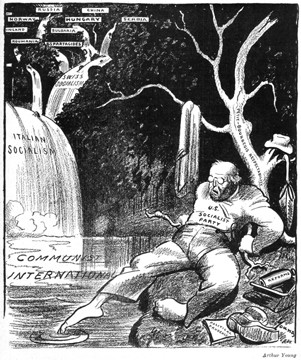
"Testing the Water,"
a cartoon by Art Young [July 1919]. ***PDF GRAPHIC FILE (460
k.) This cartoon
by Art Young appeared in the July 1919 issue of Max Eastman's
monthly,The Liberator. Untitled in the original, the drawing
features a geriatric "U.S. Socialist Party" sitting
beneath the tree of "petit-bourgeois respectability"
dipping his toe in the "Communist International" pond.
"The Soviet Republic,"
by Santeri Nuorteva [July 1919] This eloquent defense of the Bolshevik revolution
by the Secretary of the Russian Soviet Government Bureau was
published in the pages of an American academic journal. Nuorteva
states that all the Soviet government wants is an end to military
intervention and trade relations. An organized blockade had disrupted
not only supplies into the country, but information from the
country as well, he states, quoting an unnamed Western press
correspondent who told Nuorteva that 95 percent of his telegraph
dispatches from Soviet Russia had been intentionally delayed
or stopped, particularly those mentioning in any way positive
aspects of Soviet construction. The Russian revolution was not
a simple matter of personalities taking specific actions, Nuorteva
states, but rather a massive sociological upheaval based upon
the land question and the peasant nature of the Russian army.
He declares that "the peasants just took the land. Whether
you approve of it or not, it doesn't matter because you can't
change it any more than you can change the course of the sun
or the moon." Only the Bolsheviks were willing to accept
this reality at face value and to conduct a set of sweeping economic
changes which were a logical consequence of the collapse of the
land ownership and banking system. Russia was not any more chaotic
than the rest of Central and Eastern Europe, Nuorteva states
-- indeed, rather stable compared to other nations. Further,
it was hypocritical of the press to obsess upon the 3,000 or
so killed in the Russian Red Terror when 15,000 had been executed
and 10,000 systematically starved to death during the same period
by the conservatives in Finland and while the anti-Bolshevik
White Army of Kolchak took no prisoners and systematically murdered
government officials in villages falling under its control. Victory
by Kolchak would mean an exponentially more vicious bloodbath
than the rather limited violence practiced by the Bolsheviks,
Nuorteva indicates.
"The Parting of the Ways,"
by Dennis Batt [July 1919] Fundamental
splits of Socialist parties are inevitable, writes Michigan Left
Wing Section leader Dennis Batt in this article from The Proletarian:
in some countries this takes place before the revolution
and in others during the revolution itself. The reason, Batt
indicates, is that at some point in the process "the understanding
minority becomes the majority, and is in a position to take control
of the organization, a split is imminent; for the petty bourgeois-minded
conservatives within the ranks of the Socialist movement can
not, and will not, accept a real Socialist position. Rather than
do so they would wreck the organization." The Socialist
Party of America was at this juncture currently, he writes. Instead
of performing what Batt believed to be the fundamental task of
a Socialist party -- "training and organizing the working
class for the conquest of political power" -- the SPA had
filled its platform with "all kinds of nonsensical reforms,
old age pensions, government ownership, penal reforms, etc.,
etc., ad naseum." This had the effect of attracting non-Socialist
elements to the party, individuals who had proven their instability
and disloyalty in times of crisis. The NEC of the Socialist Party
is singled out for its hypocrisy in allowing its petty bourgeois
allies to flirt with the Non-Partisan League, in clear violation
of the SP loyalty pledge, while at the same time expelling adherents
of the Left Wing Section for purported violation of the same
pledge. The "National Office clique" falsely claimed
to be constructive, actually constructing nothing, and have "even
been unable to develop a press fit to read," Batt bitterly
complains. This series of failures resulted in the repudiation
of the "reactionaries in office" in the 1919 Party
election, an event which prompted the NEC to show "their
true colors -- a genuine black streaked with yellow" by
invalidating the vote and proceeding to suspend and expel their
opponents. "We congratulate them upon their maintaining
control at the expense of wrecking the organization. They have
expelled or suspended nearly 40,000 members and will expel that
many more in order to remain in the saddle of power," Batt
declares, adding "the split in America has come."
"The Left Wing and the Truth,"
by Adolph Germer [July 2, 1919]. The National Executive Secretary makes a spirited
defense of the decision of the party's governing National Executive
Committee to expel the state organization of Michigan for violation
of the constitution of the Socialist Party. Germer quotes the
newly revised constitution of Michigan and its mandate that "any
member, local, or branch of a local, advocating legislative reforms
or supporting organizations formed for the purpose of advocating
such reforms, shall be expelled from the Socialist Party"
and notes the patent contradiction of this clause with the national
constitution of the SPA. Germer notes that neither of the two
Left Wing partisans on the NEC --- Alfred Wagenknecht and Ludwig
Katterfeld -- disputed the fundamental validity of this charge
and details how the Michigan State Secretary, John Keracher,
rushed to the May 1919 meeting of the NEC in Chicago and then
refused to answer questions that might have put the position
of Michigan in a more favorable light. Germer further quotes
correspondence from a Detroit Jewish branch suspended by the
Michigan Executive Committee to confirm the reality of the Michigan
position in actual practice.
"Minor Ordered Released by
US Army Officer: All Charges Against Him Understood to Have Been
Dropped -- May Return to Paris." (New York Call)
[July 7, 1919] After
over a month in detention to answer charges leveled by the British
that he had spread radical propaganda among British and American
troops, this article announces journalist Robert Minor's release
by army officials "after word had been passed from officialdom
believed close to the Peace Commission.... Lincoln Steffens,
who assisted in the report handed the American peace commission
on Russia, learned of Minor's arrest and sought the aid of Colonel
House, the President's confidential adviser, to secure Minor's
liberty.... The father of Robert Minor, Judge Minor of Texas,
also appealed to the government, and after a month's confinement
the journalist was finally set at liberty." The account
states that "no official announcement has been made concerning
Minor's release, but it is understood that all charges against
him have been dropped and that he will immediately return to
Paris."
"Minnesota Socialists Expel
Van Lear for War Stand: State Referendum by 1,500 to 800 Also
Reads His Local Out of the Party." (New York Call) [July
8, 1919] This
news report details the expulsion from the Socialist Party of
former Minneapolis mayoral candidate Thomas Van Lear by referendum
vote of the Socialist Party of Minnesota by a margin of approximately
1,500 to 800. The charges for the expulsion of Van Lear were
his pro-war activities and his repudiation of the majority report
of the St. Louis Convention and for having joined the American
Alliance for Labor and Democracy, the article notes. State Secretary
Charles Dirba (later a top leader of the Communist Party of America)
is said to have declared the vote to be both a repudiation of
Van Lear's policies and an approval of the policies of those
he termed "the educators."
"Minutes of the Meeting of
the New York State Executive Committee, Socialist Party of America,
Sunday, July 13, 1919." In
the summer of 1919, the State Executive Committee of the Socialist
Party of New York conducted a series of charter revocations of
many of the state's local and county organizations which supported
the program of the Left Wing Section or refused to terminate
participation of members of locals affiliated with suspended
language federations. These revocations were followed by immediate
"reorganizations" of locals hostile to the Left Wing
Section and loyal to the SPA's Old Guard. These minutes of the
July 13 meeting of the SEC in Albany detail the repressive measures
taken against to following groups: Local Kings County, Local
Queens County, Local Utica, Local Syracuse, Local Rochester.
In a related matter, tension ran hot over an editorial run by
Ludwig Lore in the New Yorker Volkszeitung represented
as urging Socialists in Kings and Queens Counties not to recognize
the actions of the State Executive Committee in reorganizing
those organizations, but rather to remain loyal to the deposed
organizations. An interest esoteric tidbit: a proposal to hold
an emergency New York State Convention -- presumably a tactic
that would have benefited the Left Wing Section -- failed on
a tie 12 to 12 vote of the State Executive Committee, with future
member of the Communist Party Alexander Trachtenberg voting in
the negative. In his vote, which effectively defeated the proposal,
Trachtenberg joined such Old Guard stalwarts as Julius Gerber,
Bertha Mailly, Benjamin Orr, Barney Berlin, Morris Hillquit,
and Louis Waldman. Had Trachtenberg voted the other way, the
crushing polices of the New York SEC would have been fought out
and decided on the convention floor.
"'Left Wing' Convention is
as Secret as Paris Conference: Next Move of Faction Will be Attempt
to Capture Socialist Party's Emergency Convention in August,
says James Oneal," by James Oneal [July 15, 1919] The Socialist Party regulars kept
a close eye on the development of the Left Wing Section throughout
the summer of 1919. This report on the Left Wing National Conference
held in New York City from June 21-24, 1919 pays close attention
to internal divisions within the "Left Wing" camp.
The anglophonic element of the Left wing Section "were up
against the same proposition" previously faced by the Socialist
Party, in Oneal's view -- an attempt by the foreign language
federations to achieve double representation on the governing
Left Wing National Council and to thus control the organization.
Oneal notes that the Left Wing had altered its program at the
gathering, but had no specific details about the changes rendered.
As early as this date, six weeks before the Emergency National
Convention of the SPA, Oneal offers political analysis that is
eerily prescient: "...[U]unless the Socialist Party is willing
to submit to the dictatorship of the 'Left Wing,' the latter
is prepared to organize its motley elements into another political
party. The split, in other words, is here and the 'lefts' have
made doubly sure of it. It is just as well that they have, as
one year of a Communist Party that talks of the 'conquest of
the bourgeois state by the revolutionary mass action of the proletariat'
cannot live in this country as a political organization of the
working class. It will be driven underground. It cannot remain
on the ballot in any state as soon as this program becomes generally
known. It must become a secret society." Oneal adds that
the heterogeneous Left Wing was held together only by "common
hatred of the Socialist Party." As soon as the Emergency
Convention was concluded, "they will be thrown upon their
own resources and they can be relied upon to tear each other
to pieces," Oneal predicted.
"Ruthenberg is Jailed Under
New Ohio Law: Socialist Locked Up on Charge of "Criminal
Syndicalism" -- Called War "Mass Murder." (New
York Call) [July 18, 1919] In the evening of July 18, Cleveland Socialist
leader C.E. Ruthenberg was addressing a local crowd, making his
first speech of the 1919 mayoral campaign. About 30 minutes into
his speech he was interrupted by a squad of policemen headed
by Chief of Police Smith, who placed Ruthenberg under arrest
for allegedly violating the new Ohio Criminal Syndicalism Law.
Six others were also held "for investigation by Federal
authorities" as a result of the operation, which was aided
by the Right Wing "Loyal American League." At issue
was Ruthenberg's statement that World War I had been a period
of "mass murder." "If it is possible for the government
to take over the steamships and railroads, telephone and telegraph
lines and other public utilities in time of war in order to make
mass murder more efficient, why is it not possible for these
same industries to be publicly controlled for the common good
of all in times of peace?" candidate Ruthenberg had asked.
A further reminder that American civil liberties were not granted
on a platter by forefathers in powdered wigs and defended by
uniformed soldiers of the standing army abroad, but rather were
fought and won over time by frequently unpopular (and sometimes
despised) political radicals who had to courage to hold forth
unpopular truths in the face of massive pressure by the armed
state and its conservative vigilante allies, a vengeful judiciary,
and an apathetic citizenry.
"'Long Live the Soviet Republic!"
An Editorial in The Milwaukee Leader -- July 19, 1919.
The Socialist
Party daily The Milwaukee Leader and its founder and editor,
Victor L. Berger, have been regarded as hailing from the SPA's
Right Wing, generally by those who have never seen the paper
or read Berger. In reality, Berger and Hillquit composed a SPA
Center -- anti-militarist in sentiment, analytically Marxist,
internationalist in perspective (the true SPA Right Wing departed
en masse in the aftermath of the St. Louis Emergency Convention
of 1917). Although not written by Berger, who was in the midst
of legal proceedings for purported violation of the so-called
Espionage Act, this editorial in Berger's paper emphasizes once
again that whatever the ideological and personal differences
were between the dissident Left Wing Section and the establishment
SPA Center, political perspective on the nature of the Bolshevik
Revolution and the role of American Socialists with regard to
that revolution was emphatically NOT part of the equation. In
1919, all factions of the Socialist Party of America were in
solid support of Lenin and Trotsky and their cause. This
editorial accuses President Wilson of practicing "the opposite
of what he preaches" by rendering aid to the interventionists
in Soviet Russia. "It is because Soviet Russia is a Socialist
nation.... Should the Socialist government of Russia be allowed
to succeed and become permanent, its good example to the workers
of the other countries would be such that these workers would
establish Socialism in their countries, too. Therefore, the Soviet
government of Russia must be destroyed..."
"Call for a National Convention
for the Purpose of Organizing a Communist Party in America."
[July 19, 1919] This
is the text of the extensive "Federations-Michigan Convention
Call" for the formation of an American Communist Party.
The call states that "the National Executive Committee of
the Socialist Party of America has evidenced by its expulsion
of nearly half of the membership that they will not hesitate
at wrecking the organization in order to maintain their control."
These suspensions and expulsions had made it "manifestly
impossible to longer delay the calling of a convention to organize
a new party," notes the call, but unfortunately "the
majority of the delegates to the Left Wing Conference in New
York meekly neglected to sever their connections with the reactionary
National Executive Committee," instead continuing to "mark
time as Centrists in the wake of the Right." No other course
was possible than the immediate formation of a Communist Party
in Chicago at a convention to begin Sept. 1, 1919. A set of organizational
principles and an organizational program are provided. The call
specifies that convention representation is to be on the basis
of one delegate for each organization, and one additional delegate
for every 500 members or major fraction thereof.
"On the Party Horizon,"
by Alexander Stoklitsky [July 19, 1919] Translator-Secretary of the Russian Federation
Alexander Stoklitsky takes aim at the "Centrists" who
continue to follow the strategy of "capturing the Socialist
Party for revolutionary socialism." Stoklitsky mocks: "Every
bridge leading to the old, rotten structure of opportunism must
be destroyed.... The capture of the old party for 'revolutionary
socialism' is but a declaration of war upon windmills by the
Don Quixotes of the Center." Stoklitsky asks, "Why
capture the old party? Is the name of the Socialist Party so
dear to the working class? No. The name of the Socialist Party
is no longer dear to the proletariat. Years of reformatory and
treacherous activity have covered it with mud and slime."
Further, the SPA's structure and apparatus is unsuited for the
revolutionary movement and its literature "only fit to be
destroyed." Stoklitsky declares that "BECAUSE THE SPLIT
IN THE PARTY IS AN ACTUAL FACT IT BECOMES OUR SACRED DUTY TO
CONSTRUCT A COMMUNIST PARTY." Stoklitsky offers an analysis
that would be dominant in the CPA over the next three years,
declaring the American Socialist movement had, in parallel of
the Socialist movement of Europe, split into three tendencies:
Right, Center, and Left. However, Stoklitsky equates the dominant
SPA Party Regular tendency of Hillquit and Berger (anti-militarist,
Marxist opponents of the national regime) with the pro-war, government
Majority Socialists of Germany, calling them "Right."
Similarly, the revolutionary socialists continuing their effort
to win control of the Socialist Party in hopes of converting
it to a revolutionary socialist are rather speciously equated
with the Independent Socialists in Germany as "wishy-washy
Centrists" who are pursuing a "pitiful" strategy.
"Down with the Socialist Party! Down with the wavering Center!
Long live the militant Communist Party of America!" Stoklitsky
declares.
"Adolph the Truth Seeker,"
by John Keracher [July 19, 1919] In contrast to the barrage of ultra-Left hostility
vented by Alexander Stoklitsky in the same issue of the official
organ of the faction of the Federation-Michigan alliance, Michigan
leader John Keracher is surprisingly temperate in his criticism
of SPA Executive Secretary Adolph Germer and his cohorts. Germer
is said to be a man of honest opinions and sincere convictions
-- albeit one willing to engage in a campaign of half-truths
and distortions to bolster his cause. The central fact of the
crisis in the Socialist Party in the Summer of 1919 was this,
Keracher believes: "the membership has voted the old gang
out of office, and they prefer to split the party rather than
give up their control!" Everything else is a pretext to
justify this naked grab for power, Keracher believes. The issue
behind the suspension of the Jewish Branches of Local Detroit
had been misrepresented in the SP party press by Germer, Keracher
indicates. The SPA's NEC had taken draconian actiona against
Michigan with factional purpose; queries made by Michigan State
Secretary Keracher had been answered dishonestly. The Emergency
Convention in Michigan which had followed the NEC's revocation
of the Michigan charter had been legally called, contrary to
the assertions of Germer. In the final analysis, all of the NEC's
arguments are nothing more than "quibbling," in Keracher's
estimation: "This split, which they deliberately precipitated,
was inevitable due to the development going on within the party.
What difference does it make if the division takes the form of
expulsion or withdrawal? Those who desire to participate in real
socialist propaganda will send delegates to Chicago on September
1st [1919] to organize the Communist Party of America."
"Socialist Party of St. Louis
Makes Appeal for Unity in Organization: Party War Record Does
Not Justify 'Wing' Row, is Plea." [July 19, 1919] A lengthy and thoughtful summary
of the case against the factional war launched by the Socialist
Party's insurgent Left Wing made by Local St. Louis, an organization
comprised of SPA Regulars. "While the world war was on we
never heard of a Left Wing nor of a Right Wing," the statement
declares, as during the days of discouragement of 1914-16, the
Socialist Party "remained true to the Red Banner of Internationalism,"
while after American entry into the conflict in 1917 the party
went further and issued a "revolutionary declaration"
against the conflict. The SPA had suffered for its principled
anti-militarist stand: papers had been suppressed, the National
Office had been raided, and leaders and rank and filers alike
had been hauled before the courts by the Woodrow Wilson regime.
There was simply no claim to be made against the party for failure
to stand true to its values during the war, the St. Louis appeal
notes. Furthermore, the party had loyally supported the Russian
Revolution from its earliest phase in March 1917 until the present
day. "Mass meetings were held, demonstrations in behalf
of Soviet Russia were arranged, our Socialist press gave all
possible support to counteract the sinister work of the American
capitalist press," Local St. Louis notes. The party's position
had been taken actively to the American people. "The capitalist
class failed to break up our Socialist Party by attacking it
from the outside and by vicious persecution. Attempts will now
be made to try the destructive work from the inside. There are
many ways of procedure, which are best known to the secret agents
and agents provocateurs. It is unfortunate that at this most
critical time, when the Socialist Party ought to show a united
and solid front to resist the offensive of destruction launched
by our common enemy, our organization should be checked and hindered
in its work by a so-called Left Wing movement, and that a 'White
Card' underground organization should be formed in the party.
We can see neither rhyme nor reason in such a sideshow movement,"
Local St. Louis declares.
"Statement on the Situation
of the Socialist Party in Philadelphia," by Charles Sehl
[July 20, 1919] Brief
account of the Left-Right factional war which took place in the
Socialist Party of Pennsylvania by a SPA Regular active in reorganized
Local Philadelphia. Spurred by advice personally delivered by
NEC Regulars James Oneal and George Goebel, a July 13 informal
conference on the party situation had been followed by an immediate
secret "executive session" of the State Executive Committee.
The Pennsylvania SEC had determined to follow the path taken
by the SEC of New York State, ordering State Secretary Birch
Wilson to travel to Philadelphia and to arbitrarily revoke the
charter of Local Philadelphia, the majority of which had endorsed
the Left Wing manifesto. Local Philadelphia had refused to recognized
the authority of the State Secretary in this matter, and Wilson
had immediately moved to reorganize a rump of 300 "loyal"
members of the party as a new Local Philadelphia. Those joining
Wilson's new (truly white card) local had to sign the following
loyalty oath, not provided for in the state party's constitution:
"I, the undersigned, declare that while a member of the
Socialist Party I shall be guided by the National and State Platforms
of the Socialist Party. I do not belong to any organization within
or without the party which has a platform or constitution in
violation of the National constitution or the State constitution
of the Socialist Party. I am not and have not been a member of
the so-called Left Wing." The reorganization of the organization
was approved by a rushed telegram vote of a non-quorum of the
State Executive Committee. Thus was New York's Tammany-style
power politics made "legal" in Pennsylvania. The Emergency
National Convention of the Socialist Party was less than 6 weeks
away.
"'Local Cleveland's Referendum,"
by James Oneal [July 22, 1919] Immediately after the Socialist Party's NEC abrogated
the 1919 election, expelled Michigan, and suspended the entire
memberships of 7 of the party's language federations, the Left
Wing Section sprang into action, with Local Cleveland, Ohio putting
forward a party referendum aimed at overturning the NEC's actions
within 24 hours. This article by NEC member and arch-anti-Left
Winger James Oneal challenges the competence of those supporting
such an effort, asking, "have any of these members seen
the evidence upon which alone the suspensions were made? Have
they seen the mass of evidence regarding election frauds? Not
at all. Here are questions that involve the violation of the
party constitution and party principles. A general vote of the
members cannot decide whether the evidence was sufficient to
warrant our actions." Oneal calls for the matter to be decided
not via referendum but at the forthcoming Emergency National
Convention (a gathering that clearly would be stacked in favor
of the party administration, not accidentally). Oneal characterizes
the Left Wing Section as a rival political organization, banned
by party statute, rather than as an organized faction within
the SP. He mockingly refers to the Left Wing Section a "self-constituted
'dictatorship of the proletariat'" and encourages locals
to throw their request for seconds to their referendum "into
the wastebasket."
"Statement of Socialist Party
of Philadelphia." [published July 22, 1919] The details of the 1919 factional
struggle within the Socialist Party of America are well-known
for the party's main cities -- Chicago and New York. Details
of the fight are less clear outside of those two main centers.
This letter to the Milwaukee Leader details the battle in Philadelphia
through the eyes of the faction loyal to the party NEC. The troubles
began, it is stated, after the signing of the Armistice [Nov.
11, 1918], at which time " a small element which is un-Socialistic,
and which quietly crept into the party, began to assert itself."
First the Executive Committee was removed by a "small meeting
of the County Committee," and new party members were admitted
"wholesale" -- thus bolstering the support of the insurgent
Left Wing. This Left Wing drove "faithful" members
of the SP from meetings, not fearing to resort to "rowdyism"
to disgust and frighten off the "decent people, whose object
was to serve Socialism, and who had no time to mix in street
gutter politics and squabble." In control of the apparatus,
the Left Wing revealed their intent to "sell out the party
to a mongrel combination of anti-Socialist and anarchistic ideas
and practices such as would put the party out of business."
At a special meeting held July 9, 1919, the minority faction
loyal to the SP NEC demanded the exclusion of members suspended
by the national party from participating in local business. Defeated
in a vote, the Right Wing bolted, moving to another hall and
declaring themselves to be the official "Local Philadelphia,"
electing officers and passing resolutions.
"Legislation Against Anarchy,"
by Zechariah Chafee, Jr. [July 23, 1919] Zechariah Chafee, Jr., an Assistant Professor
at Harvard Law School and member of the Rhode Island bar, reviews
the current spate of anti-radical legislation that was sweeping
the country, concentrating his attention on the Overman bill
pending in the United States Senate. Chafee argues that existing
normal law already sufficiently covers the crimes of assassination,
destruction of property, and incitement to revolution and he
asks whether "in the haste and excitement of the moment
our legislators may not be going much too far." "As
far as state prosecutions are concerned, there has been very
little need of specific legislation against anarchy and criminal
syndicalism. Actual violence against the government, life, and
property is punishable everywhere. Those who plan or counsel
such violence are liable even if they do not actively participate,"
Chafee declares. Furthermore, "no Congressional legislation
is needed to make criminal any scheme to overthrow the United
States government by bombs or any other means," Chafee indicates.
The article is lengthy and includes numerous citations of law,
including a footnote detailing specific measures covering the
entire gamut of related crimes for four key locales: New York,
the District of Columbia, Massachusetts, and Washington state.
Chafee makes a civil libertarian argument that the current campaign
to enact criminal syndicalism, criminal anarchism, and red flag
legislation only has the effect of making opinion and thought
illegal and violating the constitutional rights of press, assembly,
and association rather than protecting society against actual
criminal deeds. In contrast to this anti-libertarian trend, Chafee
states that "normal criminal law is willing to run risks
for the sake of open discussion, believing that truth will prevail
over falsehood if both are given a fair field, and that argument
and counter-argument are the best method which man has devised
for ascertaining the right course of action for individuals or
a nation. It holds that error is its own cure in the end, and
the worse the error, the sooner it will be rejected." Chafee
concludes with a very detailed critique of the excesses of the
Overman bill currently being touted in the Senate.
"People Ready for Socialism;
Party Starting Work -- Germer." [July 24, 1919]. As the faction fight heated up
in the summer of 1919, National Executive Secretary Adolph Germer
traveled from Chicago to New York City for consultations with
leaders of his faction. This article contains the content of
an interview which Germer granted to the New York Socialist Party
daily, the New York Call. Germer held a "rosy"
view of the SP's immediate future: "The situation as it
existed last winter was wonderfully promising. If we had been
able to remain united, nothing would have been too much to hope
for. The time is ripe, and rotten ripe, for our propaganda. But
the internal discussions and wranglings have sterilized our efforts
to a very large extent." Germer added that "There are
thousands of old-time Comrades who had relapsed into inactivity,
and who are only awaiting some stirring event to recall them
to life. The time has come now. When the party gets rid of its
internal disorders, when the decks are cleared, when we point
our craft at the goal, we will be ready for work, and they will
come back to us." Germer exuded confidence as to the future
result of the forthcoming Emergency Convention of the party:
"The national convention that will meet on August 30 will
take a strong stand, a resolute stand. Then, all those who do
not care to remain with us can go their way. We will go our way,
as we have always gone."
"Fred C. Ellis Plunges 5
Stories; Hits Walk: Cartoonist Escapes with Minor Fractures When
Painters' Swing Rope Breaks," by Robert M. Buck [event of
July 24, 1919] A
short anecdotal sidebar to the tumultuous history of 1919, this
news story documents the near-fatal fall of Fred C. Ellis, one
of the great political cartoonists of his generation. Ellis,
a regular contributor to The Liberator and The New
Majority, was working at his craft putting up an outdoor
advertising sign on the side of a 6 story building in Chicago's
North Side, when one of the ropes holding the scaffold from which
he was working frayed and broke, sending Ellis crashing feet-first
to the sidewalk 60 feet below. Miraculously, Ellis escaped with
fractures to both feet, his right hand, and his back -- another
sign painter had been killed in a similar accident nearby just
a few days previously when he fell through the roof of a car.
"I knew I was due for a drop," said Ellis, "I
was too far over to grab the guide line -- so I just set myself
for the spill. I figured if I could keep my head up I would have
a chance. It seemed like I was standing in the air while I was
dropping to the sidewalk. I remember seeing the fellows come
over and scoop me off the sidewalk -- then I lost consciousness."
Includes a photograph of a youthful Fred Ellis.
"The National Left Wing,"
by Isaac E. Ferguson [published July 25, 1919] An open letter from the Secretary of the National
Council of the Left Wing Section, established by the June 1919
National Conference of the Left Wing held in New York. Ferguson
announces that the National Council is to conduct "the work
of publicity and preparation on a national scale" for the
August 30 Emergency National Convention of the Socialist Party,
to be held in Chicago. "The Left Wing triumph in the party
elections makes emphatically clear what the membership wants....
It must not be annulled by the brazen dictation of a repudiated
National Executive Committee which insists upon ruling the party
in spite of the ending of its term on July 1st." The dual
strategy of the National Council that was to lead to the division
of the Communist movement into two rival parties is already in
evidence; Ferguson states "The Left Wing must control the
regular party Emergency Convention, with the delegates instructed
by the membership to undo the manipulations of the old NEC to
join the party unreservedly with the Communist International,
and to adopt a program of revolutionary socialism for all party
activities. Or, if three-fourths of the party shall be expelled
or suspended by August 30th, as appears now to be a definite
possibility, or if the Emergency Convention shall be sidetracked
by the rump NEC, the Left Wing delegates from all over the country
must be brought together to organize an American Party of Communism."
Ferguson pleads for donations to the National Council and notes
that 25¢ Special Propaganda Stamps are for sale.
"One Lie Nailed," by
Ludwig E. Katterfeld [July 26, 1919] Left Wing Section partisan Ludwig Katterfeld goes
on the offensive in response to a charge by NEC member James
Oneal that the outgoing National Executive Committee was not
repudiated by the referendum of 1919 -- the results of which
were suppressed by the self-same outgoing NEC. Katterfeld asserts
that in reality, the 20,764 votes independently tabulated by
The Ohio Socialist from 26 reporting states represented
nearly "TWICE AS MANY" votes as the same states produced
in the previous year's national election. Oneal is further tweaked
for having received a mere 1,726 votes in those same 26 states,
as compared to the tally of 16.074 racked up by the leading vote-getter
in the race, John Reed. Katterfeld pulls no punches in making
his charge: "In view of these facts, what becomes of Oneal's
assertions and allegations? I commend these figures to our would-be
"historian" James Oneal. Was he ignorant of these facts,
or did he deliberately lie in his efforts to defend the defeated
and discredited party officialdom and to prejudice the membership
against the Left Wing and Revolutionary Socialism?"
"Report to the Incoming National
Executive Committee of the Socialist Party on the Party Press
and Publishing, Lyceum Bureau, and Party School," by L.E.
Katterfeld [July 27, 1919] There
is a tendency to see the Left Wing Section of the Socialist Party
as intent upon seizing the Socialist Party and utterly deconstructing
its form and substance. This report of Ludwig Katterfeld to the
sole physical meeting of the "new" NEC elected by the
abrogated party election of 1919 offers a tantalizing glimpse
of what seems to have far more constrained initial objective
of the faction. Rather than construction of vanguard revolutionary
organization, Katterfeld posits a modest restructuring of the
Socialist Party along its traditional lines. Katterfeld advocates
a systematically planned party-owned press based on regional
territories instead of the current "anarchistic" system
of competing private newspapers. Katterfeld postulates the division
of the country into geographic districts, each served by a weekly
paper which was to be developed to the point of daily frequency.
These territorial papers were to cooperate in the costly task
of news-gathering. An extremely low-cost national propaganda
paper was to be published by the party itself in addition to
a periodic paper to the national membership. The SPA was also
to seek negotiations with Charles H. Kerr & Co. with a view
to bringing that Marxist publishing house under party auspices
and was to further study the economics of owning its own physical
plant (unlike Kerr & Co., which jobbed out its press work).
The Party was also to once again take over the routing of national
speakers, replacing the current system based upon individuals
negotiating their own lecture tours. Finally, Katterfeld advocates
the immediate establishment of a party-owned training school
to immediately set about training hundreds of young party members
as speakers and efficient local secretaries. "In the past
these duties have fallen largely upon those who received special
training in a capitalist environment before they become Socialists.
Practiceless lawyers, pulpitless preachers, and busted businessmen
have almost had a monopoly of these positions and thereby influenced
our movement our of all proportion to their number. The way to
overcome this condition is to train up our own young people,
working men and women who were Socialists first," Katterfeld
asserts.
"The New NEC Meets: Report
of the Meeting of the National Executive Committee, Socialist
Party -- Chicago, July 26-27, 1919," by Louis C. Fraina
The constitution
of the Socialist Party of America called for a new term of office
of its governing National Executive Committee to begin July 1,
1919. The outgoing NEC had refused to tabulate the votes reported
by SPA State Secretaries, however, and had instead began a mass
campaign of suspensions and expulsions of their Left Wing opponents.
A substantial, albeit partial, tabulation was compiled by the
Left Wing and published in the June 18, 1919, edition of The
Ohio Socialist, and a group of ostensible winners named based
upon these returns. Ostensible winner of the balloting for Executive
Secretary Alfred Wagenknecht called the "new" NEC together
for its first physical meeting in Chicago, where it met July
26-27, 1919. This is the report of the gathering published by
new NEC member Louis Fraina, who was a participant. The session
was chaired by L.E. Katterfeld and Alfred Wagenknecht served
as Secretary. A committee was appointed to tabulate the vote
of the 1919 NEC referendum, reporting back that the quorum of
8 of the 15 had been "duly elected with a vote so large
as to dispose of the lying charge of fraud." A demand was
issued to Executive Secretary demanding that he turn over the
headquarters building to the new NEC and appear at its sessions;
this he refused. Germer's position was declared vacant and Wagenknecht
elected as the temporary Executive Secretary, pending the convention.
The outgoing NEC was reversed and the Massachusetts and Michigan
state organizations reinstated, as were the 7 suspended Language
Federations. State Secretaries were urged to withhold convention
funds and refrain from purchasing dues stamps from Germer's National
Office. Interestingly, Harry Wicks seems to have broken discipline
with his Michigan comrades for the first time at this moment
by attending this NEC session -- Dennis Batt and John Keracher
of the Michigan organization were also elected to the new NEC,
but boycotted the July session, as did Russian Federation leader
Nicholas Hourwich. Wicks' participation was important in that
only 8 of 15 NEC members-elect were in attendance -- the participation
of each vital for the gathering's ability to be represented as
being attended by "a majority and a quorum of the whole
committee."
"NEC Declaration to the Party:
Issued by the [new] National Executive Committee of the Socialist
Party -- An American Communist Party Urged." [adopted July
27, 1919] Official
declaration made by the "new" NEC elected in the abrogated
SPA election of 1919 to the membership of the party, detailing
their actions and issuing a call for the forthcoming Emergency
National Convention in Chicago. Drafted by a committee of 3,
including L.E. Katterfeld, Louis C. Fraina, and Harry Wicks,
the document announces "The old NEC is dead; it throttled
the will of the revolutionary masses in the party; you comrades,
must act; we meet simply to provide you the opportunity to act
and assert your supremacy." Decisions taken by the new NEC
at its July 26-27, 1919, meeting are reviewed, including the
declaration of the office of National Secretary vacant and the
election of Alfred Wagenknecht to the position on a temporary
basis, pending decision of the August convention. The document
indicates that the new NEC determined that it would "assume
full control of the Emergency National Convention" and would
"shortly inform you of the place where the Convention will
meet, together with the roster of delegates." This action,
which would in practice the organization of a parallel convention
on August 30, does not seem to have been executed by Wagenknecht,
who only rented a room downstairs from the main, Germer-organized
convention, for a gathering of bolting delegates. The document
optimistically (some might say delusionally or hysterically)
declares that "August 30, in the Chicago Convention, will
mark the end of the Left Wing controversy. Revolutionary Socialism
will control. You will crush the moderates. You will act! You
will transform our party into a Communist Party, to express the
mass struggle of the proletariat. Then -- action! Then -- the
revolutionary struggle!" Includes the full text of another
statement issued by the new NEC at its July 26-27 meeting, "Issues
of the Convention," which was composed by a committee of
3 consisting of new NEC members C.E. Ruthenberg, Fred Harwood,
and Louis Fraina.
"Letter to Adolph Germer,
Executive Secretary SPA, in Chicago from Fred Krafft, Member
NEC SPA, in Ridgefield, NJ, July 29, 1919." This brief note from Socialist
Party National Executive Committee member Fred Krafft to Executive
Secretary Adolph Germer illuminates the politics behind the scenes
leading to the suspension of the entire Socialist Party of Ohio
by the outgoing NEC (which was to have retired according to the
party constitution as of July 1, 1919). Krafft writes: "You
ask me to wait a few days with the motion which I made to revoke
the charter of Ohio. Let me say that I regret very much not to
have made this motion several weeks ago, and especially so since
reading the action of the 'new' NEC. These fellows mean business
and they proceed regardless of what we think about their actions,
and it is high time to disregard their opinions in whatever we
do, or contemplate to do. If the NEC deserves any censure in
the entire controversy, it is because of its misplaced tolerance
and hesitancy."
"Letter to Adolph Germer
in Chicago from Alfred Wagenknecht in Chicago, July 29, 1919."
The constitution
of the Socialist Party of America called for a new term of office
of its governing National Executive Committee to begin July 1,
1919. The outgoing NEC had refused to tabulate the votes reported
by SPA State Secretaries, however, and had instead began a mass
campaign of suspensions and expulsions of their Left Wing opponents.
A substantial, albeit partial, tabulation was compiled by the
Left Wing and published in the June 18, 1919, edition of The
Ohio Socialist, and a group of ostensible winners named based
upon these returns. Ostensible winner of the balloting for Executive
Secretary Alfred Wagenknecht called the "new" NEC together
for its first physical meeting in Chicago, where it met July
26-27, 1919. The group passed the resolution transmitted to the
SPA's National Office here: ""That the office of the
National Executive Secretary be declared vacant inasmuch as the
present incumbent refuses to perform his duties as National Secretary
by refusing to tabulate the vote in referendums expressing the
will of the membership and further refuses to recognize the regularly
elected National Executive Committee." This communication
was signed by Alfred Wagenknecht as "Executive Secretary,
Pro Tem."
"Circular to All Locals,
Branches, and Young People's Socialist Leagues from Alfred Wagenknecht,
July 29, 1919." Official
communique of the New National Executive Committee and Executive
Secretary pro tem Alfred Wagenknecht mailed to all units of the
Socialist Party of America and its youth section. The circular
notes that "the national constitution ended the term of
the old National Executive Committee on July 1st [1919]"
and announces that "the new National Executive Committee
met in Chicago on July 26 and 27, reversed the actions of the
old committee in its attempt to wreck the party, reinstated all
expelled state organizations and suspended federations -- more
than 35,000 members in all -- and renewed the call for an Emergency
National Convention, to be held August 30th." While the
circular states that " the new National Executive Committee
will take charge of this convention," it is not clear that
Wagenknecht & Co. did any more than arrange to rent a room
downstairs from the main convention in Machinists' Hall -- preparations
remained firmly in the grasp of standing Executive Secretary
Adolph Germer and his allies. Mileage money is promised by the
new NEC to convention delegates and the circular solicits contributions
and loans from party units to the new NEC.
"The Split in the Socialist
Party," by Joseph B. Stilson [July 30, 1919] The Translator-Secretary of the Lithuanian Socialist
Federation, one of the leading players in the 1919 crisis in
the SPA, provides a lengthy perspective on the history of the
party split. One of the definitive views of the thinking of non-Anglo
members of the Left Wing Section, Stilson (arguably) dates the
origin of the conflict to the 1916 Presidential candidacy of
Allan Benson, a referendum-nominated SP candidate who dodged
all mention of the class struggle, in marked contrast to the
fire-and-brimstone rhetoric of perennial party nominee Gene Debs.
Stilson saw the war as an important turning point in the radicalization
of the SP rank and file, one that tipped the majority of the
party against its centrist office holders. Faced with electoral
defeat in the party election of 1919, the SP leadership began
acting in a manner befitting of Tammany Hall, expelling and suspending
its opponents without trial, backed by the flimsiest of excuses,
hypocritically framed. "That these politicians knew that
the Left Wing had been in existence for over two years was frankly
admitted by [NEC member George] Goebel, who said that he kept
on his files a copy of each manifesto, program, and paper of
the Left wingers. It was evident therefore that the Left Wing
was tolerated as long as it did not threaten the control of the
reactionary machine... Only when the Left Wing touched the nest
of the Opportunists did it become a 'violation of the party Constitution,'"
Stilson asserts.
"Excerpt of Testimony Before
Executive Session of the Lusk Committee of the New York Legislature
by Archibald E. Stevenson, Associate Counsel, New York City --
July 31, 1919." Archibald
Stevenson was the chief researcher of the radical movement employed
by the Lusk Committee of the New York legislature in 1919-20
(and author of the committee's massive 4 volume final report).
This brief passage of his testimony before a closed session of
the committee goes far to explain the aggressive repression delivered
by the committee upon the Socialist Party and its affiliated
institution, the Rand School of Social Science. When asked whether
the SP had split into "two so-called wings," Stevenson
responds: "In the last 6 or 8 months the Socialist Party
has been split on a question of tactics. The more conservative
of the present membership of the Socialist Party remaining in
what is termed the Right Wing of that party, and the more impatient
or virulent organizing what is now known as the Left Wing Section
of the Socialist Party. The only difference between these two
sections that is apparent from a study of the controversy is
that the members of the Left Wing are more outspoken in their
desire for immediate and direct action methods for obtaining
socialism. It must be borne in mind, however, that both Right
and Left Wings took this revolutionary stand, and consequently
it should be understood that the Right Wingers are not the conservative
evolutionary Socialist who were either expelled or resigned from
the Socialist Party at the time of the St. Louis Convention [April
7-14, 1917]."
AUGUST
"Aping Our Elders,"
by Oliver Carlson [Aug. 1919] The newly-elected 3rd National Secretary of the
Young People's Socialist League here criticizes the tendency
for the YPSL to mindlessly divide itself into "Right,"
"Center," "Left," and "Communist"
factions. He finds that the fissure in the Socialist Party, which
was "at first about Tactics" had "passed entirely
out of sight by this time, so that the issue now is one of 'for
or against the NEC.'" The real cause of the fight was lost,
and it was unreasonable to expect young people, who had not studied
socialism for any significant length of time, to make a decision
on the matter. "What we must do is that which our League
is organized for: To Train Ourselves in the Principles of International
Socialism. We cannot hope to grasp the situation in a moment.
We cannot become able fighters for the Cause in a day or week
or month. Ours is not a creed or dogma which one can embrace
at a moment's notice. Ours is a complete philosophy which we
must learn." Carlson (later an important youth leader in
the American Communist movement) concludes that "We must
meet the new issues with a clear vision. We must take a stand
for revolutionary socialism. But above all we must become free
so that as an organization we can develop ourselves mentally
to a level where we will not be followers, where we will not
be led this way or that way, but as young men and women who UNDERSTAND
Socialism we will decide for ourselves what our attitude is going
to be."
"Left or Right?" by
Ludwig Lore [August 1919] In
this lead article from Ludwig Lore's theoretical quarterly, The
Class Struggle, editor Lore states that it is "hardly accurate"
to refer to the current controversy in the Socialist Party as
a battle between "Left" and "Right," since
"the small group of bona-fide social-patriots that our movement
harbored have either left it voluntary or been expelled"
already. The "political sins" of the so-called "Right
Wing" in the current controversy were those "of omission
rather than commission" -- failing to crystallize vast anti-war
sentiment in America at the time of American entry into the War
into a mass movement for economic and political liberation; failure
to enforce party discipline on Congressman Meyer London on anti-war
measures in Congress; failure to greet the Russian revolution
with public demonstration and public declaration of allegiance."
The policy of the NEC Regulars was in actual fact "the typical
'Centrist' position," Lore declares. The controversy in
the SP itself is international in nature, between one set of
views represented by State Socialism and gradual growth of socialism
through "democratic cooperation" with capitalism and
the other by the physical wresting of power from the capitalists
by the class-conscious working class and the establishment of
the "dictatorship of the proletariat." "Between
these two points of view there can be no compromise. Between
them the Socialist must choose -- and his choice must determine,
once and for all, his course of action," Lore declares.
"Why the New Party?"
by Oakley C. Johnson [Aug. 2, 1919] Elected State Secretary of the expelled Socialist
Party of Michigan emphasizes the depth of the split that had
developed within the Left Wing movement between the Majority
"Left Wing" still working to win control of the Socialist
Party and the Minority Federation-Michigan group intent on the
immediate formation of a distinct Communist Party of America
at the Sept. 1 convention which it had called in Chicago. Johnson
writes that "these would-be revolutionists shout "All
power to the Left Wing!" What a miserable paraphrase of
the Russian slogan 'All power to the Soviets!' The comrades now
organizing the Communist Party prefer to be something more than
a mere 'wing.' At a time such as the present, when the most momentous
turning point in the world's history is before us, we cannot
dilly dally along as a mere faction within a party. We cannot
longer handicap ourselves in such a way, but must build up NOW
an organization which shall function efficiently as 'the most
advanced and resolute section of the working class parties...'"
Johnson lists a series of criticisms of the tactics of the Majority:
(1) capture of the SPA by the Left would be practically impossible
due to expulsions and suspensions made by the outgoing NEC; (2)
even if possible, capture of the SPA was inadvisable due to the
party's "reactionary" reputation; (3) there was no
need to remain in the SPA to reach the rank and file, which had
already heard the Left Wing's message; (4) the psychological
moment for action had arrived, and a delay of 2 or 3 months would
"vitally affect the progress of socialism for the next decade."
In contrast, "What is needed is a revolutionary party, small
if need be, but united upon Marxian principles, thus forming
a nucleus around which the working class can unite. It is impossible
efficiently to unite conflicting programs, to harmonize unharmonious
principles. The only party that can function in a social crisis
is one absolutely united on principle and method."
"Minutes of the National
Council of the Left Wing Section: New York City -- August 4,
1919." The
7 member executive of the June 1919 National Conference of the
Left Wing, the National Council, was initially intended to conduct
its affairs by mail through use of executive motions. However,
the proximity of a quorum of the group to New York City led to
the convocation of several physical meetings. This document offers
the minutes of the last of these physical sessions, held August
4, 1919. Three anti-Federationist New York members (Ben Gitlow,
Jim Larkin, Max Cohen) dominated the proceedings, with Secretary
I.E. Ferguson in a consistent minority position given the absence
of his co-thinkers C.E. Ruthenberg, John Ballam, and Bert Wolfe.
A motion by Larkin to publicly respond to the "untruthful
statements" made by the Russian Socialist Federation against
Ludwig Martens' Soviet Russian Government Bureau was passed 3-1.
Ferguson was challenged by Larkin and ex-officio member Eadmonn
MacAlpine over statements he purportedly made to a gathering
of the Jewish Socialist Federation, in which Ferguson seems to
have depicted the August 30 Emergency National Convention as
no more than a tributary leading to the actual convention, to
be held Sept. 1 to establish a Communist Party. A motion by Larkin
to terminate the National Council for Ferguson having thus abrogated
its mission died by a 2-2 vote, Cohen joining Ferguson in favor
of continuing the institution. A motion providing that Gitlow
and Larkin be provided with space in The Revolutionary Age
to air their factional position was approved.
"Executive Motions of the
Left Wing National Council: August 5, 1919." A day after having been raked
over the coals by Jim Larkin and Ben Gitlow for his attempt to
patch up the split in the Left Wing movement by supporting the
Sept. 1 Communist Convention, Secretary of the Left Wing National
Council Isaac Ferguson put forward three executive motions to
the entire body: (1) Ending physical meetings of the National
Council in New York by setting August 29 in Chicago as the date
of the next gathering; (2) Constituting Ferguson, C.E. Ruthenberg,
and Max Cohen a committee of 3 with the authority to assist in
organization of a Sept. 1 convention to form a Communist Party;
and (3) Ending all further appropriation of funds by the Left
Wing National Council outside of payment of expenses already
incurred until the time of the August 29 physical meeting. "The
time has come for the majority of the Council to assert itself
decisively against the dilatory tactics of a minority which insists
on bringing within the Council meetings a rehash of every little
New York squabble between the Federation politicians and those
who are characterized by the Federationists as the Left Wing
politicians. We must complete the convention arrangements at
once," Ferguson declares. Ferguson is particularly bitter
about the insistence of National Council members Larkin and Gitlow
and their associate John Reed to "intrude controversy about
the Martens office into the work of the National Left Wing Council."
While acknowledging that a statement made by the Russian Socialist
Federation against the Martens bureau is "scandalous,"
Ferguson asks whether the National Council must "abandon
ourselves to the sport of Larkin in hunting down the lies of
the Russian Federation." Ferguson declares: " If there
is anything in this Martens issue, and this I think has been
grotesquely exaggerated, it certainly is no legitimate affair
of the National Council. Let anyone search the record of the
Left Wing Conference to show how it comes within our mandate,
and he will find absolutely nothing."
"Circular Letter 'To All
Members of the Socialist Party' from Executive Secretary Adolph
Germer, Aug. 8, 1919." Reply of National Secretary Germer to the provisional
National Executive Committee who were denied their seats on the
NEC when the outgoing NEC abrogated the 1919 party elections.
Self-proclaimed "Executive Secretary pro tem" Alfred
Wagenknecht and his cohorts are charged with being "professional
schemers" engaged in a "frame-up to wreck the party
by trying to force action in an irregular way before the Special
National Convention." As for Wagenknecht, he is said to
have had "a professional training in stirring up party controversies.
His reputation dates back to his scholarship under the famous
Dr. [Hermon] Titus of Seattle, and there is nothing new or surprising
in the part played by him now." Wagenknecht & Co. are
charged with sabotaging the party by calling for a withholding
of dues payments and convention assessments from the current
National Office. Germer declares: "The convention will clear
the decks. The membership will then learn who it is that is wrecking
the party. Don't let professional troublemakers and political
schemers capture you with appealing phrases that they hypocritically
use... Never was there such an opportunity to carry on our revolutionary
propaganda. The country is seething with unrest. Dissatisfaction
with the present economic order is prevalent everywhere. Our
opportunity in this crisis is thrown to the winds by political
intriguers, who put their personal ambitions above the party's
interest. Any one, or any group, that will split us into "wings"
or factions, when hundreds of our comrades are in prison, hundreds
more on the way, commits little short of treason to the Socialist
Party and to the case of working class internationalism, and
merit our scorn and contempt. They serve no one but the capitalists."
"Letter to Adolph Germer
in Chicago from Morris Hillquit at Saranac Lake, New York, August
9, 1919." This
short and relatively mundane letter reveals that Socialist Party
Executive Secretary Adolph Germer was in contact with staunch
SP Regulars and attorneys Morris Hillquit and Seymour Stedman
about technical issues surrounding the forthcoming Emergency
National Convention in Chicago. Hillquit believes that Stedman
does not follow the idea of the temporary and permanent convention.
Hillquit writes: "A Credential Committee will of course
have to be elected, but elected by whom? Not by the persons who
happen to present themselves with alleged credentials, for such
persons are not delegates until they have been seated preliminarily
or permanently. It is quite likely that at our emergency convention
double delegations will appear from several states or localities,
each contesting the credentials of the rival delegations. Shall
they all be permitted to take a part in the election of the Credentials
Committee?" It is the task of the Executive Secretary to
compile a preliminary listing of all unchallenged delegates,
Hillquit notes, and it is these unchallenged delegates who shall
constitute the temporary convention and elect the Credentials
Committee that will settle issues of contested mandates. Hillquit's
letter is factual, legalistic, and utterly devoid of factional
plotting. He closes with a note that "I have not been able
to do much work of late, but expect to take up the drafting of
a tentative platform within a week or so."
"The Conference of Russian
Branches of the American Socialist Party in Chicago: Organization,
Representation, and Activities," by Jacob Spolansky [events
of March 24 to Aug. 9, 1919] This Bureau of Investigation intelligence report
by Special Agent Jacob Spolansky reviews the history of the awkwardly
named creation of Alexander Stoklitsky, the "Conference
of the Russian Branches of the American Socialist Party in Chicago
who share the Program of the Communist Party" The Chicago
Conference of Russian Branches was dominated by the Russian language
branches, which contributed 36 of the 49 delegates, joined by
9 Latvian, 3 Ukrainian, and 1 Lithuanian delegate. The Chicago
Conference of Russian Branches elected delegates to the Chicago
Communist Propaganda League, which Spolansky states will join
with various English comrades and "pave their way for a
Communist Party of America." A constitution for the Chicago
Conference of Russian Branches was adopted at a meeting held
April 16, 1919. Elected Secretary of the organization was the
Russian Federationist Berezhovsky. The meeting of May 21 elected
4 delegates to the June National Conference of the Left Wing
(Alexander Stoklitsky, Joseph Stilson, Dr. Kopnagel, and William
Bross Lloyd). Spolansky states that at the June 5 meeting "various
committees to cover various propaganda lines were elected and
instructions were given to those committees to pave the way for
a Communist Party in America." "The following several
meetings were organization meetings of the now existing Communist
Party of America," writes Spolansky in this report,
several weeks before the "founding convention" of the
CPA on September 1 [emphasis mine, --T.D.]. Spolansky
provides a list of 24 Russian branches from around the country
"who have adopted the program of the Communist Party."
"Proclamation Concerning
the Race Riots by the Chicago Federation of Labor." [Aug.
9, 1919] Racist
violence erupted in the summer of 1919 centered around Chicago's
stockyards, pitting largely non-union black workers against the
largely unionized whites whom they replaced during the war and
after. This August 9 proclamation of the powerful Chicago Federation
of Labor places blame for the crisis firmly upon the employers:
"The profiteering meat packers of Chicago are responsible
for the race riots that have disgraced the city. It is the outcome
of their deliberate attempt to disrupt the union labor movement
in the stockyards. Their responsibility is shared by the daily
newspapers which are kept subsidized by the extravagant advertising
contracts of the packers..." Non-union black workers had
been imported to Chicago from the South in an effort to sabotage
the unionization efforts of the stockyards workers, the proclamation
states, adding that "organized labor has no quarrel with
the colored worker. Workers, white and black, are fighting the
same battle." Efforts were made to bring black workers under
the umbrella of unionization. "At every opportunity the
packers and their hirelings fanned the flames of race prejudice
and the fires of prejudice between strikebreakers and organized
workers, hoping for the day to arrive when union white men would
refuse to work beside unorganized colored men, so that the union
men, white and black, could be discharged and nonunion workers,
white and black, put in their places, until the spark came that
ignited the tinder piled by the packers and the race riots ensued,"
the proclamation declares.
"Letter to C.E. Ruthenberg
in Cleveland from John Reed, et al. in New York, August 11, 1919."
Archival letter attributed to
the typewriter of John Reed attempting to bring Left Wing National
Council member C.E. Ruthenberg of Cleveland up to speed as to
the rapid developments of August 1919. Reed and his associates
are extremely hostile to I.E. Ferguson, Secretary of the National
Council, stating that Ferguson had "consistently sabotaged
the position taken by the majority at the Conference, and who
on several occasions stated that unless some basis for compromise
with the Federations could be found, he would resign from the
Council and accept the minority position." Thereafter Ferguson
and Revolutionary Age editor Louis Fraina "entered into
unauthorized negotiations with the Federation politicians"
leading to the "surrender" to the Federations, who
had structured the method of electing delegates in a manner designed
to assure effective control of the new organization. Ruthenberg
had been "manipulated by the tricky attorney [Ferguson]
whose object has been from the first to surrender to the Federation-Michigan
minority," Reed and his partners claimed, noting that one
August 5 executive motion of Ferguson to end all physical meetings
of the National Council had overridden the decision the previous
day to bring out of town members of the National Council together
to hash out their differences in person, while another naming
a Convention Committee of three had the effect of expelling Gitlow
and Larkin from decision-making authority, resulting in complete
victory for the Federations' convention scheme.
"Minutes of Executive Motions
of the Left Wing National Council: August 5-12, 1919." Text of the various motions of
the Left Wing National Council made by mail during the first
half of August and the results of the balloting on the same.
The minority faction consisting of Ben Gitlow and Jim Larkin
declined to vote on any measure, indicative of a termination
of their activity with the National Council -- a position reflected
by Larkin's Aug. 4 motion to declare the work of the National
Council terminated due to Secretary Ferguson's support of a Sept.
1 Communist Convention. Ferguson's 3 propositions made Aug. 5
-- including naming a convention committee to help arrange the
Sept. 1 Convention -- were unanimously approved by the 5 other
members of the National Council. An Aug. 9 motion by Max Cohen
to accept the resignations of Gitlow, John Reed, and Eadmonn
MacAlpine from The Revolutionary Age was approved by a
majority of 4 (Ruthenberg not voting), and an Aug. 12 motion
by Cohen to remove Reed and Gitlow from their positions in charge
of the Left Wing National Conference's labor paper, The Voice
of Labor, was approved by an identical vote.
"Letter to Alfred Wagenknecht
in Cleveland from Julius Gerber in New York City, August 12,
1919." A
blistering response by the Secretary of the Socialist Party of
New York County to Alfred Wagenknecht's first circular letter
to all branches, locals, and YPSL groups in the name of the "New
National Executive Committee" -- those who would have emerged
victorious if the 1919 party referendum had not been abrogated
by the outgoing party NEC. Gerber states that both Wagenknecht
and his associate Ludwig Katterfeld had been present at the meeting
of the NEC at which an Emergency National Convention was scheduled
for August 30, 1919. "If you and the people behind you,
including your so-called NEC, do not trust the rank and file
of the party, and are afraid that you will not be able to control
the Emergency Convention...then why should the rank and file
trust or have confidence in you or the people back of you?"
asks Gerber. Wagenknecht is accused of (1) holding multiple paid
positions in the Socialist Party simultaneously, national and
state; (2) having created the Organization and Propaganda Department
and occupied the position of director of that department in the
National Office as a pretext for obtaining the party's mailing
list; (3) having obtained this mailing list without authorization,
and used it for the purpose of splitting the party; (4) having
planned to split the SPA at least as far back as January 1919;
(5) forfeited any claim to moral or financial support by practicing
ballot box stuffing and manipulation of membership lists. Wagenknecht's
comrades are accused of having misrepresented themselves (Edward
Lindgren), lied and taken actions in contradiction to the instructions
of their state committee (Fred Harwood), or called for the improper
channeling of party funds (I.E. Ferguson). The Socialist Party
of New York County would send delegates to the Chicago convention
who "will do all in their power to clean the party and the
Socialist movement of the United States of all self-seekers,
all those who are in the movement for what personal gain or glory
they can get out of it, and of all those who were or are in our
party not to help build a working class political organization
to educate and organize the workers of the country for their
emancipation, but to obstruct the growth of such organization,
and who, when they could not rule, are now trying to ruin the
party," Gerber warns.
"National Council and NEC:
An Open Letter to A. Wagenknecht in Cleveland from Louis C. Fraina
in Boston, Aug. 13, 1919." An open letter published in the pages of The
Revolutionary Age by its editor, Louis C. Fraina, addressed
to the insurgent Temporary National Executive Secretary of the
Socialist Party, Alfred Wagenknecht. Fraina resigns his place
as a member of the newly elected (unofficial) National Executive
Committee of the Socialist Party and is harshly critical of the
failure of Wagenknecht and his compatriots to alter their strategy
of fighting for control of the Aug. 30 Emergency National Convention
of the SPA. Fraina charges that original plan implied that "the
new NEC would assume complete control of the Convention"
-- a gathering "other than the convention of the old NEC."
Instead, "your decision, as Temporary Secretary of the new
NEC, to old 'our' convention in the same hall as [SPA Executive
Secretary] Germer's breaks the plan completely. Any Left Wing
delegates who now go to the Emergency Convention are going to
the convention of Germer & Co., packed by the moderates in
order to secure control for counterrevolutionary socialism."
With the Socialist Party of Ohio expelled from the SPA by the
outgoing NEC, Wagenknecht would not even have access to the convention
floor, Fraina stated. The solution was for the NEC to resign
and endorse the call for a Sept. 1 convention to establish a
Communist Party of America, in Fraina's view.
"Letter to the Labor Committee
of the Left Wing National Conference from John Reed and Ben Gitlow
in New York , August 13, 1919." Letter
written by Reed with Gitlow sent out to the other 7 members of
the Labor Committee established by the June 1919 National Conference
of the Left Wing. Reed outlines the factional politics in the
National Council of the Left Wing, pitting Secretary Isaac Ferguson,
Revolutionary Age editor Louis Fraina, and their allies
on the Council (John Ballam, Max Cohen, and Bertram Wolfe) against
the National Council minority of Gitlow and Jim Larkin, along
with their allies Reed and Eadmonn MacAlpine. At root is a battle
over the strategy to be followed -- continued struggle within
the Socialist Party for control of the August Emergency National
Convention vs. the immediate formation of a Communist Party in
accordance with a Joint Call which virtually guaranteed dominance
of the Russian Federations due to the method of delegate selection
prescribed. Reed and Gitlow feel the minority of the National
Council had been unjustly excluded from participation and the
labor publication approved by the National Conference, The
Voice of Labor, had been abandoned. "We believe that
if anything comes out of Chicago, it will be a Party or organization
formed at the National Emergency Convention, or from the delegates
to that Convention; and not to the Communist Party crazy-quilt
gathering," Reed and Gitlow state.
"Letter to John Reed and
Ben Gitlow in New York from James P. Cannon in Kansas City, MO,
August 16, 1919." The reply
of National Conference of the Left Wing Section Labor Committee
member Jim Cannon to the letter of John Reed and Ben Gitlow of
August 13 to the committee. Cannon offers his "complete
endorsement" of the decision of Reed and Gitlow to begin
producing The Voice of Labor despite the efforts of the
majority of the National Council to halt the launch of the publication,
calling the first issue of the publication "the biggest
thing, in my opinion, that has come out of the national conference."
Cannon states that the stands of Reed, Gitlow, and Larkin "in
the whole controversy with the Federations...are so much in accord
with my own opinion -- and with that of the great majority of
the membership, without a doubt -- as to entitle you to the gratitude
of those who look upon the socialist movement as an instrument
for revolutionary propaganda to the working masses and not as
a football of power-seeking bosses and fixers." Cannon writes
that the decision of the majority of the National Council to
endorse immediate formation of a Communist Party of America according
to the terms of the Federation-Michigan alliance will be repudiated
since it surrenders control of the Left Wing to "those who
cannot lead an American movement anywhere but into the ditch."
"Letter from Samuel F. Hankin
in Chicago to Benjamin Gitlow in New York, Aug. 18, 1919."
Communication
from Chicago Left Wing leader Samuel Hankin to New York leader
Ben Gitlow. Hankin assures Gitlow that the Chicago movement remains
true to the previous strategy of continuing the struggle inside
the Socialist Party, rather than throwing support over to the
convention of the Communist Party of America. Hankin sarcastically
notes that "We have been fortunate enough to have amongst
us the 'brains' and 'big men' of the already officialled 'Communist'
Party, and we know the kind of a revolutionary party they will
organize." Hankin seeks information about the financial
situation of the Left Wing Section and its organ, The Revolutionary
Age, as well as details of the political dance between "the
Lefts" and the "Communists." Hankin also notes
the recent failure of Louis Fraina to speak in Chicago as scheduled:
"One reason is because we did not allow a traitor to the
Left Wing speak from a Left Wing platform, and the second reason
is because when he heard that we would not allow him to speak,
he sent in his declination as a speaker for the evening."
"National Labor Party is
Born: Conference of Delegates Calls Convention at Chicago, November
22nd," by Robert M. Buck [event of Aug. 18, 1919] On Aug. 18, 1919, a national conference
consisting of 30 representatives of Labor Party groups from 7
states met in Chicago and determined to establish a national
Labor Party at a convention to be held Nov. 22, 1919. A temporary
chairman (Max Hayes of Cleveland) and 7 members were named to
to a temporary executive committee. The official organ of the
Chicago Federation of Labor and the Labor Party of Illinois,
The New Majority, was named the official organ of the forthcoming
party (subject to confirmation by the founding convention). A
basis for representation to the founding convention was decided.
"Letter to John Reed and
Ben Gitlow in New York from Stankowitz in Pittsburgh, August
19, 1919." The reply of National
Conference of the Left Wing Section Labor Committee member Stankowitz,
an immigrant industrial worker from Pittsburgh, to the letter
of John Reed and Ben Gitlow of August 13 to the committee. Stankowitz,
expressing himself as well as he is able in broken English, takes
a middle position between the Federations wanting immediate formation
of a Communist Party and the position of Reed, Gitlow, and Larkin.
"Comrades that are trying to unite [the] minority
and the majority of the Left Wing may be wrong, because we instructed
them to issue a call to the Emergency National Convention [of
the Socialist Party], and then form the Communist Party on the
floor of the Convention if it was captured, etc., but they may
be right, because the more one studies this fight within the
Party, the more he learns that we never will have a [chance]
to capture it for everything is on the side of [the] 'Centrists'
and 'Rights.'" On the other hand, "I don't blame you
comrades for taking the stand you took, for you are trying to
satisfy the will of [the] delegates that expressed their will
to fight in [the] Party." Stankowitz is a great supporter
of Reed and Gitlow's The Voice of Labor, calling it the
"best labor paper that has ever been put before the working
class in America" and noting that he had almost sold his
initial order of 500 copies. "Whatever happens, our future
propaganda should be in factories, mines, mills, etc., and if
the Communist Party does not unite with radical Industrial Unions,
she will be a failure," Stankowitz concludes.
"Letter to John Reed in New
York City from L.E. Katterfeld in Dighton, KS, Aug. 19, 1919."
An important letter
detailing the thinking of the future Communist Labor Party element
of the Left Wing Section heading into the August Emergency National
Convention of the SPA. Katterfeld tells Reed that while the Left
Wing National Council now felt the fight to win control of the
Socialist Party was "futile," the struggle should be
continued nonetheless. "Even if we were sure to lose there
we should make an honest effort because that is the ONLY way
that we can demonstrate to the great mass of the membership of
the Party who ARE revolutionary that they can not realize their
aspirations within the Socialist Party. If we split off before
then there will be tens of thousands that should be with us but
that will not follow us out," Katterfeld argues. Reed is
to make sure that all elected New York Left Wingers attend the
convention to challenge the right of the New York regulars' machine
(the "Gerberites") to represent the "reorganized"
locals. Katterfeld pegs the odds of success of seating every
elected New York Left Wing delegate at 10-to-1, and that the
Left still has a "very good chance to win" at Chicago.
"Circular Letter to 'All
National Convention Delegates' from Alfred Wagenknecht in Cleveland,
August 19, 1919." With the
Emergency National Convention fast approaching, National Executive
Secretary pro tem Alfred Wagenknecht sent this circular letter
to elected delegates in an attempt to organize the Left Wing
Section for action against the Center-Right alliance loyal to
National Executive Secretary Adolph Germer and the outgoing NEC
of the party. For this purpose offices were rented at Machinists'
Hall in Chicago -- site of the August 30 convention -- and a
caucus meeting was called for August 29, 1919, at 8 pm. This
meeting was organized "so that all delegates that denounce
the acts of the former National Executive Committee and who are
in sympathy with the principles for which nearly half the party
membership was suspended and expelled, may discuss the necessary
steps to take" at the Emergency Convention, Wagenknecht
indicated.
"Excerpt of a Letter to Morris
Hillquit at Saranac Lake, NY from Victor L. Berger in Milwaukee,
August 20, 1919." Two of
the biggest bogeymen lurking in the CP's mythology of the 1919
Socialist Party split were Morris Hillquit and Victor L. Berger,
held to be the grand chess masters who manipulated lesser players.
This perspective is not in accord with objective reality. This
is a valuable glimpse behind the scenes, correspondence from
Wisconsin publisher and party leader Berger to the ailing Hillquit,
recovering from tuberculosis at a sanitarium in upstate New York,
written a mere 10 days before the start of the decisive Emergency
National Convention of the Socialist Party. Berger blames the
moderate wing of the party for the current discord: "We
have always played too much with the revolutionary phrase. In
this game of would-be radical phrases, the one who can play the
game the hardest will naturally win. And the emptier the barrel
the louder the sound. I am sick and tired of the business. If
there is to be a revolution some day, I and my crowd will surely
be there. But that continuous threat of a 'revolution' reminds
me of a man who is continuously brandishing a revolver which
is not loaded." Berger notes the difference between the
young communist Marx and the mature socialist and remarks to
Hillquit that "those who believe in communism, not in socialism,
should be kind enough to start an organization of their own,
which, by the way, the consistent fellows among them have already
done." Berger wishes the Russian Bolsheviki well but does
not believe that their experience is transferable to America.
He believes neither in dictatorship, the Bolshevik concept of
an International, nor the Berne International -- "cowed
by the war patriots and completely dominated by English Laborites,"
whom he characterizes as "weak sisters" and "dull."
As for the SPA Emergency Convention: "What the outcome of
our convention in Chicago will be, I don't know and don't care
-- because Wisconsin is in a good position to go it alone for
awhile, and to for a new center for crystallization."
"Open Letter 'To All Party
Members' from Alfred Wagenknecht, Socialist Party Executive Secretary
pro tempore." [pub. Aug. 20, 1919] The Executive Secretary of the dissident Left
Wing Section claiming victory in the 1919 SP election published
this communique "to all party members" in the pages
of the friendly Socialist press. Wagenknecht points out the constitutional
July 1, 1919, date of termination for the outgoing NEC and reemphasizes
that State Secretaries should not transmit special convention
assessment funds to the outgoing NEC and its Executive Secretary,
Adolph Germer, but should rather send these monies with the delegates
themselves to the convention. For example, Wagenknecht notes,
the outgoing NEC was even then in the midst of expelling the
state organization of Ohio from the Socialist Party, adding that
"had Ohio sent the proceeds from the sale of convention
assessment stamps to Adolph Germer, it would have lost this money,
for it would never have been paid to the Ohio delegates to defray
their fare to the convention." Furthermore, the Left Wing
had no denial to make with regards to the allegation that it
made use of bloc voting, emphasizing that such tactics were not
fraudulent and additionally had been the very mechanism by which
Adolph Germer had been elected as Executive Secretary in the
previous election. Germer "did not protest at that time
because he won by it. He protests now because he and his fellow
moderates lost by it," Wagenknecht states. Wagenknecht charges
that the call of the outgoing NEC to "wait for the convention"
to decide the party controversy is brazenly hypocritical, noting
that although the Left Wing is supposed to wait, "in the
meantime...the former National Executive Committee plus Germer,
DO NOT WAIT until the national convention before carrying out
their plans. They 'expel' right and left in an effort to make
the national convention 'sure' for them."
"Former National Executive
Committee Thinks It Rules by Divine Right: Sits Like a King Upon
the Throne and Calmly Votes to Expel Ohio," by Elmer T.
Allison [Aug. 20, 1919] Opinion
piece from the pages of the Ohio Socialist attributed
to co-editor Elmer Allison on the pending expulsion of the Socialist
Party of Ohio from the Socialist Party of America. The Ohio party
was charged with three transgressions, Allison notes, including
recognizing suspended language federations as part of the organization,
failing to send funds collected from sale of special convention
assessment stamps directly to the National Office, and deciding
in convention to affiliate with the Left Wing Section. "All
of the above alleged "crimes" are acts of the recent
state convention of the Ohio party. These acts have not yet been
ratified by the state membership, and will not become acts of
the state party until so ratified. Balloting upon these acts
does not close until the last of August," Allison notes.
Nevertheless, the outgoing NEC, who according to the SPA Constitution
Article 3, Section 3, had their term terminate effective July
1, 1919, was rushing to expel the Socialist Party of Ohio ahead
of the forthcoming Emergency National Convention. Regardless,
the state's 16 delegates would be sent to Chicago to "pick
up the pieces" of the party shattered by the suspension
and expulsion happy former NEC, Allison notes.
"Communique to the NEC of
the Socialist Party of America Announcing the Result of Committee
Motion No. 56 from Executive Secretary Adolph Germer, Aug. 20,
1919." Executive
Secretary of the outgoing NEC Adolph Germer announces the result
of NEC member Fred Krafft's August 13 motion to expel the Socialist
Party of Ohio from the Socialist Party of America (this immediately
ahead of the August 30 Emergency National Convention of the SPA).
The motion passed by a tally of 8 to 1, with committeeman Wagenknecht
refusing to vote and 5 others not submitting ballots. Those voting
for the Krafft motion included Victor Berger, Dan Hogan, Morris
Hillquit, Krafft, James Oneal, Abraham Shiplacoff, Seymour Stedman,
and John Work. Includes the verbatim explanations made by Berger,
Hillquit, Krafft, Oneal, Stedman, and Wagenknecht appended at
the time of the submission of their ballots.
"A Message from Convict No.
9653," by Joseph W. Sharts [Aug. 21, 1919] In August 1920, State Secretary
of the Socialist Party of Ohio, Alfred Wagenknecht, dispatched
Marguerite Prevey of Akron and Joseph Sharts of Dayton to Atlanta
Federal Penitentiary to obtain imprisoned Socialist leader Gene
Debs' signature on legal documents seeking his release on a writ
of habeas corpus on the basis of his punitive transfer from Moundsville
(WV) Federal Penitentiary to Atlanta. At his first meeting with
the committee (including Debs' Atlanta lawyer) he hesitated,
asking for time to think about the proposal. The next day, Debs
again balked, asking for 30 more days to further consider the
matter. With regards to the Left/Right factional war in the Socialist
Party, Sharts quotes Debs as saying that "he had implicit
faith in the intelligence of the rank and file of the movement
and their ability to come to a common understanding without any
compromise of revolutionary principles; and that their present
differences can be reconciled." Debs finds fault with the
position of both sides in the factional war, with Sharts indicating
that Debs felt that "One side in the present controversy
has overemphasized industrial action at the expense of political
action. But the other side has overemphasized political action
to the exclusion of industrial action and has temporized too
much with craft unionism." The principle of state autonomy
was supported by Debs as a possible means of determining whether
each state adopted or failed to adopt a program including "immediate
demands."
"Letter to Patrick S. Nagle
in Kingfisher, OK from Adolph Germer in Chicago, Aug. 21, 1919."
This letter from
Socialist Party Executive Secretary Adolph Germer to his factional
ally Patrick Nagel in Oklahoma demonstrates that there was very
little mystery with regards to the probable strategy of the Left
Wing Section at the forthcoming SPA Emergency National Convention
in Chicago. "The 'Left Wingers' have rented halls in the
same building, but on the first floor. Our convention is on the
second floor. I don't know just what their program is, but I
am inclined to think that they are going to survey the line-up
of delegates and if they find themselves in the minority, which
according to present calculations they will, they are going to
withdraw to their hall and then decide what course to follow,"
Germer writes. "They have rented the downstairs hall for
three days. In those three days they are going to try to influence
as many delegates as they can reach to leave the Socialist Party
convention and go with them to the Communists," he accurately
predicted, although not envisioning that the Communist Party
convention would block unity with the Socialist Party Left Wing
group.
"Germer's Grand March,"
by Jack Carney [Aug. 22, 1919] In the last weeks before the Socialist Party's
1919 Emergency National Convention in Chicago both sides in the
impending battle jockeyed for position, the outgoing NEC attempting
to reorganize summarily various state organizations and the Left
Wing attempting to elect solid delegate slates of their own.
This article from the Left Wing Duluth, MN weekly Truth
by editor Jack Carney details the attendance of meetings in Minnesota
by the Executive Secretary of the Regulars, Adolph Germer. On
Sunday, August 17, Carney states that a "secret meeting"
of the State Executive Board was held with Germer in attendance,
at which "all referendums of the party that have just been
voted upon were declared illegal" -- including a referendum
which recalled the State Executive Board and elected a solid
Left Wing slate for Minnesota to the SP Convention. A follow
up official meeting of the SEB on August 18 was "disbanded"
by State Secretary Charles Dirba, who "was wise to their
game," Carney states. "Germer endeavored to use strong
arm tactics, but he was unable to do so because there were other
comrades present that would have been able to settle matters
somewhat unevenly," Carney adds. An appeal was issued for
Left Wingers to attend an emergency Minnesota state convention
to be held August 24 in Minneapolis, at which "the rank
and file of the party must decide what it is going to do."
Carney includes a complete vote count for the recently concluded
Minnesota convention delegate election, showing a smashing victory
for the candidates of the Left Wing, by an average margin of
about 5 to 1.
"Report on the Minnesota
Organization to the National Executive Committee of the Socialist
Party of America from Adolph Germer, Executive Secretary, Aug.
22, 1919." Executive
Secretary of the outgoing NEC of the Socialist Party relates
his recent trip to Minneapolis at the behest of the Regulars
on the State Executive Board of the Socialist Party of Minnesota.
Germer states that on the evening of August 17 a "membership
meeting" was held, at which "a number of the 'Left
Wingers' were present and indulged in their usual tirade and
misstatements, but the vast majority of the meeting was with
us." The next evening, the State Executive Committee met
and State Secretary Charles Dirba announced the result of a number
of recently concluded party referenda in the state, including
one which recalled the entire State Executive Board in question.
The recalled committee refused to recognize the legality of this
vote, however, citing the fact that Dirba allowed members of
language federations suspended by the National Executive Committee
of the SPA to vote. The recalled SEB and Germer thereupon bolted
to meet in another office, at which they declared the position
of State Secretary vacant and named S. Friedman as temporary
State Secretary of Minnesota.
"The Left Wing Answers,"
by I.E. Ferguson [Aug. 22, 1919] National Left Wing Section leader I.E. Ferguson
takes on 7 commonly leveled charges against adherents of the
Left Wing. He states that the Left Wing does not seek to destroy
Socialist Party unity -- rather that the organization has long
existed on the basis of a "false unity." Rather the
Left Wing seeks to build unity on a new set of principles. Thus,
the Left Wing does not, as charged, play into the hands of the
capitalists, but rather threatens the capitalists by building
a united and focused revolutionary organization. With regard
to the purported affection for revolutionary phrases, Ferguson
replies that there is nothing wrong with this, that the phrase
sometimes leads to action: "It is when the revolutionary
phrases seize the mind of the masses and become translated into
revolutionary action that the proletariat wins its triumphs."
The charge that American workers are not ready for revolution
is dismissed as a salve for the "nervous fears of the timid
and cautious." The important thing, Ferguson declares, is
that America needs a revolution and that objective conditions
for this social revolution were ripening. The charge that the
Left Wing advocated the use of violence is dismissed as a false
argument; violence in the labor movement was the product either
of " capitalistic provocation or by individual act unrelated
to the organization propaganda or tactics." The allegation
that the Left Wing had no constructive program was parried with
the assertion that the "catalog of occupational and administrative
reforms" of the reformist Socialists was "constructive
of nothing, unless it be a more efficient Capitalism, a better-ordered
slavery of the wage-worker." On the other hand, "The
Left Wing declares that the first constructive step is the establishment
of the Dictatorship of the Proletariat. Only after this step
can there be proletarian democracy and socialization of industry,"
according to Ferguson. Finally, to the charge that the Left Wing
was an emotional response to the Russian Revolution, Ferguson
answers that while "there is a large element of emotionalism"
in the response to the Russian Revolution, "such emotionalism
is the very life of our movement. It must be tempered and tested.
But without it we would not be a movement of flesh and blood,
but a sectarian creed of abstract dogma."
"The Martens Affair: Report
of CEC Representative Gurin to the 5th Regular Convention of
the Federation of Russian Branches, Communist Party of America:
Detroit, MI -- Aug. 22, 1919." The published historiographical literature indicates
there was bad blood between the Russian Socialist Federation
headed by Translator-Secretary Alexander Stoklitsky and Secretary
Oscar Tyverovsky and the Soviet Russian Government Bureau in
New York headed by Ludwig Martens. Little background has been
provided, a crude grasp to expropriate Soviet funds has been
intimated. This report by Russian Federation CEC member Gurin
to the 5th Convention of the RF presents the full tale of the
battle between the Russian Federation and the Martens Bureau
for the first time. Rather than a grab for cash, the antagonism
between Martens and the RF is depicted as the by-product of a
struggle to submit the one-man managed RSGB to workers' control,
the members of the RF seen as expatriate but fully vested
members of the Russian working class abroad. Free of any external
supervision and inspection, Martens had made a series of "errors,"
Gurin states. Particularly galling was the fact that for every
staff position at the RSGB, "Martens has appointed either
a Right Wing Socialist or an impartial person. You will find
there an anti-Bolshevist Nuorteva, Lomonosov, and Mensheviki
-- old man [Isaac] Hourwich [father of Novyi Mir editor
Nicholas, incidentally], who sheds tears at the thought of the
dispersal of the Constituent Assembly, and the well known [Morris]
Hillquit." Gurin continues by noting "We are not against
the inviting of bourgeois experts to these jobs. But at the very
moment when any blind man could see that any day there might
be a break in the Socialist Party, filling vacancies in the local
Soviet mission by Right Wing Socialists would mean that the sympathy
of the Soviet Bureau was with the Right Wing Socialists in their
struggle with the Left. Just think! The representatives of Revolutionary
Socialism in the US supports the Right Socialists in their struggle
with the Revolutionary Socialists!" After a stream of orators
spoke on the question, almost universally expressing condemnation
of Martens for failing to submit to workers' control of the activities
of his bureau, Martens had been given the last word in the debate,
not subject to ordinary time limit. "Comrade Martens in
his reply continued to state that he could not fulfill the demands
of control over his activity... His opinion was that he as a
representative of Soviet Russia had a right to present any demands
to the Federation and the Federation must execute them."
Martens asked the RF to renounce its demands for supervisory
control over the activities of the RSGB. In the reply to debate,
reporting CEC member Gurin unleashed a withering barrage at Martens:
Martens had thrown representatives of the RF out of his office,
had threatened to have his opponents blacklisted in Soviet Russia,
had broken his promises, and had refused to submit to the reasonable
authority of the Russian revolutionary socialist movement in
America. A resolution was moved declaring that "all the
activities of Comrade Martens as a local representative of the
Russian worker-peasant government, as well as the activity of
the Bureau and its clerks, must be under the complete control
of the local Bolshevik (Communist) organizations." This
resolution was approved in a massive landslide by the RF, 127
in favor, 8 opposed, and 15 abstaining.
"Call for a Convention for
the Purpose of Establishing the Communist Party of America,"
signed by I.E. Ferguson and Dennis Batt. [Aug. 23, 1919] The National Council of the Left
Wing Section of the Socialist Party of America, established in
the summer of 1919 as a central organization for the organized
Left Wing movement in the SPA, found itself deeply divided over
tactics. One group -- predominantly anglophonic and tending to
be individuals not yet suspended or expelled from the party by
Executive Secretary Adolph Germer and the outgoing NEC -- sought
to stay in the SPA through the Chicago Convention, attempting
to win control of the party or winning as many party members
to the cause as possible if the effort should prove a losing
proposition. The other group -- consisting in large measure of
the members of the 7 suspended Language Federations and the suspended
state party of Michigan -- sought an immediate break with the
SPA and formation of a new Communist Party. Ultimately, those
favoring immediate action won the day on the Left Wing National
Council, and this convention call for the formation of the Communist
Party of America was issued and published in the press. The rapid
pace of events is emphasized by the fact that this call, which
outlined an organizational perspective and defined the basis
for participation in the Founding Convention of the CPA, was
published in the Revolutionary Age barely a week before
the start of the Chicago convention.
"The Left Wing Unites,"
by Louis C. Fraina [Aug. 23, 1919] In this unsigned editorial from Revolutionary
Age, Louis Fraina makes known the decision of a big majority
of the Left Wing National Council to join the "Federation
of Russian Federations" in calling a Sept. 1, 1919 convention
to establish a Communist Party of America. In joining in the
issuance of the call for the new party, Fraina states that the
"split of the real Communist elements of the Left Wing"
was effectively liquidated. "The agreement on a joint call
for a convention to organize a Communist Party on September 1
unites the Communist elements in the Left Wing, gives each the
opportunity of casting off their non-Communist adherents, and
uniting all the Communists irresistibly for the conquest of power
in the new party," Fraina asserts. This move towards immediate
unity was made necessary by the failure of the Left Wing-dominated
"new NEC" of the Socialist Party to issue a call for
convention under their own auspices; thus, those Socialists coming
to Chicago on August 30 would be attending a convention which
had been called and effectively packed by the outgoing NEC, with
certain defeat in the offing. Only 2 bitter anti-Federationists
on the National Council (Jim Larkin and Ben Gitlow) out of the
total of 7 remained committed to the old tactic of attempting
to win at the Socialist Party Convention and refused to join
in issuing the call. "Some of the problems in dispute are
still unsolved, but they will be solved at the Communist Party
Convention," Fraina notes, adding that "It is indisputable
that the old party is not in accord with revolutionary Socialism.
Deprived of the stimulus of the Left Wing agitation in the party,
it must more and more rely upon counterrevolutionary moderates,
more and more become a Labor Party in fact if not in name."
Fraina declares that "the controversy within the Left Wing
must now end; the few comrades on both sides who are disgruntled
with the decision to unite are acting against the Communist Party."
"Ohio State Organization
Expelled from Party." (NY Call) [Aug. 25, 1919] Short news tidbit buried on page
7 of the New York Call making note of the seemingly trivial
detail that the National Executive Committee of the Socialist
Party, slated to leave office on June 30, 1919, had expelled
the entire Socialist Party of Ohio "for repeated and flagrant
violations of the state and national platforms and constitutions
of the party." This action conveniently took place about
1 week before the gathering of the SPA's Emergency National Convention
in Chicago. "Under the guidance of a small, compact, and
well-oiled political machine, headed by two individuals named
Ruthenberg and Wagenknecht, the party has been repeatedly sabotaged
and its work crippled. The violations have become so intolerable
that, upon request of a large number of loyal Socialists of the
Buckeye state, the charter of the state organization has been
revoked and the Socialists who are loyal to the organization
are reorganizing upon the basis of the Socialist platform and
constitution," the unsigned article notes.
"Notification to the Socialist
Party of America of Changes to the State Executive Board of the
Socialist Party of Minnesota by Charles Dirba, Secretary."
[Aug. 25, 1919] On
Sunday, August 24, 1919, an Emergency Convention of the Socialiist
Party of Minnesota was held in Minneapolis at which it was decided
to make the recent referendum vote recalling the State Executive
Board (Regular faction) effective immediately. A new 7 member
Left Wing SEB was elected including future Communist Party stalwart
Clarence Hathaway. "Please take immediate notice of this,"
Left Wing State Secretary Charles Dirba writes.
Bylaws of the Federation of Russian
Branches of the Communist Party of America [convention of August
20-28, 1919].
This is the complete
text of the constitution approved by the Federation in August
1919 at its 5th Convention in Detroit. This document sheds light
upon the organizational structure of the Russian Federation,
one of the most important institutions in the Communist Party
of America.
"The Communist Party of America,"
by Nicholas I. Hourwich [Gurevich], Aug. 26, 1919. This is the report delivered to the Federation
of Russian Branches in August 1919 at its 5th Convention in Detroit.
The son of a long-time Socialist Labor Party member, Isaac Hourwich,
Nicholas Hourwich was formerly on the 3 member Editorial Board
of the Russian Federation's newspaper, Novyi Mir, and
was named responsible Editor by the 5th Convention. He was active
in the Left Wing Movement and a founder and leading figure in
the Communist Party of America from 1919.
"The Socialist Party Convention:
An Editorial in the New York Call," by James Oneal
[Aug. 27, 1919] Editorial
from the New York Call by one of the primary leaders of
the SPA's Regular faction in the 1919 factional war. "It
is certain that the convention will simply be a formal recognition
of a schism within the organization which has been developed
by skilled propagandists," Oneal confidently predicts. "Just
as at the beginning of the war a hysterical type developed and
separated from the movement, so the end of the war brings with
it a similar type determined on the same course," Oneal
declares, emphasizing that this dissident Left Wing is "by
no means harmonious" and is rent with internal divisions
of its own. "A temporary truce has been formed upon the
basis of organizing a party of their own without any further
activity within the Socialist Party. This will again throw them
together, and in the absence of the one tie that held the groups
together, a common antagonism to the Socialist Party, it is fairly
certain that they will not maintain unity for any long period.
The reason for this is the multiplicity of views they must try
to reconcile, and these views diverge so much that permanent
reconciliation is practically hopeless," Oneal presciently
asserts. Oneal foresees the party "adjusting itself"
with respect to program and policies, due to changing conditions
"in keeping with a militant, fighting organization of the
working class."
"New Jersey Delegates to
the Convention." [Aug. 1919] Short list of the candidates for delegate to the
Emergency National Convention of the Socialist Party of America
hailing from the state of New Jersey, including the vote count
for each. A delegation (with the exception of Krafft) committed
to radical reorientation of the party but opposing the tactics
of the organized Left Wing Section was the result of the vote,
the veracity of which was never challenged by the Regular faction
(although leading vote-getter Fred Harwood was challenged at
the convention for having sat with the "new" NEC at
its sole physical gathering, July 26-27, 1919). Elected as delegates
were: Valentine Bausch, Stephen Bircher, Fred Harwood, Frank
Hubschmidt, Frederick Krafft, Henry Petzold, Patrick L. Quinlan,
Rose Weiss, and Louis F. Wolff. A number of these ultimately
bolted the SPA convention to the founding convention of the Communist
Labor Party, while Fred Harwood, after being seated late in the
SPA's proceedings, threw up his hands and went home in disgust,
quitting the radical movement.
"Report to the National Executive
Committee, Socialist Party of America," by Adolph Germer
[August 27, 1919] Extensive
"State of the Party" report by Executive Secretary
Adolph Germer of the Socialist Party to the members of the outgoing
NEC on the eve of the 1919 Emergency National Convention. Germer
provides state-by-state assessments for Michigan, Massachusetts,
Minnesota, and Ohio -- the critical regions of conflict between
the Regular and the Left Wing factions. Germer recounts developments
in the struggle of the provisional NEC to obtain control of party
headquarters from Germer. He notes that the Left Wing had rented
a hall and committee room in the same building being used by
the SPA for its Emergency National Convention for three days,
Sept. 1-3. "The reasons for renting a hall and rooms in
the same building in which the National Convention is held, of
course, are obvious and need no comment," Germer states.
Germer makes specific recommendations about the party constitution,
conventions, international relations, dues, and the place of
the language federations. With regard to the latter, Germer indicates
that "One of two things should be done, either the language
federations should be made autonomous bodies and have a working
relation with the Socialist Party, or the federations as such
should be abolished and the propaganda and organization work
should be conducted by language organizers employed directly
by the party and under the control of the party." Germer
provides a summary of financial affairs which shows the party
over $20,000 in debt -- mostly owed for the recent purchase of
party headquarters and to the party's women's propaganda fund,
which had been raided to balance the budget. Of particular value
is a state-by-state summary of actually paid dues by month for
the period January to July 1919. These statistics indicate that
with all the suspensions, expulsions, and a dues strike by the
Left Wing, between April and July paid membership in the SPA
had plummeted from well over 100,000 to just under 40,000.
"Preparations for the National
Convention to Organize the Communist Party of America,"
by Louis Loebl [events of Aug. 27, 1919] This Bureau of Investigation report was written
by Louis Loebl, a Special Agent who worked undercover in St.
Louis, attending various meetings under the guise of a radical.
Loebl went to Communist Party headquarters on Blue Island Avenue
in Chicago with a view to meeting I.E. Ferguson, who he had heard
speak in St. Louis the week previous. Ferguson was not there
at CPA headquarters, but Loebl was able to talk at length with
Michiganders Dennis Batt and Oakley Johnson, learning that they
expected between 280 and 300 delegates to be in attendence at
the founding convention, scheduled to open on Sept. 1. Loebl
spotted Hungarian communist J. Frankel in another room at headquarters,
whom he had played a part in arresting in 1914, and had felt
himself compelled to leave the premises rather than risk having
his cover blown.
"Party Delegates Ready to
Meet Big Problems at National Convention," by Herman Michelson
[Aug. 29, 1919] Initial
coverage of the forthcoming Emergency National Convention of
the Socialist Party of America by the correspondent of the New
York Call. Michelson covers the report of Executive Secretary
Adolph Germer to the outgoing National Executive Committee in
Chicago on the eve of the convention. Starting 1919 with a paid
membership of over 109,500, the Socialist Party had lost nearly
70,000 members through suspensions, expulsions, and disorganization
accompanying the factional war. Germer portrayed the catastrophic
decline in the most neutral light possible, stating that the
reduced figure "cannot be taken as a legitimate showing,
due to the internal controversy." Michelson likewise gave
the Regular faction every benefit of the doubt, noting that while
"the membership has been cut down almost two-thirds; the
National Office is practically without funds; the forces of reaction
are ever welding their ranks closer in their united assault on
the party," nevertheless "the spirit manifest here
tonight, on the eve of the convention, is one of energy, enthusiasm,
and hopeful, vigorous work to rebuild a still greater party in
1920 than the one which polled nearly 1 million votes in 1912."
Michelson contributes the information that the Regular faction
had commenced the convention's work in advance of the opening
of the actual gathering, observing that "in a dozen rooms
at headquarters committees are at work preparing resolutions,
reports, platforms, and a manifesto of the party's position"
and adding that "all this will speed up the work of the
convention tremendously."
"Call to the Convention to
Organize a National Labor Party in the United States." [Aug.
30, 1919] This
is the call for a convention to establish a national Labor Party,
to begin Nov. 22, 1919, in Chicago. The basis of representation
was announced as: "1 delegate from each state or local organization
with a membership of 500 or less and 1 delegate for each 500
additional members or major fraction." The convention is
said to be summoned for the "formation of a political party
of hand and brain workers based upon political, industrial, and
social democracy embodying the following: 1. Restoration of all
civil liberties. 2. The national ownership and democratic management
of the means of transportation and community mines, finance,
and all other monopolies and natural resources. 3. The abolition
of excessive land ownership and holding land out of use for speculative
purposes." "All Labor Parties and bona fide labor organizations
(including city central bodies) and cooperative societies"
are called upon to send delegates to the gathering.
"Introductory Remarks to
the 1919 Emergency National Convention of the Socialist Party
of America: Chicago, IL -- August 30, 1919," by Adolph Germer
The 1919 Emergency
National Convention was a landmark in the history of American
radicalism -- the event at which the split of the Socialist Party
of America into "Socialist" and "Communist"
organizations was finalized. The convention proved to be a one-sided
battle, with the Regular faction in control of the National Executive
Committee and key State Executive Committees and able by means
of wholesale suspensions and expulsions to dominate the delegate
roster and to further perpetuate itself by means of delegate
challenges and tight control of the body's Credentials Committee.
Here, for the first time, are the remarks made by Executive Secretary
Adolph Germer, field general of the Regular faction, at the opening
of the convention. "Tremendous changes in thought"
had taken place in the 5 years since the outbreak of World War
I, Germer states -- changes which had augmented the preexisting
factional divisions of the party. The situation had made the
convocation of a gathering to set party policy and program in
the new world situation and to thus "unite the working classes
of this country, that we might follow the splendid example set
by our comrades in Russia," Germer states. Germer hastily
adds that this is not to say that Russian tactics are to be emulated
in the greatly different American political and economic conditions
-- "our methods will have to be somewhat different in accomplishing
our goal," Germer indicates. Germer declares that disagreement
over tactics is only part of the ongoing factional controversy
in the SPA, adding that this situation is not discouraging to
him: "I always believed that this factional division leads
to healthy methods, provided it is not carried to the extent
where the organization is torn into parts and shreds, and leaves
us an easy prey to our common enemy." Unfortunately, Germer
continues, "personal slanders and conspiracies against individuals
that have been engaged in for no other reason than to break down
the confidence of the membership" in the party's elected
leadership. These Left Wing critics offer "no specific statements,
but general gossip, rumor, suggestion, innuendo," says Germer,
adding that he welcomes an open investigation by the convention
of the activities of its National Executive Committee in the
previous months.
"Keynote Address to the Emergency
National Convention of the Socialist Party of America: Chicago,
IL -- August 30, 1919," by Seymour Stedman The first order of business of
the seminal 1919 Emergency National Convention was the election
of a chairman of the day, a post handily won by Regular Seymour
Stedman over Left Winger Joseph Coldwell of Rhode Island, by
a vote of 88-37. Upon his election, Stedman delivered the traditional
keynote address to the gathering. Stedman recounts the history
of the previous 5 years, in which the workers of Europe, "many
of them drilled in economics by Marx and Engels." went to
war against one another. The Socialist Party of America stood
out by way of contrast, Stedman indicates, adopting the St. Louis
Resolution against the war and standing true to its principles
despite the "attacks of the mob on the streets, or rage
from the [judicial] bench." Rather than be erased by the
initial repression, despite losses of numerous locals in small
town America, the membership of the Socialist Party soon began
to grow. "This served to provoke more desperate measures
against us," says Stedman. "Our National Office was
raided again and again. Small papers of the workers were suppressed;
foreign language papers were suppressed. The privilege of the
mails was denied to our leading dailies. Our members were arrested,
jailed, convicted and sentenced to long terms of imprisonment.
The liberties which we were supposed to enjoy were throttled,
and constitutional guarantees we found to be merely academic
declarations." Stedman's tone is measured, mentioning the
Left Wing insurgency almost as an aside, accusing this group
of "misjudging entirely the psychology" of the American
working class movement. This group "commenced an agitation
in the party; not solely to bring before our national convention
their propositions, but to declare that they alone held the secret
of success and to impose it upon the party; and upon refusal
of the membership to accept their proposition to launch a new
political party. With many of them this has been carried our
in the formation of the Communist Party." The split of the
SPA is thus judged by Stedman to be an accomplished fact from
the opening gavel of the 1919 convention.
"Socialists Open Convention
After 'Lefts' Are Ousted: Police and Department of Justice Take
Notes as Party's Proceedings are Opened in Chicago -- Important
Committee is Selected," by Herman Michelson [Aug. 30, 1919]
Coverage of the
first day of activity at the Emergency National Convention of
the Socialist Party of America by the correspondent of the New
York Call. After witnessing a single day of activity on the
convention floor, electing a chairman of the day, listening to
opening remarks from Seymour Stedman and Executive Secretary
Adolph Germer, and naming a Credentials Committee, reporter Michelson
seems ready to declare victory and go home. He optimistically
declares: "Very little remains of the Left Wing as a rival
or even a disrupting force in the party. It is practically certain
there will be no Left Wing convention. The convention will adopt
a stand, expressed in a manifesto that is expected to satisfy
all those in the Left Wing who are contending for what they believe
to be revolutionary principles. The others probably will be gathered
back into the folds of the various "progressive" wings
of the old parties, from which they emerged to play a brief role
as ultra-revolutionists." Michelson relates the tale of
"clearing the hall" in advance of the convention's
opening as follows: "John Reed, prominent in the councils
of the Left, tried to brush past Julius Gerber of New York, who
was aiding in the seating arrangements. Gerber demanded that
Reed get an admission card, and they got into a brief tussle,
in which several other Left Wingers thought they would aid Reed.
This was the only disorder that occurred, despite the lurid stories
sent out by the press associations. Gerber, seeing that an attempt
was being made to rush the convention, determined to clear the
hall. A squad of policemen had been detailed to the convention
by headquarters, and he asked them to get everybody out, which
they did, without difficulty or violence."
"'Left Wing' Attempt to Capture
Convention Hall Proves Failure." (NY Call) [Aug.
30, 1919] This
unsigned account of the first day of the convention of the Socialist
Party of America (possibly contributed by Call editorial
page editor James Oneal) offers an alternative account of the
legendary "clearing the hall" incident. Rather than
threatened fisticuffs between Reed and Gerber at the door, this
rather less colorful version has the convention hall successfully
infiltrated by "John Reed and a picked company of free-lances."
The article states that "some 50 men and women occupied
Machinists' Hall auditorium, disporting themselves in the delegates'
seats without benefit of credentials. When, half an hour later,
Adolph Germer, National Secretary of the Socialist Party, and
his staff arrived to open the convention, they were confronted
with the choice of either surrendering the hall to the Lefts
or of insisting on their right to the auditorium." The onus
of having to call in the armed forces of reaction to clear the
hall is shifted from Executive Secretary Germer in this version
of events, which maintains that "Germer felt that the problem
rested with the management of the hall, and the management, recognizing
the Socialist Party as entitled to what they had contracted for,
asked the intruders to get out. The Lefts refused, whereupon
the management obliged the Lefts by letting them pose as they
planned and called in two corpulent policemen. With smiles of
triumph wreathing their faces, the Lefts then went into caucus
to capitalize their martyrdom." Text of a printed statement
from the Left Wing subsequently distributed to convention delegates
is included. The article baits a number of the Left Wing leaders
for their fashion sense and social origins, including as targets
of ridicule "John Reed, always picturesque in his Norfolk-cut
suit and hatless; Rose Pastor Stokes, in neat tailor-made blue;
Maximilian Cohen, crisp and cool in his Palm Beach suit of light
tan; Louis C. Fraina, with his neatly trimmed Van Dyke beard;
Max Eastman, sunburned and debonair in blue serge -- these
are the leaders in this offshoot of the 'revolutionary proletariat'
as against the 'bourgeois' Socialist Party."
"Debate on Seating the Minnesota
Delegation at the Emergency National Convention of the Socialist
Party of America: Chicago, IL -- August 31, 1919." From the opening gavel there was
little, if any, drama about the outcome of the 1919 Emergency
National Convention. The so-called "Right Wing" Regulars
had maneuvered themselves into a position of clear control in
the face of a Left Wing split over strategy towards to the convention.
Despite its preordained outcome, there was drama and a defining
movement at the Socialist Party convention, however, -- the extensive
debate over the Credentials Committee's recommendation as to
the seating of the Minnesota delegation. It was during this debate
that the various philosophies and ethical orientations within
the Regular wing of the party became clear, as the loyalists
attempted to navigate a split without losing the party's democratic
soul. Basing their case upon affidavits from 4 Minnesota locals
that they had not received ballots for the election for convention
delegates from State Secretary Charles Dirba and the acknowledgement
that members of suspended language federations had participated
in the vote, there were some who favored the adoption of the
Credentials Committee report, setting aside the Minnesota election
of a Left Wing delegation and instead seating the alternative
slate hastily named in an extra-constitutional manner by the
Regular State Executive Committee of Minnesota. Others loyal
to the Regular faction stood strongly for the principle of rank
and file democracy, defending the slate elected by the membership
of the state in spite of the delegation's ideological coloration,
the alleged and acknowledged electoral irregularities, and the
decision of the Minnesota Left Wing delegation not to accept
seats in any event (their spokesman Jack Carney having told Jacob
Panken's Credentials Committee to "go to hell.") The
Left Wing perspective was advanced by delegates from Illinois
and New Jersey. Behind the debate lay the question of whether
the Socialist Party's National Executive Committee had the ethical
authority and legal right to arbitrarily suspend 7 language federations
of the party in the first place. The stenographic report reveals
a certain complexity and diversity of thought among adherents
of the Regular faction which has been little appreciated in the
literature. Includes an Art Young pen-and-ink caricature of the
leading lights of the dominant New York delegation and a photo
of iconoclastic Duluth editor Jack Carney.
"Report to the National Convention
of the Socialist Party of America by the Special 1919 Election
Investigating Committee: Chicago, IL -- Aug. 31, 1919."
The May 24-30
meeting of the NEC which expelled the Socialist Party of Michigan
and suspended 7 language federations from the Socialist Party
of America also appointed a 4 member special committee to study
the question of election fraud in the 1919 party election which
it terminated, the committee to report back to the Emergency
National Convention scheduled 3 months hence. This is the report
of the committee to the assembled delegates in Chicago. While
the report confirms the claim of the Left Wing that it had won
a big majority of the 15 seats on the SPA's governing National
Executive Committee "on the face of the returns," as
well as sweeping the 4 International Delegate positions and voting
to affiliate with the Communist International by a margin of
more than 6-to-1, the special committee cites a litany of electoral
irregularities said to have been systematically perpetrated by
several of the suspended federations. This report was approved
unanimously by the convention and used as a rationale for a complete
restructuring of the party constitution and the election of a
new 7 member "temporary" NEC by the convention itself.
The margin in the resolution on international affiliation was
so wide as to remove any question of the validity of its passage,
and was declared adopted. This document includes explanatory
footnotes by Tim Davenport which argue against several of the
assertions made by the special investigating committee.
"Minnesota Group Seated But
Denied Vote by Convention: Socialist Emergency Gathering in Chicago
Sustains Action of National Executive Committee -- Telegrams
of Greetings Sent to Debs, Mrs. O'Hare, and Hillquit: Big Vote
Cast Favors Referendums B and D: Evidences of Widespread Frauds
in Balloting are Charged in Investigation of Practices of Suspended
Sections of Party -- Bloc Voting Said to Be Prevalent,"
by Herman Michelson [Aug. 31, 1919] The highlight of the 2nd day of the Emergency
National Convention of the Socialist Party of America was the
protracted debate on the seating of the Minnesota delegation,
a controversy which brought into play most of the big issues
about the authority of the National Executive Committee to impose
its will upon state organizations. This report by the correspondent
of the New York Call saw the result of the debate, seating with
voice but no vote a substitute delegation appointed by a contested
State Executive Committee over a delegation elected by party
referendum of Minnesota Socialists as decisive. Reporter Michelson
declares that this action effectively "puts the stamp of
approval by the convention on the action of the National Executive
Committee in expelling [sic.] the 7 foreign language federations
from the Socialist Party." The tepid response which met
Rhode Island Left Winger Joseph Coldwell's 2 pm declaration of
a delegate bolt over the convention majority's decision to conduct
business before all credentials challenges were resolved is the
object of much mirth on the part of Michelson, who proclaims
it "a very mild affair" prematurely conducted over
a "perfectly trivial excuse." The unanimous report
of the committee investigating the 1919 party referendums was
read by Otto Branstetter, Michelson notes, alleging "serious
frauds in balloting" but making no concrete recommendations.
"What'll Folks at Home Think
of this '85-45' in Convention Wrangle?" by Eugene Wood [Aug.
31, 1919] Valuable
first-hand account of the proceedings of the pivotal Credentials
Committee (Committee on Contests) of the Emergency National Convention
of the Socialist Party, headed by Judge Jacob Panken of New York.
Wood contrasts the quite and understated style of the committee
with the frequently boisterous pontification indulged in by the
various spokesmen of challenged delegations -- "'thrillers'
who swing their arms and talk about 'class-conscious revolutionary
movements' and use a Madison Square Garden voice to carry four
feet." The hearings were held in public in one of the rooms
of the old Illinois club, attended by often cheering spectators.
Wood notes that "These who cheer and handclap and rejoice
when the smashing and shattering of the Socialist Party is proposed
will form part of the membership of the Communist Party, if it
doesn't split into too many divisions. It is calculated that
there are at least 6 divisions already in sight. It is believed
that this is not so much a split as a fringe, or a broom, or
some other word expressive of a complete frazzle." Wood
sees the impending split as an inevitability: "The moment
the decision of the Committee on Contests is announced and it
doesn't suit them, they blow the whistle and pull 'em all out,
and go down to Blue Island Avenue or wherever the 'Communist'
convention is to meet, and start in, and we shall have to teach
ourselves to call 'em 'Mister.' 'What's the use, if you're 85
[delegates] and we're 45?' they ask. And that seems to end it
with them. The only thing to consider is the folks at home, who
have been Socialists when it cut deep to be a Socialist. The
question is, what'll they think about it all?"
"Minutes of the Left Wing
Section of the 1919 Convention of the Socialist Party of America."
[Aug. 29-31, 1919]. The
1919 Chicago Convention of the SPA pitted two organized factions
against one another, the group of "Regulars" around
National Executive Secretary Adolph Germer and the outgoing NEC
and the "Left Wing" faction around newly elected National
Executive Secretary Alfred Wagenknecht and the incoming NEC --
a group whose legitimacy was bitterly challenged by their outgoing
counterparts, who refused to recognize the results of the 1919
election and who launched a series of suspensions of "Left
Wing" Federations and states in an effort to rid the party
of what they perceived as an alien influence. These are the meeting
minutes of the Left Wing section from the time of their first
organized caucus in Chicago on Aug. 29 until the issuance of
a convention call for establishment of a new Communist Party
(specifically, the Communist Labor Party) on August 31.
"Minutes of the Founding
Convention of the Communist Labor Party of America, Aug. 31 -
Sept. 5, 1919." After
fighting for control of the 1919 Emergency National Convention
of the Socialist Party of America in Chicago and losing in their
bid, the organized Left Wing Section of the SPA retired downstairs
and held a convention of their own -- a gathering which established
the Communist Labor Party of America (CLP). The body elected
organizational officers and wrote and adopted a platform and
program.This document collects the minutes of every session of
the CLP convention held over the six day period.
SEPTEMBER
"America: The Foundation
of a Communist Party," by "Y." [Sept. 1, 1919]
This article from
the Petrograd magazine The Communist International speaks of
the formation of a Communist Party of America as an accomplished
fact -- in an issue with the same publication date as the opening
of the founding convention of the Communist Party of America!
The author, signing only with the initial "Y.", declares
that the SPA, "led by the notorious traitors to Socialism,
Algernon Lee and Maurice Hillquit, has long been ripe for a split."
The issuance of the Left Wing Manifesto is heralded and quoted
extensively in this article. The June 1919 National Conference
of the Left Wing Section, held in New York, is mentioned, although
"Y." remarks that "unfortunately we have no information
as to the decision adopted concerning adhesion to the Third International.
All we know is that the question was on the agenda. Nor have
we any information as to the numerical strength of the party.
It is quite possible that the party has not yet assumed the character
of an organization of the masses." Despite the grossly deficient
state of communication, "Y." depicts the prospects
of the revolutionary movement in America in glowing colors, noting
that "in the epoch of universal history upon which we have
now entered, every great movement of the toiling masses and the
oppressed invariably assumes a Communist form and inevitably
culminates in a struggle for the dictatorship of the proletariat.
At this juncture, America may be described as an erupting volcano.
Strikes follow one another ceaselessly. In many of the states
there have been armed revolts among the negroes, who demand equal
rights. More than 100,000 fully armed Afro-Americans took part
in what amounted to actual battles in the streets of Chicago.
The revolt was led by colored ex-soldiers back from the front...
We are confident that our American comrades will unite into a
single stream the scattered torrents of the mass movement, that
they will free it from foreign bodies, and will break the lava
crust which has formed upon the surface. Then, from the rumbling
volcano of the capitalist order there will escape a brilliant
and mighty jet of flame which will consume all the obstacles
in its path, and will crystallize, as it cools, to form a new
society of labor."
"Circular Letter to Comintern-Affiliated
Parties on Parliamentarism and the Soviets from Grigorii Zinoviev,
President of ECCI, September 1, 1919." This communique from the President
of the Executive Committee of the Communist International to
affiliated Communist organizations around the world (received
and published in the United States in February 1920) deals with
the hot-button topic of parliamentarism. Communist elements were
uniting across Europe and in America around the slogan of Soviet
Power and "at all costs" needed to implement "uniform
tactics," Zinoviev states in the September 1 letter. Zinoviev
indicates that the "universal unifying program" of
the revolutionary socialist Communists and those whom they left
behind in the "official Social Democratic parties"
was "at the present moment the recognition of the struggle
for the dictatorship of the proletariat in the form of the Soviet
power." Citing precedent in Russia, Sweden, Bulgaria, and
Germany, Zinoviev forcefully argues for the "complete admissibility
and usefulness" of parliamentary campaigns and use of the
parliamentary tribune by socialist revolutionaries. He continues:
"Such 'parliamentary work' demands peculiar daring and a
special revolutionary spirit; the men there are occupying especially
dangerous positions; they are laying mines under the enemy while
in the enemy's camp; the enter parliament for the purpose of
getting this machine in their hands in order to assist the masses
behind the walls of the parliament in the work of blowing it
up." Zinoviev emphasizes his position by asking and answering
a rhetorical question: "Are we for the maintenance of the
bourgeois 'democratic' parliaments as the form of the administration
of the state? No, not in any case. We are for the Soviets."
Noting that the Russian Bolsheviks variously boycotted and participated
in Duma campaigns depending upon the situation which they faced,
Zinoviev allows that concrete national conditions must be considered
in the matter of electoral participation: "The matter of
taking part in the election at a given time during a given electorial
campaign, depends upon a whole string of concrete circumstances
which, in each country, must be particularly considered at each
given time."
"Report of the National Executive
Committee to the Emergency National Convention of the Socialist
Party of America: Chicago, IL -- Sept. 1, 1919," by James
Oneal Text of
the report of the NEC to the Emergency National Convention, justifying
the committee's action in abrogating the party's 1919 electoral
referendums and launching a series of suspensions and expulsions
which led to the loss of approximately 70,000 of the party's
roughly 110,000 paid members between the first of the year and
the date of the convention. NEC member Oneal, one of the leaders
of the Regular faction in the intra-party conflict, recounts
the days since the St. Louis Emergency National Convention of
1917, marked by the "desertion and betrayal" of the
party by its "small Right Wing" and the launching of
mass government repression in an attempt to crush the SPA and
eradicate its press. A new period began with the collapse of
the Central Alliance and the end of the war, in Oneal's estimation.
In this period "a systematic campaign of falsehood"
was waged against the Socialist Party and its leadership by a
faction within the party, which falsely claimed that the party
was allied with the Berne conference of pro-war Socialist Parties
and insulted its officials as "Noskes" and "Scheidemanns"
looking to drown the revolutionary workers in blood. "In
no single instance has this faction attempted to buttress these
attacks with any official declarations of the party," Oneal
declares, noting the party's consistent support for the revolutionary
movement in Germany and Russia. Oneal characterizes the Left
Wing as "disrupters" who conducted "organized
and systematic treachery" for the purpose of "capturing
the party." They had shunted aside party veterans, sabotaged
the party's efforts to hold an amnesty convention on behalf of
its political prisoners, and made use of "vicious and corrupt
practices in the recent referendum elections," Oneal charges.
"We have no apologies to make to the Left Wing or any of
its wings. The National Executive Committee has tried to make
the best of the most trying situation the party has ever faced.
It welcomes honest criticism and differences of opinion. But
for those who have wrought ruin in their confessed attempts to
'rupture the party,' it voices the opinion of the honest members
in saying that such conduct is a gross violation of Socialist
ethics, Socialist solidarity, and Socialist principles."
"Statement Subscribed to
the Delegates of the Emergency Convention by the Delegates of
the State of California." [September 1, 1919] A document from the CLP/UCP archive seized by
the New York Bomb Squad and the Department of Justice's Bureau
of Investigation in April 1921. This statement was apparently
read or distributed to the 1919 Emergency National Committee
by the California delegation, a Left Wing body denied the seats
to which they were elected by the machine of outgoing National
Executive Secretary Adolph Germer. Despite being elected by overwhelming
majorities of uncontested locals in their states, and despite
not being opposed in person by an opposition delegation, the
California delegation was ejected from the convention floor by
the Chicago Police and forced to stand for hours in an anteroom
where they could not hear the proceedings for which they had
traveled 2,000 miles to attend. All the while, " packed
delegations from other states occupied the convention floor,"
the statement declared. The Contest Committee stalled a decision
on the California delegation for two days, thus preventing them
from participation, eventually coming in on the third day of
the gathering with a recommendation to deny the delegation their
seats. This was overturned by action from the floor by delegates
who were held to have awoken to the "despotic procedure
steamrollered by the officialdom of the convention." The
California delegation demanded that all contested delegations
be seated, that the representation of the packed delegations
from "reorganization states" be scaled down to the
number of votes to which they were entitled based on actual paid
membership, and the removal of the Chicago Police was demanded.
The delegation -- which included Max Bedacht, James Dolsen, and
John C. Taylor -- ultimately refused their seats and bolted the
SPA convention to help establish the Communist Labor Party.
"Convention Voids Referendum
C by Unanimous Vote: Delegated Decide to Choose Temporary National
Executive Committee as Soon as Party's Constitution is Rewritten
by Convention: New Balloting Will Be Instituted for Officials:
California Delegation Fails in Its Attempt to Bolt Gathering
-- Seated Envoys Who Participated in 'Communist Convention' Will
be Permanently Excluded Today by Herman Michelson [Sept. 1, 1919]
Front page account
of the 3rd day of the Emergency National Convention of the Socialist
Party by the correspondent of the New York Call. Michelson
reports on the convention's unanimous vote to set aside the results
of the 1919 party referendum for National Executive Committee
on the grounds of electoral irregularities. Michelson notes that
"State Secretaries from as far apart as Kansas and Massachusetts
told of branches voting twice the number of their members; of
voting en bloc in which ballots were marked and signed by the
same person throughout; of refusal to allow the investigating
committee to see the actual ballots; of ballots being destroyed
on the plea there was not room to store them; and other procedure
claimed to be highly irregular." He adds that "when
the unanimous roar of approval invalidated the referendum, the
convention launched into an ovation, presumably for itself and
its own good judgment in ordering a new deal." Later in
the day, after this decisive action had been taken, the decision
was made to overrule the recommendation of the Panken Credentials
Committee and to seat the elected Left Wing delegation from California.
This group declined to accept their seats, however, sending James
Dolsen as its spokesman. "We will not take our seats,"
Dolsen declared, "unless all duly elected delegates are
seated, until the packed delegates from several reorganized states
be reduced, nor until the convention ceases to act under the
guardianship of the Chicago Police Department." An appeal
was made for delegates to abandon the Socialist Party convention
for that of the Communist Labor Party downstairs in the same
building; this earnest request met with no response, Michelson
states.
"Socialist Convention Held
at Chicago," by Joseph W. Sharts [Sept. 1, 1919] Valuable first-hand account of
the pivotal 1919 Emergency National Convention of the Socialist
Party beginning in Chicago on Aug. 30, 1919. Sharts, a SP Regular
lacking the pugnacious attitude common during the summer of 1919,
tells the tale of dominance of the convention by an effectively-run
machine. "Along the left-hand side of the room ran a railing,
and out beyond this railing were the seats for the spectators.
Here the "Lefts" were packed, pressed, crammed, suffocating;
while inside, although the big hall was full, there was comfortable
elbow-room," Sharts writes. The pivotal test of strength
came in the election of the contest committee, which was headed
by Right Winger Jacob Panken of New York. As the contest committee
slowly and methodically conducted its inquisition of challenged
delegates and acrimony erupted on the floor of the convention
upstairs, "an ominous sound" began to be heard from
the billiard room downstairs -- "the singing of songs, sharp
outbursts of applause. The Left Wingers have started their rival
convention without waiting the action of the old organization
on the contests." A press deadline unfortunately limits
Sharts' account to the early stages of the convention.
"Communist Party Convention:
Day 1," by James O. Peyronnin [Sept. 1, 1919] In addition to having a "confidential
informant" as a delegate on the floor of the founding convention
of the Communist Party of America (N. Nagorowe, Gary, IN), the
Department of Justice's Bureau of Investigation had one of its
Special Agents sitting at the press table, taking notes in shorthand,
and other agents mingling in the guest area. The BoI's "journalist"
was James O. Peyronnin, who contributed daily reports of the
activity of the convention to his superiors. This is Peyronnin's
account of the opening day of the CPA convention. Peyronnin notes
that prior to the opening, officers of the Chicago Police Department
removed red decorations from the convention floor, presumably
to bring it into compliance with a state or local "red flag
law" -- political speech not enjoying any substantive constitutional
protection in this period. A local attorney acting on behalf
of the CPA was summarily arrested when he remonstrated over the
removal of the red signs, streamers, and bunting. The convention
was opened by Michigander Dennis Batt, representing the organizing
committee. Louis Fraina was elected Temporary Chairman and delivered
a keynote address. The all-important Credentials Committee was
elected, 7 members from a field of 18. The committee was chaired
by Lithuanian Federation leader Joseph Stilson and additionally
included Elbaum (Polish Fed.), Olkin (Russian), Kopnagel (Russian),
Lunin (Jewish), Forsinger (Latvian), and Baltrusaitis (Lithuanian)
-- a clean sweep for the Federationist faction. Peyronnin estimated
that 150 delegates and approximately 300 visitors were gathered
for the first day's session. The Credentials Committee reported
out, a process which took 90 minutes and generated a neat list
of convention delegates for Peyronnin and his superiors -- list
included here. Following the report of the Credentials Committee,
the convention formally opened, with the Michigan faction's Al
Renner topping the Left Wing National Caucus faction's I.E. Ferguson
in balloting for Chairman of the Day. The Left Wing National
Caucus' John Ballam was elected Vice Chairman. Rules and an order
of business were passed. A motion by Ferguson to establish and
elect a committee of 5 to conduct unity negotiations with the
Communist Labor Party group was defeated and initial dissatisfaction
with Russian Federation Control began to brew, with Missouri
delegate Henry Tichenor bolting for the CLP gathering and challenged
Californian Irene Smith gavelled down by Chairman Renner "and
interfered with by the delegates at her table."
"Communist Party Convention:
Day 1," by August H. Loula [Sept. 1, 1919] August Loula was a Special Agent
of the Bureau of Investigation who attended the first day of
the founding convention of the Communist Party of America as
a "visitor," using an IWW card to gain admission. Loula
reassures his superiors that "Our Confidential Informant
No. 121 [N. Nagorowe], who has been directed by Division Superintendent
Edward J. Brennan to attend this convention, has been elected
as a delegate and is taking an active part in the proceedings,
and any secret sessions of the heads of the Communist movement
or any other secret procedure that may be contemplated by the
radicals outside of the convention hall are concerned, will be
taken care of by him." Loula passes on the exact vote totals
of the 7 leading candidates for election to the Credentials Committee,
with the Polish Federation's Daniel Elbaum leading the way with
89 votes, followed by Lithuanian Federationist Joseph Stilson
with 87. The keynote speech of Louis C. Fraina is quoted at great
length. "The beginning of this movement has its roots many
years back and has but now reached the stage where it can proceed
as the dominant one. Our work here is to formulate the position
and structure of an organization that will be the weapon by which
the working class will train and organize itself for a conquest
of political power. The party is here. The movement is here.
It is for you to shape its structure. The Communist Party of
America is a fact," Fraina declared. With regard to the
Left Wingers who were to emerge as the Communist Labor Party,
Fraina stated: "Events of the last few days in this city
have amply established the truth of our contention that it was
futile to participate in the Socialist Party Convention. The
Communists who are still of the opinion that they should participate
have since been forced by the contemptible acts of the rules
of the Socialist Party to leave that convention. There is no
question but what these Communistic elements will eventually
be lined up with us. There is also the possibility that a third
movement will be organized." Fraina added: "The American
proletariat, I am confident, does not lack the intelligence and
courage to follow the path lighted by the Moscow International
to a conquest of political power."
"Communist Labor Party Convention:
Day 2," by L. Loebl [Sept. 1, 1919] This report was written by Louis Loebl, an undercover
Bureau of Investigation based in St. Louis who attended the founding
convention of the Communist Labor Party as a guest. Loebl passes
on to his superiors a complete list of delegates successfully
passing muster of the Credentials Committee, including 16 from
the state of Ohio (including C.E. Ruthenberg, who departed) and
10 from New York. Loebl notes that the gathering was in limbo
awaiting the return of its 5 member unity committee, appointed
to seek merger with the Communist Party on the basis of organizational
parity. As the committee did not return until after noon, the
morning was spent composing a "Bolshevik War Cry,"
an "Official Convention Yell," and singing various
songs. The afternoon was spent hearing the report of the unity
committee, delivered by Jasper Bauer of California, as well as
the individual reports of committee members. "Every one
of them were of the belief that the members of the Communist
Party were absolutely hostile to them and that the Russian delegates
are controlling the situation, who are against any kind of a
unity of those two parties," Loebl reports. Consequently,
late in the afternoon "it was finally decided to organize
definitely and to go on with the order of business regardless
of the Communist Convention." Loebl predicts that no amalgamation
of the two parties would be possible so long as the bitterly
anti-federationist John Reed and Ben Gitlow remained in the leadership
of the CLP.
"Convention May Name Debs
Today for Presidency: Nomination Will Be Submitted to Referendum
of Party Membership Upon His Acceptance of Candidacy, Resolution
Proposes. Choice of Running Mate Will Probably Be Put Off: Drastic
Revisions Sure to Be Made in Constitution -- Special Bureau to
Deal with Relations to Economic Organizations Regarded Certain
of Creation," by Herman Michelson [Sept. 2, 1919] The New York Call's staff
correspondent from the Chicago Emergency National Convention
reports on the activities of that gathering's 4th day. Full rosters
of the various committees were named and the day was dominated
by committee work. Text of a cable to Ludwig Martens of the Soviet
Russian Government Bureau is included, expressing the best regards
of the Socialist convention and wishes for success in the establishment
of friendly relations between the peoples of the United States
and Soviet Russia. Michelson is preoccupied on the question of
whether the Emergency Convention would nominate Gene Debs as
its Presidential standard-bearer for the 5th time (it ultimately
did not; instead Debs was nominated by the 1920 Convention).
A complete list of delegates "present and taking part"
in the SPA convention (that is, excluding delegates who were
challenged and rejected, those refusing to assume their seats,
those bolting, and those who missed roll call) is included, listing
128 names of regular and fraternal delegates to the convention
for which 200 delegates were originally authorized.
"First Convention of the
Communist Party of America: Day 2," by James O. Peyronnin
[Sept. 2, 1919] The
Department of Justice's Bureau of Investigation had no fewer
than 8, and perhaps a dozen or more, of its agents, operatives,
and confidential informers in Chicago in Aug.-Sept. 1919 for
the conventions of the Socialist Party, Communist Labor Party,
and Communist Party of America. One of the most important was
James O. Peyronnin, who apparently sat undercover as a "journalist"
at the press table of the CPA Convention, and who wrote lengthy
reports of each day's sessions and gathered relevant documents
for BoI Headquarters in Washington, DC. These and other reports
have been preserved on freely available and unexpurgated microfilm
by the National Archives and Records Administration and are an
exciting new historical source. The 2nd day of the CPA convention
sees the acrimonious departure for the CLP convention of delegate
Henry Tichenor of St. Louis, who likens the Russian Federations'
machine control of the CPA gathering to the domination of the
SPA conclave by the Regulars' machine: ""I have certainly
had the steamroller run over me recently -- once by the Berger
regime in Milwaukee, and once right at this convention. It will
be utterly useless for me to work with the element that is in
control and therefore I ask the Credentials Committee to kindly
return me my credentials." Chairman of the Credentials Committee
Joseph Stilson announces that 128 delegates are seated (so far),
representing a membership of 58,000 (the latter number certainly
inflated). A surprising mass resignation takes place by the Left
Wing National Caucus Faction, with a dozen or more delegates
and two convention technical secretaries resigning their posts
over a failure to negotiate with the Communist Labor Party's
unity committee. Michigander Dennis Batt defiantly declares "I
think myself the Convention will progress better without them."
Following a 3 hour recess to resolve the crisis, the convention
reconvenes and reconsiders its previous action, appointing its
own 5 member unity committee, which included Federation chiefs
Stoklitsky, Hourwich, and Elbaum in addition to Ruthenberg and
Ferguson of the Left Wing National Caucus faction. Chicago police
arrest Dennis Batt from the floor of the convention on an outstanding
warrant for alleged violation of the Illinois State Sedition
Act. A Manifesto and Program Committee is elected by the convention
with Nicholas Hourwich the top vote-getter and other committees
of the convention are elected as well.
"Communist Party Convention:
Day 2," by Jacob Spolansky [Sept. 2, 1919] Report of the proceedings at the
the 2nd day of the founding convention of the Communist Party
of America by Bureau of Investigation Special Agent Jacob Spolansky.
Spolansky sees the convention as being "ruled" by a
Russian Federation clique including Alex Stoklitsky, Nick Hourwich,
Oscar Tyverovsky, George Ashkenuzi, and Alex Bittelman. Always
with a flair for the melodramatic, Spolansky reports that "the
convention elected an Emergency Committee of 19. Before the election
of this committee took place, Alex Stoklitsky and several other
Russian radicals appealed personally to every delegate not to
inquire as to the purpose of this committee. Employee ascertained
that the real purpose of this committee is the creation of a
RED GUARD." While Michigan leader Dennis Batt played a key
role in organizing the convention, Spolansky states that he actually
"has no influence whatever and the delegates don't pay any
attention to his suggestions or motions which he makes."
On the other hand, "Stoklitsky is the czar and Stoklitsky
is the man who gives instructions to all the delegates how to
vote. They all look upon him and as soon as he raises his hand
everybody follows him." Spolansky also makes known that
the Military Intelligence Division had placed one of its own
as a delegate at the rival Communist Labor Party convention:
"An undercover representative of the Military Intelligence
[who] is attending the Communist Labor Party convention as a
delegate informed Employee that Ludwig E. Martens has advanced
a considerable sum of money for the organization and propaganda
work of the new Communist Labor Party."
"Resignations Split Ranks
of Communists: Fraina and Ruthenberg Among Those Who Quit --
Another Party is Formed." (NY Call) [Sept. 2, 1919]
This report from
the hostile New York Call notes with barely concealed
glee the bitter acrimony which met the founding convention of
the Communist Party of America in the second day of its founding
convention. The report notes that "the Communist Party,
composed of the Michigan crowd, the Russian Federation, and the
former Left Wing National Council, nearly split in two when,
at a concerted signal, there resigned from the important Emergency
Committee of the convention Louis C. Fraina, C.E. Ruthenberg,
I.E. Ferguson, Maximilian Cohen, D. Elbaum, and A. Selakovich
and, from other offices, former Organizer A. Paul of Queens and
Fannie Horowitz. The issue was over sending a committee of conciliation
to the 'Lefts' who had meanwhile formed the Communist Labor Party.
Afraid of losing their numerical and actual domination of the
convention and of the Communist Party, the Russians had throttled
the proposition to increase the English-speaking element. But
the scantily veiled threat of the 'Lefts' in their midst had
a partial effect." The Federation group ultimately consented
to naming a 5 member unity committee composed of Russian Federationists
N.I. Hourwich, Alexander Stoklitsky, Polish Federationist Daniel
Elbaum, and English speakers I.E. Ferguson, and C.E. Ruthenberg.
"On one thing the Russians and their opponents agreed. Nobody
would be permitted to join the Communist Party Convention without
first passing the Credentials Committee, which consists of 7
Russians out of 7 committeemen. Also tacitly, it is agreed that
under no circumstances would they admit John Reed, Ludwig Lore,
Benjamin Gitlow, A. Wagenknecht, L.E. Katterfeld, L.B. Boudin,
and the others who had insisted on disobeying the Russian-Michigan
mandate for a Communist Party several weeks ago," the unsigned
news report avers.
"Report on CLP Mass Meeting,
West Side Auditorium, Chicago," by P.P. Mindak [Sept. 2,
1919] On the evening
of Sept. 2, 1919, the fledgling Communist Labor Party held its
first public meeting in Chicago. Undercover Bureau of Investigation
Agent Peter P. Mindak was in attendance to make a report on the
proceedings. The session was addressed by three CLP leaders --
Ella Reeve Bloor, Jack Carney, and Jack Reed. Mindak is most
enthusiastic about the ability of Irish emigré and CLP
NEC member Carney, calling him "a very eloquent speaker"
who made use of "a very poetic and dramatic style"
to review the history of the contemporary radical movement. "He
spoke of the proposed formation of the Communist Labor Party,
which he stated was in wholehearted sympathy with the Russian
Soviet, and urged agitation amongst the workers and the formation
of shop committees throughout all the shops and factories. He
urged the workers to prepare themselves for the opportunity when
a proletarian dictatorship could be established in this country,"
Mindak states. "There appeared to be a lack of enthusiasm
which is usually seen at gatherings of this kind," according
to Mindak, who adds that "many of those present came for
the purpose of hearing Jack Carney, who is a very eloquent orator."
Literature for the IWW and Soviet buttons were available for
sale at the meeting, Mindak adds.
"Communist Party of America
Convention: Day 3," by Jacob Spolansky [Sept. 3, 1919] While he is the best-known of
the Bureau of Investigation's undercover operatives by virtue
of his melodramatic 1951 memoir, The Communist Trail in America,
Jacob Spolansky was by no means the most important (or the
most accurate) of the bevy of agents put into the field at the
1919 Chicago radical conventions. Spolansky provided to BoI headquarters
in Washington this detailed account of Day 3 of the Founding
Convention of the CPA. Spolansky notes the report of Press Committee
chairman C.E. Ruthenberg, which called for the establishment
of a party owned English language daily called The Daily Communist,
a monthly theoretical journal called The Communist Review,
and the establishment of a $100,00 fund for the publication of
free leaflets and other literature. The name of the theoretical
journal was changed to The Communist International and
the (wildly optimistic) dollar "limit" on the literature
fund were removed by vote of the convention. The convention spent
a good deal of time and energy arguing the question of whether
non-proletarian elements should be allowed in the party, ultimately
approving the essence of Nick Hourwich's motion " that no
man who earns a living through rent, interest, or exploiting
his brother worker can be admitted into the ranks of the Communist
Party. That no Federal, County, City, or Civil Service employee
can be admitted into the ranks of the Communist Party" (as
Spolansky summarized the motion). Another small bolt was made
by Morris Zucker and Edward Lindgren of Local Kings Co., Left
Wing, who purportedly received instructions by telegram from
their local instructing them to leave the CPA Convention. Zucker
stated he and Lindgren were leaving "because the convention
was controlled by Russian elements and that other representatives
have no show whatever; that caucus is being held every half an
hour and the Russians have a well organized machine which has
full control of this convention" and because Zucker "did
not see any difference between this convention and the Emergency
Socialist Convention and he was afraid that a few leaders were
trying to dominate the Communist Party of America for their own
selfish purposes." The departure was met in silence, Spolansky
indicates. Negotiations between the 5 member unity committees
of the CPA and CLP continued without any show of progress, Spolansky
states, and documents exchanged between the committees were reviewed
by the convention.
"The Chicago Convention:
An Editorial in the New York Call, Sept. 3, 1919."
This editorial
in the New York Call from the time of the Socialist Party's
Emergency National Convention provides numeric detail illustrating
the magnitude of the "regrettable" party split: "The
report of Secretary Germer, showing that of the 200 delegates
allotted to the convention, 136 were entitled to seats without
a contest, indicates the extent of the schism in the party. But
even this figure does not tell the whole story. About 103 of
these uncontested delegates are said to be 'Regular.' That is,
they stand for the Socialist Party organization, but among them
are a considerable number who are uncertain of their course and
reserve judgment on matters in controversy. Some have positive
convictions that the expulsions of several state organizations
and suspension of language federations were not justified, and
it will require strong evidence to convince them." The remaining
33 uncontested delegates were "strongly sympathetic to the
so-called Left Wing," the editorial continues, adding that
"some of them may be won over if the evidence is strong
enough to justify the expulsions." The preposterous claim
is made by the editorialist that "every delegate entitled
to a seat, no matter what his views are, was seated" at
the convention.
"Convention Urges US to Recognize
Republic of Erin...: Formation of Socialist Press Syndicate Favored:
Question of Naming Debs for Presidency Put Over Until Today --
Resolutions Adopted Demand Berger Be Seated in Congress and Denounce
Recent Race Riots," by Herman Michelson [Sept. 3, 1919]
The New York
Call's day-by-day account of the Emergency National Convention
of the Socialist Party in Chicago continues in this coverage
of Day 5. Reporter Michelson emphasizes the recommendation of
the convention's Press Committee that a nationwide Socialist
press syndicate be established for the collective gathering of
news on behalf of the daily press affiliated with the SPA --
standing at 10 papers and slated to rise to a dozen in the coming
year. If there had been such an organization of the Socialist
press, the present crisis in the party would have been averted,
Press Committee chairman Eugene Woods claimed. Michelson also
reports the findings of a special committee headed by Left Wing
sympathizer Rose Weiss of New Jersey which was given the task
of investigating whether the delegations of the "reorganized"
states of Massachusetts, Pennsylvania, New York, and Michigan
were packed by the party officialdom. "The committee found
that 4 states were entitled to a representation of 69 and only
61 delegates seated on the floor of the convention," Michelson
reports. The news account includes full text of the Press Committee
Report as well as resolutions adopted in favor of Irish national
liberation, condemning race rioting, and demanding the seated
of elected Congressman Victor L. Berger by the House of Representatives,
which had denied him his seat on political grounds.
"Supplementary Report of
the National Executive Committee of the Socialist Party of America
to the Emergency National Convention: Chicago, IL -- September
4, 1919." The
Emergency National Convention of the Socialist Party demanded
of the outgoing National Executive Committee a supplemental report
justifying its actions of expulsions and suspensions which took
place at its May 24-30, 1919 meeting in Chicago. This is the
second of the two reports of the NEC, signed by 8 of the 15 members
of the committee, written in the unapologetic and combative language
of NEC member James Oneal, who delivered the report to the gathering.
"The federations attempted to usurp power that belongs only
to the general membership and conventions and such power as is
delegated to the National Executive Committee between conventions.
Either the National Executive Committee had to accept the offending
federations as a self-constituted supreme court with power to
veto our decisions, or else suspend the federations," the
report asserts. The report declares that the charges made that
the federations had no opportunity to defend themselves to be
false and adds that Michigan State Secretary John Keracher had
declined an invitation of the NEC to reopen the matter of the
Michigan expulsion in order to present contradictory evidence.
The expelled state of Massachusetts had at its convention sent
representative voting delegates to the National Conference of
the Left Wing in June, a banned "party within the party,"
and the expelled state of Ohio had been "the worst offender
of all" through its call through its State Secretary, Alfred
Wagenknecht, to withhold funds from the national organization.
"For the National Executive Committee to acquiesce in all
these actions would have been for its members to surrender the
party organization and the convention to those responsible for
them. We had to act as the National Executive Committee or vacate,"
the report declares. The NEC's abrogation of the 1919 party election
had already been justified by the convention's accepting of the
report of the special investigating committee that "gross
frauds" had been committed and the charge that the Emergency
Convention had been "packed" was without merit, the
report adds.
"Party Manifesto Demands
Amnesty and End of Blockade Against Russia Be Instituted by US
Immediately: Document Reaffirming Solidarity with Revolutionary
Workers of World Adopted Unanimously by National Socialist Convention
at Chicago...: National Executive Committee Rebuked by Gathering
for Expelling Language Federations and State Organizations Without
Appealing to Their Members," by Herman Michelson [Sept.
4, 1919] During
the 6th Day of the Socialist Party of America's Emergency National
Convention in Chicago, the delegates unanimously adopted a manifesto
of the party which New York Call reporter Herman Michelson characterizes
as "the most revolutionary the party has ever drawn up,
and one certain to bring back into the organization thousands
of members temporarily outside of it, either because their local
organizations were expelled or by reason of what Lenin has called
'the intoxication of the revolutionary phrase.'" Upon adoption
of the document, "the convention broke into an ovation that
lasted for several minutes, winding up with three cheers for
the Socialist Party," Michelson notes. An extremely controversial
supplemental report of the National Executive Committee was also
delivered and debated, detailing the NEC's aggressive policy
of suspensions and expulsions which stripped upwards of 70,000
members from the SPA's ranks in a few short months. The convention
approved the report by a vote of 53 to 8, concurring that "the
administration of discipline was necessary and justified, but
feels that had the National Executive Committee made a sufficient
effort to acquaint the membership of the suspended and expelled
organizations with the facts and endeavored to have them repudiate
their officials that many of the members now outside the party
might have remained in." The view of William Henry of Indiana
is cited as being typical of that of convention delegates: ""There
is little doubt that the National Executive Committee was absolutely
right in its action. But that action was very bad tactics."
"Dove of Peace Badly Treated
by Communists: Two Factions Throw Charges of Treason at Each
Other; Folks at Home Worried." (NY Call) [Sept. 4,
1919] This unsigned
account from the pages of the Socialist Party daily the New
York Call revisits the ongoing soap opera in the Communist
movement to unite. The Communist Labor Party sought unification
on the basis of organizational equality with the (larger) Communist
Party of America, the report notes; meanwhile, "each convention
declares that the other consists of inharmonious elements damned
by both as centrist." The news account states that "when
the CLP statement, full of counter-accusations, was read at the
Communist Party convention yesterday morning there was considerable
laughter. But the matter was taken up for caucus and careful
consideration, for both sides realize that negotiations have
reached a critical phase." Standing in the way of easy unity
were matters of personality (active dislike of some leading members
of each organization with their counterparts), the "strenuous
objection to the domination of the Russian Federations"
by the CLP, and organizational rules adopted by the CPA which
would exclude from membership CLP leading light William Bross
Lloyd and others deriving the whole of their income from rent,
profit or interest. CPA convention committee members are listed,
as is the New York delegation to the Communist Party's convention.
The claimed representation of 14,900 New York members of the
CPA is said to have been characterized as "grossly inflated"
by both the Socialist Party and the rival CLP.
"Polish Communist Meeting,
Walsh's Hall, Chicago," by P.P. Mindak [Sept. 4, 1919] In contrast to the tepid mass
meeting of the CLP held the evening of Sept. 2, Bureau of Investigation
undercover agent Peter Mindak indicates that the mass meeting
of Polish CPA members and supporters held 2 nights later was
a rousing and enthusiastic affair, attended by 700 or 800. The
keynote speaker was Daniel Elbaum, editor of Glos Robotniczy
[The Voice of the Workers] of Detroit, with Translator-Secretary
of the Polish Federation Joseph Kowalski chairman of the meeting.
Elbaum "explained to the gathering the purpose and program
of the Communist Party and that this party represented the revolutionary
element of the Socialist Party. His speech had a very powerful
effect on the audience, as at the conclusion the applause lasted
for several minutes," Mindak reports. In his remarks, Kowalski
is said to have taken aim at the American Federation of Labor,
ridiculed as an organization which had outlived its usefulness.
"The meeting was one of the most enthusiastic Polish Communist
gatherings which Employee has so far attended and shows that
the leaders of the Polish Communist movement have been and still
are very active in spreading the Communist Party and organizing,"
Mindak notes.
"Party Repudiates Berne Parley,
Calls for New Conclave: Convention Goes on Record As Favoring
Eugene Debs For Presidential Candidate in 1920 and Ends Its Sessions...:
National Executive Officials Instructed to Appoint Committee
of 7 to Draw Up Statement of Principles and Working Platform..."
by Herman Michelson [Sept. 5, 1919] The final day of the Socialist Party Emergency
National Convention is reviewed by the New York Call's reporter
on the scene, Herman Michelson. During its 7th day, the convention
delegates unanimously declared themselves in favor of Gene Debs
as the party's Presidential standard-bearer in the coming 1920
campaign, but left the matter of formal nomination to a convention
to be convened for that purpose in the coming year (the revised
party constitution calling for annual conventions in lieu of
the previous quadrennial gatherings). The issue of international
affiliation was debated and a majority resolution adopted for
referral to the party membership which called for SPA affiliation
to a "reconstructed Socialist International" in which
"only such organizations and parties should be given representation
which declare their strict adherence by word and deed to the
principle of the class struggle." The majority resolution
added that "to such an international must be invited the
Communist parties of Russia and Germany and those Socialist parties
in all countries which subscribe to the principle of the class
struggle. No party which participates in a movement coalition
with parties of the bourgeoisie shall be invited." This
majority resolution was ultimately defeated by vote of the party
membership in favor of an even more radical minority resolution
authored by Illinois delegates Louis Engdahl and Bill Kruse,
calling for affiliation of the SPA to the Third International.
A 7 member "provisional National Executive Committee, which
is to function until the next national convention in 1920, or
until a permanent committee is elected" was named by the
convention, consisting of William Brandt, William Henry, John
Hagel, Edmund Melms, James Oneal, George Roewer Jr., and Oliver
Wilson. Substantial changes in the party constitution were made
and referred to the membership for ratification by referendum,
including a provision that the new Executive Secretary of the
Party was to be named by the NEC rather than directly elected
by the party membership, as had previously been the case.
"First Convention of the
Communist Party of America: Day 6," by James O. Peyronnin
[Sept. 6, 1919] In
this Bureau of Investigation report, Special Agent James Peyronnin
notes that the morning of the 6th day of the Founding Convention
of the CPA was occupied with paragraph-by-paragraph consideration
of the proposed program of the organization -- based upon the
draft prepared by Louis Fraina and the Left Wing National Council
faction rather than the alternative prepared by the Socialist
Party of Michigan. While 2 days earlier chairman of the convention
Al Renner (Michigan) had been eager to push the pace of the gathering,
now he strongly objected to a proposal to move to electing of
officers of the CPA. Peyronnin notes that Renner "stated
that there are certain delegates who are struggling for time
in which to put something over; that the reports of the committees
should by all means be acted upon before the election of officers."
Peyronnin adds that the proposal to move to elections by Left
Wing National Council faction member Isaac Ferguson, "who
seemed now to be in unity with the Russian Revolutionary Organization
to control the convention", was carried, and the process
of nominations and elections moved forward. Four International
Delegates (and 4 alternates) were elected, as was a 15 member
CEC (with 5 alternates). Michigan faction members declined all
nominations, notably Renner for Executive Secretary (Ruthenberg
elected) and Batt for National Editor (Fraina elected). In the
night session of the convention, Dennis Batt took the floor and
excoriated the "100% Bolsheviks" of the Russian Federations
for the "junk which you threw on the table for the delegates
to pass on" (i.e. the Fraina version of the party program).
"Batt in his discourse was very incitive and expressed himself
with much force," Peyronnin notes. The complete Michigan
program was read into the record. Batt was forcefully answered
by Alex Bittelman on behalf of the majority, comparing the two
programs "practically paragraph for paragraph." "In
course of his inflammatory remarks, Batt vacated the hall for
the balance of the night," Peyronnin reports.
"Communist Party Mass Meeting:
Douglas Park Auditorium, Chicago," by Louis Loebl [Sept.
6, 1919] Bureau
of Investigation Special Agent Louis Loebl briefly reports to
his superiors in Washington on the mass meeting of the CPA held
in Chicago the evening of September 6. "From all appearances,
it was a Russian Affair pure and simple, the English speakers,
Ferguson and Ruthenberg addressing the audience for conventionality's
sake, rather than with a view to convey their messages to the
English speaking audience. It is a fair estimate to state that
99% of the crowd were Russian, Lithuanian, and Polish,"
Loebl states. In addition to the two English speakers, Alexander
Stoklitsky addressed the gathering in Russian, A. Forsinger in
Latvian, and Boleslaw Gebert in Polish.
"First Convention of the
Communist Party of America: Day 7," by James O. Peyronnin
[Sept. 7, 1919] Bureau
of Investigation Special Agent James Peyronnin reports on the
7th and final day of the Founding Convention of the CPA. The
report of the Resolutions Committee was presented by S.A. Kopnagel
and was approved by the convention without discussion. P. Sparer
reported for the Committee on the Young Peoples Communist League,
the proposed youth organization of the CPA (never launched).
George Ashkenuzi and Bert Wolfe resigned from the Central Executive
Committee to make way for Harry Wicks (breaking factional discipline
with his Michigan comrades) and Charles Dirba. The finance committee
reported that a total of 137 delegates had been seated at the
convention, with nearly $5900 collected thus far on registration
fees and all but $100 of the amount spent on delegate train fares
and building rent. Translator-Secretary of the Lithuanian Federation
Joseph Stilson indicated that the new organization would be receiving
approximately $10,000 from the various Federations as the portion
of dues withheld from the Socialist Party's National Office during
the faction fight of 1919. At the conclusion, C.E. Ruthenberg
seems to have addressed the convention at length as the new Executive
Secretary of the CPA, deprecating the efforts of the rival Communist
Labor Party, whose list of 90 delegates was seriously padded,
including 7 who "did not represent anyone to speak of";
10 from New York, a state in which Ruthenberg states that he
did not think there were more than "a couple of hundred"
in support of the CLP; and 11 from Illinois, were "not more
than a few hundred at the very best represent them." Ruthenberg
declares "The only sound organizations they have behind
the delegates who were in that convention were Washington, California,
and Oregon. And we have delegates here on the floor representing
those states." Special Agent Peyronnin states in conclusion
that "on account of the antagonism and friction existing
between certain groups of the Convention, the ultra-radicals,
who are the real 'Bolshevists' in the United States, did not
deviate to any extent from the actual business of the convention,
but these radicals, with especial reference to the group representing
the Russian Revolutionary Organization from New York, should
be kept under surveillance in their activities in behalf of the
Communist Party, and which organization with the other foreign
element of the Convention practically controlled the Convention
from its inception to end."
"Platform and Program of
the Communist Labor Party of America." [Adopted Sept. 1919]. This is the programmatic document adopted by the
Founding Convention of the Communist Labor Party of America (CLP)
-- the group which emerged when the 1919 Emergency National Convention
of the Socialist Party of America was successfully controlled
by an "old guard" headed by National Executive Secretary
Adolph Germer. The CLP founders consisted of three basic groups:
credentialed delegates who bolted the SPA Emergency Convention,
delegates denied access to the SPA Convention by the SPA's Credentials
Committee, and delegates who had mandate to attend the SPA Convention.
This "Platform and Program" remained in effect for
the CLP for the duration of its short life, from adoption in
early September 1919 until merger with the Ruthenberg/Ferguson
group of the CPA to form the United Communist Party of America
in May 1920.
**Dues Stamp and Organizational
Stamp of the Communist Labor Party.** [pdf graphics file, circa
Sept. 1919] Specimens
of a dues stamp and special revenue stamp sold to founding members
of the Communist Labor Party in 1919, from a scrapbook preserved
by CLP founding member W.E. Reynolds, now in the collection of
Pittsburg State University, Pittsburg, Kansas.
"Constitution of the Communist
Party of America: Adopted at the Founding Convention, Chicago,
Sept. 1-7, 1919." Basic document
of organizational law of the old Communist Party of America.
Structurally similar to the apparatus used by the Socialist Party
of America -- the basic unit of organization being the "branch"
of at least 7 members, combined into a "City Central Committee"
if more than one existed in a locale (the SP basing itself on
the city-level "Local" which may or may not be subdivided
into "branches"). These CPA branches and City Central
Committees were to be combined into either state or (at the discretion
of the CEC) industrial district organizations. In all there were
two or three layers of organization between the individual member
and the governing 15 member CEC. An inner circle of the CEC called
the "Executive Council" -- all living in the specified
headquarters city of Chicago and consisting of the Executive
Secretary, Editor, and 5 members of the CEC -- were to handle
day to day operations of the party. Also notable in this organizational
structure was the fact that the Executive Secretary and Editor
were to be elected annually at party conventions held in May
or June and that there were to be no members-at-large.
"The Chicago Conventions,"
by Max Eastman; Drawings by Art Young. [events of Aug. 30-Sept.
7, 1919]. [Large
file -- 1 megabyte] At
the end of August and first of September, there were three monumental
conventions of the American left simultaneously taking place
at Chicago: the 1919 Emergency National Convention of the Socialist
Party of America, the Founding Convention of the Communist Labor
Party, and the Founding Convention of the Communist Party of
America. No more than a small handful of people attended sessions
of all three bodies and only one chronicled them with a journalist's
touch and a historian's eye. This lengthy analysis of the three
gatherings by Max Eastman is a seminal pieces of reportage --
absolutely indispensable for historians of the Debsian SPA and
the early American Communist movement. First published in the
pages of The Liberator in its October 1919 issue, this
a the revised version of the article, adding many of the original
sketches and pen-and-ink drawings by Art Young. Those with slow
internet may alternatively download the text-only
version.
"Impressions of the Convention,"
by James Oneal [events of Aug. 30-Sept. 5, 1919] This article by leader of the
Socialist Party's Regular faction, James Oneal, provides a review
of the party's life in the months leading up to the August 30,
1919, Emergency National Convention. Oneal charges the Left Wing
with a breach of faith for abandoning the Socialist Party when
it was under external attack by the US government, despite its
maintenance of a consistent and principled anti-militarist perspective
during the world war. While Oneal allows that "many of those
who had in the meantime attached themselves to the insurgent
forces were thoroughly sincere in their belief that the Socialist
Party had in some way betrayed the historic aims of the Socialist
movement," he charges that the Left Wing had never provided
evidence of any sort documenting the validity of their position.
Outside of a few lapses of individual members from the party
and its cause, the Left Wing's criticism had amounted to nothing
more than "highly emotionalized attacks which at times bordered
on hysteria," Oneal charges. "The insurgent group displayed
the same sort of mental distress and irrational conduct that
the deserters who left the party shortly after the entrance of
the United States into the war. Both constituted an irrational
reaction to the great events transpiring in Europe. Thousands
of party members who were not swept off their feet undoubtedly
felt the impress of the European upheaval and at certain moments
were inclined to permit their emotions to sway their reason."
Oneal claims that the outcome of the Emergency National Convention
was not determined until its third day, when at last "normal
judgments began to return and became more and more stable."
The chief cause of this change was the "sobering effect"
of certain delegates "demanding admission and then refusing
to take their seats when given them" -- "something
that had never been witnessed in a Socialist convention before."
The unanimous vote accepting the controversial report of the
special investigating committee on the 1919 party referendums
is characterized as another pivotal moment in the history of
the convention: "When the negative vote was called for there
was silence for a moment. Then the convention burst into a roar
of applause," Oneal recalls. "No convention in the
party's history was ever characterized by so many dramatic moments
and so much tense feeling and uncertainty, for the first few
days of this one," Oneal declares.
"The National Emergency Convention
Through Yipsel Eyes," by William F. Kruse [events of Aug.
30-Sept. 5, 1919] Participant's
report of the Socialist Party's 1919 Emergency National Convention
in Chicago by the former National Secretary of the Young People's
Socialist League. Kruse, elected by the Socialist Party of Illinois
as a delegate to the convention, relates the story of the SPA
gathering in Machinist's Hall through the prism of his former
organization. He indicates that he and other friends of the YPSL
were able to persuade the Constitution Committee and then the
convention itself to liberate the YPSL from formal Party control
by deleting constitutional provisions that the YPSL "shall
be under the control and direction of the Executive Committee
of the Socialist Party," in favor of language establishing
a "Director of Propaganda and Education among the young"
who "shall organize and cooperate with the existing Young
People's Socialist Organization for the extension of propaganda
and education among the young people." In this way it was
hoped that the YPSL might be able to steer its way clear of the
factional war that was decimating and disorganizing the adult
socialist movement. Kruse also makes mention of the "Minority
Report" on international affiliation that he put forward
with Louis Engdahl. He emphasizes the commonality between Majority
and Minority perspectives: "All agreed that the Second International
was dead. All repudiated absolutely the Berne Conference. All
agreed that the new International would have to be organized
upon the definite and rigid basis of the class struggle. All
repudiated the social patriots who had stood by their warlords
in time of test and struggle. All agreed that those who entered
coalition governments with the bourgeoisie could not sit in the
International. The distinction came on the point of whether the
Third International should come into being through the call issued
by the Communist Party at Moscow, or upon some subsequent call...coming
from some other source among the revolutionary socialist parties
of Europe."
"Report of the Missouri Delegates
on the National Emergency Convention to the Membership."
[events of Aug. 30-Sept. 5, 1919] Brief report by W.M. Brandt, G.A. Hoehn, Caleb
Lipscomb, Jacob Kassner, Missouri delegates to the Socialist
Party's Emergency National Convention to the members of the Socialist
Party of Missouri. "We find that the action of the National
Executive Committee in holding up the referendum on the election
of a new National Executive Committee last May was not only fully
justified, but extremely proper. It saved the party from total
destruction. We examined the returns and heard the report of
the special committee elected to investigate the charge of fraud,
which report was adopted by unanimous vote of the delegates,
and find beyond doubt that the most shameful frauds were perpetrated,
mostly by some of the foreign language federations, and largely
under the direction of American citizens," the report declares.
The report also cites financial improprieties on the part of
the suspended language federations, but optimistically asserts
"aside from the financial condition of the party, we feel
that it is in better condition than ever before."
"Socialist Party Convention,"
by Emma Denney [events of Aug. 30-Sept. 5, 1919] This is a unique first-hand account
of the pivotal 1919 Emergency National Convention of the Socialist
Party, published in the pages of the official organ of the rival
Socialist Labor Party. This account does not seem to have been
known by Theodore Draper and it advances out understanding of
the most eventful week in the history of American Socialism on
the following matters: (1) Denney seems to indicate that the
Chicago police responded to the scuffle between John Reed and
Julius Gerber and were thereafter spontaneously used for their
own ends by the Party Regular leadership, rather than through
prearrangement. (2) The meeting hall was very large and included,
in addition to the 200 or so delegates and potential delegates,
spectators and press bringing the total to approximately 1,000.
(3) Bits of flavor about the actual proceedings, including a
heckling call by the Left Wing delegates for the election of
the Chicago Chief of Police as Chairman of the day. (4) A protracted
struggle on the floor over the presence of the police, in which
the SP Regular leadership, headed by Chairman of the day Seymour
Stedman, defeated all efforts to remove or formally protest the
police presence. (5) The only first-hand account of the work
of the Credentials Committee in its interrogation of challenged
Left Wing delegates, in which Chairman Jacob Panken is said to
have queried about personal information and hypothetical convention
situations, during which some Left Wing challenged delegates
are said to have responded to the committee's politically-driven
obstructionism and badgering in an aggressive manner. (6) Prolonged
discussion over the matter of setting aside the SPA constitution
and electing the new NEC by the convention, despite lack of legal
authority to do so. Denney also visited the conventions of the
Communist Labor Party and the Communist Party of America taking
place at the same time, but does not contribute appreciably to
our understanding of either with her brief account.
"Report of the National Convention
at Chicago," by John C. Taylor [events of Aug. 30-Sept.
5, 1919] First-hand
account of the 1919 Emergency National Convention of the Socialist
Party and the founding Convention of the Communist Labor Party
from California SP State Secretary John C. Taylor, not included
in volume 1 of Draper. Taylor provides the best account of Adolph
Germer's use of the Chicago police to "clear the hall"
of those delegates not carrying a white card issued by Germer.
Taylor charges bad faith on the part of the Germer clique in
the distribution of such cards, these not being mentioned the
day prior to the convention during conversation with Germer and
his associates. Removed by a plainclothesman and "fully
a dozen" uniformed officers already standing by, Taylor
and his comrades were excluded from the hall from 10 am until
after 1 pm, at which time they were only permitted to stand in
an adjacent room in the heat. Taylor details the machinations
of the credentials committee, which operated in slow motion until
the Germer clique was certain of the stability of their majority.
Taylor remarks on that several votes were decided by a tally
of 88 to 33 the first day, giving an indication of the relative
strength of the two factions among uncontested delegates, and
details the walkout of the Left Wing delegates when the convention
moved to conduct business before the resolution of all delegate
contests. Taylor's account of the founding convention of the
CLP downstairs is unfortunately less valuable, emphasizing the
songs sung by the delegates but providing little additional substantive
detail.
"Convention Impressions,"
by William Bross Lloyd. [events of Aug. 30-Sept. 5, 1919]. An account of the preliminary political jousting
and formation of the Communist Labor Party by a founding member
of that organization. William Bross Lloyd, a millionaire, was
one of the financial angels of the American radical movement
during the last years of the 1910s. In this article, published
in The Class Struggle, he harshly criticizes the Left
Wing National Council of Ruthenberg, Ferguson, & Co. for
having exceeded its authority when it collaborated with the Language
Federations and Socialist Party of Michigan in calling for immediate
formation of a Communist Party of America. Lloyd is particularly
blunt with regards to the "Russian Federations," which
he characterizes as "a machine just as pernicious as the
old SP National Executive Committee. That is the situation which
is the fundamental cause of disunion today." If there is
unity between the CLP and the CPA, Lloyd states, "it will
come because self-seeking politicians and their power of control
have been eliminated."
"The Communist Party Convention,"
by I.E. Ferguson [events of Sept. 1-7, 1919]. Ferguson, a prominent member of the Left Wing
National Council, founding member of the Communist Party of America,
and editor of that party's official organ provides a lengthy
and detailed account of the founding of the CPA, published in
the pages of The Communist for the benefit of CPA members.
Ferguson's account makes clear that the gathering was anything
but monolithic -- he emphasizes the division of the organization
between three groups: the Michigan faction, the Language Federationists
headed by Alexander Stoklitsky, and the Left Wing National Council
group. Ferguson emphasizes that the latter favored a softer line
with regards to the participation of bolting delegates from the
Socialist Party Emergency National Convention and serious unity
discussions with the emerging Communist Labor Party group --
a position which was defeated by the convention in a test of
strength. Includes a very useful list of elected officials of
the CPA using "real" names.
"In Re: Communist Party Convention,"
by N. Nagorowe [events of Sept. 1-7, 1919] In its first great anti-Communist intelligence
coup, the Department of Justice successfully placed one of its
"Confidential Employees" on the floor as a delegate
at the Founding Convention of the Communist Party of America.
This is individual was neither Louis C. Fraina nor Harry M. Wicks
(about whom there have been hushed whispers and furtive glances
over the years; neither of whom were on the BoI payroll by any
indication), but was rather the Russian delegate elected by Branch
2, Gary, Indiana, N. Nagorowe. This extensive report by Bureau
of Investigation employee Nagorowe is an extraordinarily important
historical document, containing a first person account of the
closed door caucus activities of the Russian Federations faction.
According to Nagorowe, the various language federations were
driven by the action of the Russian Federation, disciplined and
united fresh from their Federation Convention in Detroit held
just the previous week. The chief of the faction is said to have
been Translator-Secretary Alexander Stoklitsky, a man of few
words at the caucus meetings. Stoklitsky's verbose and doggedly
persistent front men are said to have been Novyi Mir editor
Nick Hourwich and top Jewish Federationist Harry Hiltzik. Also
playing a key roll was CEC member and Latvian Federation chief
John Schwartz, characterized as "a resolute rough leader
of the mob." The Left Wing National Council faction is interestingly
characterized as the "Fraina group" by Nagorowe. Nagorowe
is particularly important for his description of the 3 way dance
between the Federations with the "Fraina group" and
the "Michigans" -- in which the Michigan draft program
seems to have been abruptly and faithlessly dropped in favor
of the Fraina-drafted program as the working basis for the CPA
program by the top leadership of the Federation. Stoklitsky and
Hourwich failed "even to give any intimation of it to their
own caucus members" this drastic change had been made, Nagorowe
notes. The entire situation was masterfully handled Stoklitsky
& Co., Nagorowe indicates, with open split with either the
Left Wing National Caucus or the Michigan faction avoided and
merger with the Anglophonic "Centrists" of the Communist
Labor Party skillfully managed and ultimately avoided.
"Communist Party Convention,"
(A Michigander Perspective) [events of Aug. 30-Sept. 7, 1919]
There are numerous
primary accounts of the founding conventions of American Communism.
The greatest number deal with the high-profile split at the Socialist
Party convention, which lead to the formation of the Communist
Labor Party. A lesser number deal with the establishment of the
Communist Party of America at the convention of its own, called
for Sept. 1, 1919 in Chicago. Of these few, the only one written
from the perspective of an adherent of the ideologically-distinctive
Socialist Party of Michigan seems to be this one -- published
in The Proletarian, the official organ of the Michigan
party and the Proletarian University of America. The unnamed
author of this report emphasizes that there were 3 fairly compact
caucuses at the CPA convention: "The largest group of the
convention was the Russian caucus group, made up of the Russian-speaking
elements, including Poles, Lithuanians, Letts [Latvians], Ukrainians,
and others." Second was "the Fraina-Ferguson caucus,"
consisting primarily of anglophonic elements associated with
the National Council of the Left Wing. The third group, "generally
referred to as the Michigan group," was composed of "delegates
from Muskegon, Grand Rapids, Grand Lodge, Jackson, Detroit, Buffalo
[NY], Rochester [NY], Cleveland, Rockford, Ill., and Chicago,"
the author indicates. This latter group, consisting of approximately
20 delegates to the convention, remained united in support of
a minority program and platform written in accord with the distinct
teachings of the Michigan organization, which rejected any notion
of mass action by a conscious minority, instead arguing for the
necessity of minority support for any revolutionary action.
"Minutes of the Central Executive
Committee of the old Communist Party of America, September 7,
1919." The
first physical meeting of the Central Executive Committee of
the old CPA was held in Chicago immediately after the conclusion
of the founding convention of the organization. Attended by 14
of the 15 individuals elected by the Convention, the CEC elected
five additional members to join Executive Secretary C.E. Ruthenberg
and Editor of Party Publications Louis Fraina on an "Executive
Council": I.E. Ferguson, Charles Dirba, K.B. Karosas, John
Schwartz, and Harry Wicks. The CEC named the Executive Council
as the party's legal bureau and committed to undertake the legal
defense of Dennis Batt, naming Isaac Ferguson as party legal
counsel. Ferguson was also named Associate Editor of Party Publications.
A standard party wage of $45 for those with families and $35
for single employees was established. The New York members of
the CEC were named a subcommittee to organize a NY state district,
with Max Cohen as secretary of the organization committee. The
CEC agreed to conduct its ongoing activities by mail through
executive motions with the next physical meeting set for October
1. Party funds were to be deposited in a bank account under the
name of C.E. Ruthenberg, with I.E. Ferguson a necessary co-signer
for all party checks -- a decision which would eventually haunt
the CEC when Ruthenberg and Ferguson bolted the party in April
1920, taking with them thousands of dollars in misappropriated
CPA funds.
"Letter to Alfred Wagenknecht
in Cleveland from John Reed in New York, Sept. 7, 1919."
Brief note from John Reed in New
York to the Executive Secretary of the Communist Labor Party
in New York, Due to Reed's high profile and sexy personality,
the secondary literature often indicates that he was the founder
and head of the Communist Labor Party. This is quite incorrect
as illustrated by this letter; Executive Secretary Wagenknecht
was the outstanding political leader of the CLP and it is from
him that Reed inquires for authoritative documents and pleads
for financial support for the labor publication which he edited,
The Voice of Labor. Reed relates that fact that "We
held a meeting tonight, a hastily-assembled but enthusiastic
crowd from different branches. About three hundred. They are
very much interested, especially in the report on our efforts
to reconcile the two conventions.... There is going to be a terrible
fight in New York, but everybody so far seems to think that the
CP has acted wrongly - everybody, that is, except the Michigan
shouters and the Federation fanatics. We've got three branches,
anyway, already."
"Circular Letter to All Russian
Branches of the Communist Party of America from Alexander Stoklitsky
in Chicago, Sept. 8, 1919." Immediately after the conclusion of the Founding
Convention of the CPA, Translator-Secretary of the Russian Federation
Alexander Stoklitsky dispatched the following circular letter
to the various branches of the Russian Communist Federation detailing
the activities of the convention. Stoklitsky uses a low count
for the number of delegates credentialed (128; actual number
seems to have been 137, according to the Finance Committee's
report late in the convention). He announces the publications
launched by the convention -- the weekly organ (The Communist)
and the monthly theoretical magazine (The Communist International)
and details the names of those elected as International Delegates
and members of the organization's CEC. Stoklitsky declares that
"the work of the construction of the Communist Party of
America has been crowned with success. The old, rotten Socialist
Party has cracked at all its seams. All thinking elements have
joined the fighting Communist Party of America." He adds
that "a difficult task lies before our party. Surrounded
on all sides by enemies, it will be obliged to fight on many
fronts simultaneously" -- including particularly "the
Germers and the Bergers," brothers of the German Social
Democratic "traitors" and "social-patriots,"
who "are ready to do all in their power in order to crush
the real Revolutionary movement."
"Circular Letter to All Locals
and Branches of the Socialist Party of America from Alfred Wagenknecht,
Executive Secretary of the CLP, circa Sept. 10, 1919." This communique was sent out by
Executive Secretary of the Communist Labor Party Alfred Wagenknecht
immediately after the formation of the CLP to all local units
of the Socialist Party, seeking their affiliation with the new
organization. "The Left Wing delegates whom you sent to
Chicago to attend the convention of the Socialist Party were
thrown out of the convention hall by the police in command of
the Socialist Party National Secretary. These Left Wing delegates,
82 in number, then organized the legal Socialist Party convention,
under the direction of the new National Executive Committee which
you elected and in obedience to the mandate of the National Left
Wing Conference, organized the Communist Labor Party, the logical
outgrowth of the fight for Left Wing principles made in the Socialist
Party by the majority of its members," Wagenknecht declares.
Wagenknecht advocates the immediate call of a meeting of each
local body for the sole purpose of considering the constitution,
program, and platform of the CLP and for decision on the question
of affiliation. "Take your stand with us in a united revolutionary
movement. Out all ties that bind you to that kind of socialism
which has made Scheidemann and Kerensky infamous.... The old
Socialist Party is dead. The new party is virile with the spirit
of those who know no compromise," Wagenknecht implores.
"Russia -- The World's Greatest
Labor Case: A Speech in San Francisco," by Robert Minor
[Sept. 14, 1919] Texas
born, California dwelling cartoonist and journalist Robert Minor
was one of the first-hand American observers of the Russian Revolution.
For the better part of a year he lived in Moscow, interviewing
Lenin, contributing a cartoon to Pravda, and attempting to fulfill
his journalistic obligations in spite of suppression of his various
cables to America. Once home, Minor toured and spoke extensively
on behalf of the Russian Socialist Republic. This is the text
of Minor's second speech in America, made in San Francisco late
in the summer of 1919. Minor charges that Soviet Russia is the
victim of the greatest of labor frame-ups, a "conspiracy
to falsify the facts" on the part of governments and their
diplomats working hand in glove with the bourgeois press. Soviet
violence was exaggerated and depicted in the lurid accounts,
while the greater violence of the anti-Communists went largely
unreported. Minor tells his audience to "dismiss from your
minds the lies that have been told on the score of the 'red terror.'
Perhaps 4,500 or 5,000 people were killed under the 'red terror.'
For that reason Russia is to be excluded from all consideration,
they say. Look on the other side of the fight. Not less than
76,000 were killed by the 'white terror' and you never heard
of it." Minor makes the provocative claim far from American
being threatened by the virus of Bolshevism, to the contrary
it was American that was radicalizing Soviet Russia. Minor asserts
that he "ran across these American-Russians everywhere,
and every one of them who has been here got his political education
and has no illusions, knows all the potentialities of this country."
It was these American-Russians who were "the most radical
of all." The St. Louis stockbroker-turned-diplomat David
Francis was dismissed by Russians as an "old stuff shirt,"
Minor declares, while the "one American representative in
Russia who understood and saw" was YMCA man Raymond Robbins,
"a capitalist of the kind that can understand a few things
and see ahead."
"Old Local Queens [NY] Votes
to Leave Socialist Movement: Report of Meeting of Sept. 14, 1919."
This news report
from the New York Call details the exodus of Local Queens from
the Socialist Party as the result of a decision made at the membership
meeting of September 14, 1919. The session received the report
of Maurice L. Paul, a delegate to the founding convention of
the Communist Party of America, who declared asserted the decision
of Local Queens to send him to the CPA gathering was the correct
one. "The Socialist Party Convention was packed. For example,
New York was represented by 36 delegates, whereas 36 delegates
is out of all proportion to the true representation. The Communist
Convention and the bolters' convention, or Kangaroos [the CLP],
was made up of such comrades who fluctuated one way or another
and knew not where to go." After hearing Paul's report,
Edward Lindgren reported on behalf of the Communist Labor Party,
who claimed the CLP delegates were attempting to fulfill their
mandates to attend the Socialist Party's Emergency Convention;
as opposed to the CPA, which Lindgren stated was dominated by
the federations and thus "could never amount to much in
this country as a revolutionary party." Jay Lovestone also
spoke on behalf of the CPA. "His remarks were mostly personalities,
and of all the speakers of the evening he seemed most bitter,"
the account notes. After extensive debate on a series of amendments,
Local Queens voted 39-8 to join the Communist Party of America.
"Historical Review of the
Split in the Socialist Party and the Organization of the Communist
Party and Communist Labor Party. [Sept. 1919] An official review of the split in the Socialist
Party and division of the Communist movement in two new organizations
from the perspective of the Communist Labor Party. Authorship
is unknown, but the document appeared in the CLP's official organ,
Communist Labor Party News, and was reprinted in the CLP-affiliated
press. Onus for the division is placed squarely on the shoulders
of the Communist Party of America, which broke ranks with the
will of the Left Wing National Conference and then "refused
to elect a committee on unity to confer with the committee elected
by the Left Wing delegate convention" -- changing this decision
only when faced by a bolt of about 40 delegates from their own
convention. The CPA, said to be "controlled" by "the
Russian Federation" and run by means of "dictatorial
methods" then refused to unite with the CLP on the basis
of equality, but instead sought control of the new organization
by uniting on the basis of declared memberships. The claim of
the CPA to represent 55,000 members is contested by this article;
instead the CPA included only 24,900 Federationists and "two
or three thousand English-speaking members" while the Communist
Labor Party represented the Socialist Parties of 23 states as
well as the German, Scandinavian, and Italian Federations --
30,800 in all.
"Circular Letter 'To All
Ohio Locals and Branches,'" from Alfred Wagenknecht. [Sept.
1919] This mimeographed
letter was sent out to the Secretaries of the various Locals
and Branches of the Socialist Party of Ohio by Communist Labor
Party Executive Secretary Alfred Wagenknecht in the immediate
aftermath of the split of the Socialist Party of America at its
convention held at the end of August and during the first week
of September. Wagenknecht briefly recounts the history of the
Left Wing movement from the time of the June 21-24, 1919, Left
Wing National Conference in New York. Those favoring immediate
formation of a Communist Party of America are categorized as
"the Russian Federation bolting minority group," which
"refused to unite with us, for it wanted the "honor"
of organizing the first communist party." Wagenknecht is
careful to describe the actions of the group which founded the
CLP as having "obeyed instructions to the letter."
Wagenknecht states that "Your delegates were not instructed
to attend the convention called by the bolting minority group,
the Russian Federation group, but to attend the convention which
was to have been called by the National Council under instructions
from the National Left Wing Conference." The Socialist Party
of Ohio, having been expelled from the SPA, was henceforth affiliated
with the new CLP, Wagenknecht indicated. The dues structure of
the new organization is detailed -- an initiation fee of $1 (half
to the local organization) with dues of 50 cents per month (15
cents of which were to go to the local organization).
"Statement of the Illinois
Delegates Who Withdrew from the Emergency Convention and Participated
in the Formation of the Communist Labor Party." [September
1919] This mimeographed
letter was sent out to the Secretaries of the various Locals
and Branches of the Socialist Party of Illinois by a group of
12 delegates elected to the Socialist Party's August 1919 Emergency
National Convention. The document is useful in helping to establish
a timeline for the SPA convention -- a four hour caucus of the
Illinois delegation on the second day (Sunday, Aug. 31) is described,
and the full convention did not return to session until 2:00
pm, at which time the Credentials Committee was still unready
to report. When the convention -- sans a mass of challenged Left
Wing delegates -- moved to conduct its business without the resolution
of the credentials question, the bulk of the Illinois delegation
walked out, according to this document. They apparently gathered
with like-minded others in the interim, waiting until 6:00 pm
for resolution of the issue. Failing that, the disputed National
Executive Secretary-elect Alfred Wagenknecht called the "real
Emergency Convention" to order in a room downstairs from
the convention of the Germer-SPA, according to the document.
The charge is made that "we demanded immediate action of
our claims [to seat all constitutionally-elected delegates],
only to learn that it was the intention of those in control to
seat [only] enough of us that they might retain control by a
safe margin." The document states that "it is our purpose
to make of the Communist Labor Party an instrument for the conquest
of the class state and the inauguration of Industrial Democracy."
"Call for a Mass Membership
Convention For the Purpose of Organizing Local Cook County of
the Communist Labor Party of America." [Sept. 1919] . A rare leaflet held in the Comintern Archive,
a call by the provisional Cook County, Illinois, CLP organization
for a "Mass Membership Convention" to establish "Local
Cook County, Communist Labor Party of America." All those
pledging allegiance to the program of the CLP and submitting
an application for membership were to be entitled to participate
at the organizational convention, to be held Sunday, Sept. 28,
1919. Includes the organizational principles and program of the
CLP, an illuminating view of the ideology of the party's early
participants. Published over the signatures of the Cook. Co.
Organization Committee: G.A. Engelken, Arthur Procter, J. Meisinger,
Sam Hankin (Sec.), and John Nelson.
"Circular to All Branches
of the Russian Federation of the Communist Party of America from
Oscar Tyverovsky, Secretary." [circa Sept. 15, 1919] In this communique from the first
days after the split of the Socialist Party of America into 3
competing organizations, Secretary of the Russian Federation
Oscar Tyverovsky offers the Communist Party of America's perspective
of the dispute. Tyverovsky is harshly critical of the Communist
Labor Party element for not joining with the Communist Party
of America after the outcome of the Socialist Party convention
became clear on its first day, Aug. 30, 1919. These delegates
disregarded the fact that the CPA organizing committee had agreed
to accept those delegates who would be willing to submit to the
requirements governing the delegates of the Communist Convention,
i.e., to pass the Mandate Commission." Instead, they formed
their own dual communist political organization, the CLP -- a
group which Tyverovsky characterizes as "a party of leaders
without [the masses]." Tyverovsky notes that these "so-called
communists" had admitted to their organization branches
of the Russian Federation which recently been expelled by the
Russian Federation "because of their Menshevik tactics and
disorganizing activities." Instead of making known the real
differences in the orientation of these two wings of the Russian
Federation, Tyverovsky states that the CLP was instead exaggerating
an artificial issue, the question of control over the Russian
Soviet Government Bureau of Ludwig Martens (which the CLP supported
and worked with and the CPA sought to subordinate to its own
party control). The CLP also made use of their "backbiting,
lying paper, Pravda" to slander the Russian Federation,
Tyverovsky charges, adding that "we must stand fast at our
post, not allowing the evil-doers to disrupt our ranks."
"Strength of the Two Left
Wing Parties." (Communist Labor Party News) [circa
Sept. 15, 1919] This
short article pronounces the Communist Labor Party's view of
the membership status of the CPA and CLP at the time of their
formation. The article correctly notes that "only an estimate
of the strength of each can be given at this time for the exact
membership can not be ascertained until both organizations have
functioned for some months and then only upon the basis of dues
stamp sales." The CPA is said to consist largely of members
from the language federations: "Russian, 6,500; Ukrainian,
3,500; South Slavic, 3,000; Lithuanian, 6,000; Lettish [Latvian]
1,500; Hungarian, 2,400; Polish, 2,000," plus "a few
thousand English-speaking members" for a total estimated
membership of the Communist Party of "about 28,000."
This estimate is reasonable. The count of its own CLP organizational
ranks is highly inflated however, based upon Anglophonic state
memberships plus "the greater portion of the German Federation
membership, with a Left Wing of "about 5,000, plus "the
Italian Federation, 1,000; and the Scandinavian Federation, 3,000."
Thus, "the membership of the Communist Labor Party equals,
if it does not exceed, that of the Communist Party," the
article writer optimistically (and wrongly) declares.
"Letter to John Reed and
Ben Gitlow in New York from Alfred Wagenknecht in Cleveland,
circa mid-Sept. 1919." Short
note from the head of the Communist Labor Party to the editors
of the CLP's labor publication, Voice of Labor in New
York. Wagenknecht indicates that discretion is the better part
of valor with respect to impeding enlistment in the army through
the pages of The Ohio Socialist, when mailing privileges
and a potential jail term would be in the offing. But "don't
call me an angle-worm -- backboneless," he asks, noting
that "it will please you to learn that the Communists are
AFRAID to publish their platform and program. Ruthenberg said
to me the other day that they would probably have to circulate
it SECRETLY." Little did he know that in little more than
three months the CLP, too, would be driven underground...
"'Bulletin No. 1' to Local
Units of the SPA and SLP from C.E. Ruthenberg, Exec. Sec. of
the CPA in Chicago." [Sept. 18, 1919] Immediately after formally organizing itself at
its founding convention, Sept. 1-7, 1919, the Communist Party
of America attempted to win adherents en masse to the CPA banner.
This typeset flyer was sent to various branches of the Socialist
Party of America and Socialist Labor Party, attempting to win
the allegiance of entire branches and locals previously affiliated
with these organizations. Noting the move for organization of
a third party by the bolting delegates from the SPA convention,
Executive Secretary Ruthenberg states: "It is still possible
to attain unity between all the workers who are ready to support
Communist principles. If every branch which stands for those
principles endorses and becomes part of the Communist Party,
which already has 50,000 members, no second organization can
come into existence."
"National Secretary Germer's
Letter of Resignation: Retiring Party Official Gives Reason for
Quitting Post at This Time -- Is Under 20 Years' Prison Sentence,"
by Adolph Germer [Sept. 18, 1919] With the exception of factional leader James Oneal,
the members of the National Executive Committee of the Socialist
Party stood down after the Emergency National Convention which
began August 30, 1919, and a new NEC was elected to govern the
organization. National Secretary Adolph Germer was not far behind
them, submitting this letter of resignation to the newly named
"Temporary NEC" little more than 2 weeks after the
convention closed. "Much has been made of the claim that
the old National Executive Committee precipitated the controversy
within the party in order to keep itself in power," Germer
declares, noting that "the report of the special committee
that investigated the election frauds fully vindicated the course
of the old National Executive Committee. Those who questioned
the motives of the National Executive Committee in holding up
the election for party officials, suspending the 7 foreign language
federations, and expelling Michigan and Massachusetts were proven
malicious slanderers and professional disrupters." The decision
by the outgoing NEC to terminate the 1919 election of party officials
was "unanimously endorsed by the recent national convention,
which included a large number of the Left Wing delegates."
Germer announces that "I assume my full share of the responsibility"
for the halting of the election, suspensions, and expulsution,
and that he would follow the example of the outgoing NEC by standing
down as Executive Secretary, effective Oct. 11, 1919, "or
sooner if the NEC can make arrangements to have a successor take
over the affairs of the National Office."
"The Communist Party,"
by Jack Carney [Sept. 19, 1919] This article by Duluth, Minnesota Left Wing iconoclast
Jack Carney, a member of the National Executive Committee of
the Communist Labor Party, takes aim at his rival Charles Dirba
and the Communist Party of America. Carney had in the previous
week asserted that "The majority of the English-speaking
membership" which the CPA had was "drawing away from
it" and State Secretary Dirba had taken exception, asserting
that "common decency and honesty demands that you retract
this misstatement." Carney sticks to his guns, writing "If
you want to judge the membership of any party, just judge them
by their actions, not their TALK. There has been more work done
in the city of Duluth than in both of the Twin Cities. We have
sold more literature than the State Office, which has the whole
membership to serve. The Scandinavian Local has practically kept
the State Office above water. This has been made possible because
within the Socialist Party of Duluth there has been unity of
purpose and unity of action. We have not engaged in talk so much
as action. True it is that we have not used many revolutionary
phrases, but we have gone to the place where the worker was reached
and that was on the job." Carney seeks unity of Communist
forces: "There is no Communist Party that has a right to
say that WE are the only party. The times call for more tolerance
and they call for the exercising of our common sense in these
matters. We must come together. If you are prepared to stay in
your own little party, then you are lost to all sense of a conscious
realization of the task that is set before you."
"'Death for Me or Release
for All,' Says Debs: 'I Trust in My Comrades,'" by Joseph
W. Sharts [event of Sept. 20, 1919] News account of a follow-up visit to imprisoned
Socialist leader Gene Debs at Atlanta Federal Penitentiary by
Dayton, Ohio Socialist Joseph Sharts. Sharts' visit was to receive
the final word from Debs about whether to proceed with a habeus
corpus appeal on his behalf -- a procedure put on a 30 day delay
by Debs at an August 21 meeting with Sharts and Marguerite Prevey.
Debs declines to allow action taken for him as an individual
by his comrades: ""I have studied this matter for 30
days. Every instinct in me is against my making an individual
fight for liberty while my comrades rot in jail! Woodrow Wilson
and his political crowd sent me here from Moundsville [WV] to
kill or break me. I shall stay until I die or he is forced to
release us all. My faith is in the rank and file of my comrades."
With regard to the split in the ranks of the Socialist Party,
Sharts quotes Debs directly: "'The rank and file of the
Socialist movement have no quarrel with each other,' he declared.
'It is the leaders always, and those who want to be leaders,
who keep up factional differences and stir up new ones.'"
"Application for Membership
in the Communist International on Behalf of the Communist Labor
Party of America," by Alfred Wagenknecht [September
21, 1919] Succinct application
for Comintern membership by the Executive Secretary of the Communist
Labor Party of America, acting in accord with a resolution passed
unanimously at the founding convention of the party, which closed
Sept. 5, 1919. The resolution states: "We hereby declare
ourselves one in principle and actions with all the parties and
organizations already affiliated with the Third International
formed at Moscow, and send them our heartiest greetings. We pledge
ourselves to work upon the lines and according to the program
determined upon by the first Congress of the Third International..."
By way of contrast, the Communist Party of America applied for
Comintern membership on Nov. 24, 1919, and the Socialist Party
of America applied for Comintern membership on March 12, 1920.
"In Re: Communist Meeting
at West Side Auditorium, Chicago," Reports by Peter P. Mindak
and Jacob Spolansky [Sept. 21, 1919] Two Bureau of Investigation reports on the mass
meeting held in Chicago in the afternoon of September 21, 1919,
by the Communist Party of America. According to Special Agent
Mindak, about 800 or 900 persons were in attendance, "most
of whom appeared to be Russians," to hear speeches by Harry
Wicks and C.E. Ruthenberg (in English), J. Kaminski (in Polish),
and Alexander Stoklitsky (in Russian). Mindak singles out Wicks
for special mention: "This speaker assailed the President
in most violent terms, and his entire speech, it can be safely
said, was the most revolutionary and fiery talk that employee
has yet heard. He called all the police and other peace officers
as being all thugs cutthroats, and pimps. He could not find words
powerful enough to portray his contempt and animosity. He advocated
the organization of the workers in the various shops, to prepare
themselves for the time, which he stated was at hand, when the
workers will take the plants in their own hands as they did in
Russia." Ruthenberg is said to have delivered "more
of the old time Socialistic anti-Capitalistic talk and was tame
in comparison with the talk of Wicks." Mindak states that
Stoklitsky was the most effective speaker, resoundingly greeted
by the assembly. The Russian-speaking Spolansky adds a note on
the content of Stoklitsky's speech, noting that he "worded
his speech to the coming strike" on Sept. 22. As is his
wont, Spolansky luridly adds that Stoklitsky "stated that
the steel strike, which is going to start on September 22nd [1919]
will become a general revolution, and that the Communist Party,
whose aim is to bring about this revolution in this country should
make every possible effort to explain to the steel strikers that
proclaiming getting more wages for shorter hours is not the thing
to fight for. He stated that they must fight for the establishment
of communism through the proletarian dictatorship."
"'Not Goodbye, Just Change,'
Says [Alex] Georgian." (NY Call) [event of Sept.
21, 1919] On Sept.
21, 1919, a meeting was held in Minneapolis, Minnesota to honor
Russian-American Socialist activist Alex Georgian, who was slated
to be transported to Ellis Island, New York for eventual deportation.
Georgian was greeted with an ovation by his comrades before telling
them: "Deportation is not a new thing. It has existed since
the exploitation of man was introduced into society. It was so
in Russia, and it is so in England, France, and all over. Deportation
is a social crime by the master class to subjugate workers. I
am not the first, and I will not be the last. Deportation will
exist as long as the capitalist class.... Because of the prosecution
and oppression visited upon the workers of Russia, Russia is
in the vanguard of progress. The same thing is coming here, and
they can't crush it. This is not a farewell, just a changing
of place. I have always been in the struggle, and am going to
talk whether they send me to China, Germany, or Hell." A
footnote by Tim Davenport notes that Georgian was ultimately
freed on a writ of habeas corpus and remained undeported throughout
the early 1920s -- eventually playing a major role as a member
of the dissident Ruthenberg faction of the Communist Party of
America and serving as a delegate to the 1922 Bridgman convention
under the pseudonym "Kasbeck."
"Morris Hillquit Returns
After 14 Months' Recuperation; Looks Fine." (NY Call)
[event of Sept. 22, 1919] While
certainly not of the same world-historical importance as the
meeting of the returning Lenin at the Finland Station by the
Bolshevik faithful, there is a certain faint echo of the event
depicted in this news report from the New York Call detailing
the meeting of Socialist Party leader Morris Hillquit at Grand
Central Station in New York after his 14 months' illness and
recuperation in upstate New York. At 7:45 am, "about 40
of [Hillquit's] close friends and party officials, together with
committees from some of the branches, greeted him with enthusiasm.
The cheering was so great that an impromptu meeting gathered
around the Socialists, from which Hillquit laughingly escaped
with his companions." In attendance were such heavy-hitters
of the Socialist Party as Executive Secretary Adolph Germer,
Secretary of Local Greater New York Julius Gerber, NEC member
George Goebel, and representatives of various party units and
institutions. "Flowers were sent by many of the branches,
and someone laughed and wondered where the rice was," the
reporter notes. "When asked his opinion upon the League
of Nations, the steel strike, the Left Wing, the chances of the
Reds copping the world's pennant, and of the Shantung settlement,
Hillquit said: 'Let's all have breakfast.' The announcement was
greeted with cheers." The party thereupon adjourned to the
Grand Central Station restaurant for bacon and eggs.
"We Are All Socialists: Split
Need Not Weaken the Movement -- Let Us Waste No More Time In
Quarreling, but Throw Our Whole Strength Into the Fight on Capitalism,"
by Morris Hillquit [Sept. 22, 1919] This article in the New York Call marked Socialist
Party leader Morris Hillquit's return to active party life after
a 14 months' illness and recuperation at a sanitarium in upstate
New York. Hillquit weighs in publicly on the 1919 party split
for the first time, taking a benign position on the bitter factional
struggle, which Hillquit characterizes as "unfortunate but
unavoidable." The division of the party had been "an
accomplished and irrevocable fact many months ago" and the
various Chicago conventions had done "nothing more than
recognize the fact," Hillquit notes. The departure of the
Left Wing from the ranks of the Socialist Party did not mean
that their loss to the Socialist movement, however, nor need
it necessarily mean a weakening of that movement. "Our newly
baptized "Communists" have not ceased to be Socialists
even though in a moment of destructive enthusiasm they have chosen
to discard the name that stands for so much in the history of
the modern world. They are wrong in their estimate of American
conditions, their theoretical conclusions, and practical methods,
but they have not deserted to the enemy. The bulk of their following
is still good Socialist material, and when the hour of the real
Socialist fight strikes this country, we may find them again
in our ranks," Hillquit declares. Hillquit urges against
an preoccupation with factional infighting: "The quarrels
of political stepbrothers are always more violent than those
of political strangers. It is to be hoped that the Socialist
Party at least will effectively resist the temptation, for nothing
could be more ruinous to the Socialist movement than frittering
away its energies and resources on internecine strife,"
Hillquit cautions. Hillquit upbraids those who have taken the
party's dirty laundry to the capitalist press: "Our quarrel
is a family quarrel and has no room in the columns of the capitalist
papers, where it can only give joy and comfort to the common
enemy."
"The Foreign Language Federations
in the Socialist Party: What Should the Relation Be Between Non-English
Speaking Groups and the American Workers?" by Andrew Pranspill
[Sept. 23, 1919] A
thoughtful and provocative reassessment of the role and function
of language federations in the Socialist Party of American in
the aftermath of the great split of 1919. Pranspill, formerly
the Secretary of the SPA's tiny Estonian Federation and now secretary
of Local Astoria, New York, argues that each of the federations
are actually nothing more than a dreaded "organization within
an organization," in which the participant members have
their own set of nationally-determined concerns and further reflect
the general concerns of the foreign worker in America, rather
than the issues which concern the American working class as a
whole. For perhaps the first time in the Socialist Press, the
real cause of growth of the Russian, Ukrainian, and other language
federations in late 1918 and early 1919 is correctly identified:
"They have joined the Socialist Party because they want
to go back to their old country. 'The workers in Russia have
overpowered the capitalists and all the exploiters, and in the
struggle they have not spared their lives.... What will you say
on your return when the Russian comrades ask you "What good
did you do in America?"' These are the arguments one almost
invariably hears at the Russian propaganda meetings. The reason
they so eagerly flock to the Socialist Party is their desire
to go back to Russia." The publications of these foreign
language groups are dominated by news of the old country, while
the news of the American movement is given short shrift. No matter
how radical the positions it takes, the American party will never
be radical enough for such foreign workers, Pranspill declares,
since the federationists held the anglophonic membership in even
greater contempt than English speaking workers hold for their
foreign brethren on the basis of national chauvinism. "Why
should then the federations pay dues to the party for merely
supervising their work? They need no supervision. To do that
is an insult to them. This state of affairs naturally breeds
discord and dissatisfaction. The Socialist Party in America should
stand on its own feet. It should not have any foreign federations
inside of itself.... It is a condition detrimental to both the
party and to the federations. The best thing to do is to leave
them alone. Let them have their platform if they wish, and let
them do whatever they please. No matter how revolutionary the
foreign federations may be, no matter how perfect their organization,
the American workers will not be led by the foreign federation.
The Socialist Party must represent the workers in America, not
some homesick immigrants. It must speak to the American workers
in the terms of their grievances," Pranspill declares.
Letter to A.M. Rovin in Detroit
from I.E. Ferguson in Chicago, September 23, 1919. A historically important and illuminating document
from the Comintern archives. This lengthy letter from National
Left Wing Council Secretary and CPA founding member I.E. Ferguson
answers a hostile interlocutor and defends the decision to move
to an immediate September 1 launch of the Communist Party of
America. Ferguson charges that the Communist Labor Party resulted
from "the trickery of about a dozen reckless men who were
in the strategic position to mislead about 30 delegates who really
belonged in the Communist Party Convention but were purposely
kept away by misinformation." As for the remaining members
of the CLP founding convention, Ferguson calls them "drifters
of one kind or another, men and women incapable of decision,
and at the moment representing no membership and no set of principles."
Aside from the question of programmatic differences between the
CPA and the CLP, the issue of so-called "autonomous federations"
is discussed, with Ferguson defending the CPA's federation model
as "realistic, yet uncompromising so far as the principle
of party centralization is concerned."
"National Yipsel Head Under
Charges." (NY Call) [Sept. 27, 1919] Brief news snippet from the pages
of the New York Call announcing that charges had been brought
against Oliver Carlson, head of the Socialist Party's youth section,
by William Kruse, former head of the Young People's Socialist
League ("Yipsel"). "The charges are that he has
not occupied his office, although regularly drawing his wages;
that he has had his official mail directed to his home, and that
he refused to occupy his seat at the national convention, but
attended the convention of a party formed as a rival to the Socialist
Party instead," the article states. Kruse had been placed
in interim charge of the YPSL organization. The article ironically
notes that Bill Kruse had himself recently been "the leader
of the "Left Wing" element in the national convention,
but that he refused to bolt the party."
"Civil Rights Dead in America;
Labor Must Build Anew: Problem is to Change Conditions So That
Under Workers' Administration Free Speech and All Civil Liberties
Will Be Guaranteed, American Freedom Convention is Told: Permanent
Organization Planned." by H. Austin Simons [Sept. 27, 1919]
While the new
American Communist Parties were attempting to perfect their organization,
the Socialist Party regulars concentrated much of their time,
money, and effort on attempting to build what might accurately
albeit anachronistically be labeled a "United Front mass
organization" with a view to uniting various labor, political,
civil libertarian, and pacifist religious organizations to gain
amnesty for those convicted for "crimes" related to
their political, economic, or ethical views. The new organization
was also to be charged with attempting to win the restoration
of the constitutional rights of speech, press, and assemblage
abrogated by the Wilson regime and the bellicose Congress during
the war. From Sept. 26 to 28, 1919, an "American Freedom
Convention" was held in Chicago, bringing together 250 delegates
from around the country. This is a news report from the Milwaukee
Leader reporting on the initial speeches delivered to the
American Freedom Convention, including one delivered by Albert
DeSilver, Director of the National Civil Liberties Bureau, which
declared that "The whole vice of suppression of civil liberties
lies in the alternative that a society that suppresses the honest
expression of political opinion must either decay from lack of
new though, new blood, or else must become an autocracy."
DeSilver added that "Organized labor is the only element
in our society that can prevent either condition today."
Recently released conscientious objector Roger Baldwin was directed
by the convention to draw up a preliminary report on the establishment
of a permanent amnesty organization. The convention was divided
by a proposal to endorse the "One Big Union" concept,
which was ultimately tabled as a non-germane issue. This gathering
was boycotted and sharply criticized by the infant Communist
Parties, both of which were engaged in ultra-left posturing and
concentrating their efforts on uniting their own ranks rather
than serving as junior partners in a Socialist Party-dominated,
non-class, mass organization dedicated to regaining "liberty"
under a "capitalist" constitution.
"Cheer Plea to Impeach Wilson:
President Scored by Congressman at Freedom Meeting: Convention
Elects Immediate Action Committee to Organize Machinery for Carrying
Propaganda for Amnesty and Restoration of Civil Rights to All
Parts of Nation: Statement of Principles is Adopted," by
H. Austin Simons [Sept. 29, 1919] Second report in the Milwaukee Leader by recently
released conscription resister Austin Simons on the American
Freedom Convention held in Chicago from Sept. 26 to 28, 1919.
Simons notes that the convention decided to establish itself
as the "American Freedom League," with headquarters
in Chicago, to be governed by a National Committee consisting
of one representative from each state. The convention heard a
speech from Congressman William Mason of Illinois in which he
stated "In my opinion Wilson stands impeached because he
has changed the form of our government from a republic to a monarchy."
Mason's call for the impeachment of Woodrow Wilson was met with
a thunderous 3 minute ovation from the 250 assembled delegates.
This article includes the full text of the statement of principles
of the American Freedom League, which included the declaration
that "So long as the vicious repressive laws denying free
speech, free press, and free assemblage in the United States
are on the books; so long as the steel trust barons are permitted
to forbid steel workers peaceably to assemble for organization
into unions; so long as there is danger of a settled policy of
conscription for military service; so long as our Prussian court-martial
system exists -- so long will democracy continue to be dead in
the United States and our government will be a republic only
in name."
"Large Section of Old Local
[Cuyahoga County, OH] Back in Party (NY Call) [event of
Sept. 28, 1919] Brief
news account from the Socialist Party's New York daily detailing
the visit of party NEC member William Brandt to a large Sept.
28, 1919, gathering of Local Cuyahoga County, Ohio -- the massive
local organization from which both Communist Party Executive
Secretary C.E. Ruthenberg and Communist Labor Party Executive
Secretary Alfred Wagenknecht hailed. Brandt had been denied the
right to address the gathering on behalf of the Socialist Party,
which limited presentations to the two rival Communist organizations.
CLP NEC members Wagenknecht and Alexander Bilan spoke on behalf
of the Communist Labor Party and Ruthenberg had spoken on behalf
of the CPA. Debate followed, after which the gathering voted
overwhelmingly for the affiliation of Local Cuyahoga County to
the Communist Party -- the CLP astoundingly mustering only 3
votes of support. The vote for affiliation prompted an immediate
bolt of a small number of loyalists to the Socialist Party, who
proceeded to reorganize as Local Cuyahoga County, Socialist Party,
with former Cleveland City Council member John G. Willert as
Secretary. NEC member Brandt assured the rest of the SPA's NEC
that "the English membership was with the party, as was
the membership of the Jewish and Finnish branches," according
to the news report. "Brandt estimates that while 25 percent
of the membership is inclined toward the Communist Party, at
least 25 percent is loyal to the Socialist Party, with 50 percent
indifferent. He feels that the better part of this 50 percent
can be brought into the Socialist Party," the report optimistically
continues.
"An Open Letter to All Yipsels,"
by William F. Kruse [late September 1919] This open letter, sent out by former YPSL National
Secretary Bill Kruse to all of the organizations state organizations
and circles, provides important details about the history of
the organization in the turbulent months around the Socialist
Party split in the summer of 1919. As the Aug. 30 Emergency National
Convention of the SPA approached, YPSL National Secretary Oliver
Carlson polled the state and local YPSL organizations as to their
intentions should the Socialist Party split. A clear consensus
indicated that the YPSL should attempt to steer a middle course
through organizational independence. When this split became a
reality at the end of August 1919, Carlson unilaterally removed
himself from the National Office, instead having the Post Office
transfer mail service to his home, from which he attempted to
establish de facto YPSL headquarters. This arrangement proved
unsatisfactory to the Socialist Party which was paying his weekly
salary -- mail stacked up and went unanswered, the Young Socialists'
Magazine began to become irregular, and Carlson's long unexplained
absences caused the SP's NEC to first suspend his paychecks and
then terminate his employment by the party altogether. William
Kruse was convinced to take over the National Office's "Young
People's Department" and resume editorship of the YSM
-- although Kruse was careful to explain in this open letter
that he made no claims to be the National Secretary of the organization.
"The Socialist Party regrets exceedingly to part company
with its younger comrades at this time, but feels that the Yipsels
know best what will help maintain the integrity of their organization.
If by this step the young comrades can avoid the fratricidal
strife that has torn the older movement, the Party will put no
obstacles in the way of such a step," Kruse states.
OCTOBER
"Otto Branstetter Named Secretary
of Socialist Party: Edmund Melms Sees Huge Increase Coming in
Party Membership." (Milwaukee Leader) [Oct. 1, 1919]
Following Adolph
Germer's mid-September resignation as Executive Secretary of
the Socialist Party, the party's governing 7 member "temporary"
National Executive Committee quickly moved to fill the vacancy.
Their choice was was long-time Oklahoma party functionary Otto
Branstetter. The decision was announced to the SP daily, the
Milwaukee Leader, by NEC member Edmund Melms, returning
home from the NEC's quarterly gathering in Chicago. "Encouraging
reports were received from Ohio, Rhode Island, Massachusetts,
Indiana, and California, an from indications it will be only
a short time when the Socialist Party of the United States will
witness a new growth and a tremendous increase in membership,
as the result of overcoming the recent troubles forced upon it,"
Melms optimistically told the paper. Melms proclaims the Communist
Labor Party to be a stillborn organization: "The so-called
Communist Labor Party is dead. One of the strongest states that
it claimed was Ohio, and that state is hopelessly lost to it.
Some of the strongest industrial cities have repudiated it. In
Cleveland, in the city and country convention just held, the
Left Wingers [CLP] were able only to muster the votes of 3 delegates
seated in the convention." Plans for aggressive expansion
of the SP's membership ranks are noted by Melms.
"The Three Parties,"
by L.E. Katterfeld [October 1919]. An
official CLP history of the division of the American Marxist
movement into "three parties" -- the Socialist Party,
the Communist Party of America, and the Communist Labor Party
of America. Katterfeld portrays the division of the movement
into reformist and revolutionary camps as a fundamental opposition
of viewpoints with the split being reproduced around the world.
As for the split of the American revolutionary section, Katterfeld
states that the germ was planted by the partial suspension and
expulsion of the Left Wing Section by the NEC of the Socialist
Party. A Conference was held in Chicago where it was agreed to
continue the fight within the SPA, but "within two weeks
the Michigan-Russian Federation coalition violated this joint
agreement and began boosting for a separate party." The
matter came up again at the National Left Wing Conference in
New York, where the majority again agreed to carry on the fight
"until the natural climax in convention." A third meeting,
that of the new NEC of the Socialist Party, held in Chicago on
July 26 reaffirmed this decision. Although both Louis Fraina
and C.E. Ruthenberg were at this last meeting and supported the
decision, "within a week they flopped" and endorsed
the call for an immediate convention regardless of the outcome
of the internal Socialist Party fight. "Then the Revolutionary
Age turned a somersault and began to play its financial masters'
tune by abusing as 'centrists' all those that did not join it
in its flop." This was the cause of the split between CLP
and CPA, a division which Katterfeld stated was not based upon
any "fundamental difference of principle." The CLP
stood ready "at any time, anywhere to meet on a equal basis
of Comradeship" with the CPA to forge unity, Katterfeld
noted.
"Fifty-Seven Questions Answered,"
by the National Office, CLP. [Oct. 1919]. Frequently
Asked Questions of the National Office regarding affiliations
of individuals and full SP Locals and Branches to the newly organized
Communist Labor Party -- published in order to minimize the amount
of costly individual correspondence that needed to be conducted
on these matters. Affiliations of SP Locals and Branches were
to be automatic upon majority vote; Socialist Party dues stamps
were no longer to be valid after Nov. 1, 1919; uniform dues for
individuals and couples was to be 50 cents per month (with allocation
of this amount specified); new members were to pay a $1 initiation
fee; and the Communist Labor Party News was to serve as a temporary
membership bulletin until a regular publication could be launched.
"An Interview with Hillquit."
(article from the Reading Labor Advocate) [October 1919]
This is said to
have been the first interview granted by Socialist Party leader
Morris Hillquit in more than 14 months (Hillquit being stricken
with tuberculosis and to have stepped back from vigorous political
activity for the duration of his stay at a sanitarium in upstate
New York). Hillquit asserts the existence of three basic forms
of Socialism in the world: "the Russian, the German, and
the English. The Russian form is what has come to be known, quite
unscientifically, as Bolshevism. The German form is largely parliamentary,
while the English form, while it is political to a degree, is
largely industrial." These three basic forms of Socialism
emerged under differing historical circumstances but were gradually
converging. With regard to the Russian Revolution, Hillquit observes
that "The revolution came when it did because of the circumstances
of the case, and it took form, not as the revolution had been
dreamed for years by the Russian revolutionists, but in an entirely
different form. Kerensky could not succeed. He was miserably
weak. But Lenin is a great man; in a very real and a very important
sense, he is an opportunist, and he met things as he found them."
There was but one choice for Socialists in Russia, Hillquit asserts
-- the support of the Bolshevik Revolution. "That is why
the Socialists who do not belong to the Bolshevik faction are
rallying around the Soviet government with all their hearts to
fight off the forces that threaten it. That is why Martov is
trying to bring about a unity between all Socialist groups, to
work out a Socialist regime supported by all the Socialists in
Russia," Hillquit states. As for the United States, Hillquit
declares that "we are, as usual, the rear guard of the revolutionary
workers' movement. But things are speeded up these days. Fifty
years of evolution is encompassed in a year these days. We may
expect anything."
"Be a Socialist -- Join the
Party," by Otto Branstetter [Oct. 6, 1919] This article by new Socialist
Party Executive Secretary Otto Branstetter provides an excellent
example of the relatively simple agitational literature which
that organization issued in copious quantities. It also provides
a window upon the dominant SPA ideology in the months following
the September 1919 party split. Branstetter draws parallels the
Socialist Party to several broad membership social and fraternal
organizations -- the Methodist church, the Masons, the trade
union local. The notion of the SP as a "vanguard party"
is entirely lacking in this construct; rather, joining of the
Socialist Party (and paying its dues) is seen as a matter of
civic duty for those sharing the socialist vision. Branstetter
declares: "I know of but two reasons why a man who calls
himself a Socialist does not join the organization. The first
is that, while he believes in the principles of Socialism, he
does not realize the need of the party organization. In this
case he has missed the essence of Socialism -- cooperation, organization,
concerted effort, and united action on the part of the working
class for their own advancement and their own emancipation...
If, on the other hand, he realizes the need of organization ...
and then he refuses to get into that organization which he knows
to be necessary -- he is unfaithful to his principles, to the
party and to his class, and is unworthy of being called a 'comrade'
or a 'Socialist.'" Branstetter states epigrammatically that
"It is well to agitate, it is good to educate, but it is
absolutely necessary to organize." The activity of the broad
Socialist Party in the electoral sphere is seen as the mechanism
for the victory of the Socialist system, the SP "a political
movement that will become a power for the benefit of the working
class in your city and in the nation."
"Circular Letter to All Branches
and Locals of the Communist Party of America from C.E. Ruthenberg,
Executive Secretary, Oct. 7, 1919." This recently-surfaced circular letter by CPA
Executive Secretary C.E. Ruthenberg outlines his party's side
of the argument with the Communist Labor Party over the question
"Who is blocking Communist unity?" Ruthenberg unhesitatingly
declares the fault lies with the CLP, the leaders of which asserted
falsely that "the decisions of the Left Wing Conference
called for a third convention, and, logically, for a third party."
These leaders went to Chicago fully intending to hold a convention
of their own to establish such a third party, Ruthenberg asserts,
although they did not have the courage to announce this intention
to the party membership. Ruthenberg reveals that at the caucus
of the Left Wing delegates to the Socialist Party held the evening
before the convention convened, he introduced a resolution "binding
them to enter the Communist Convention immediately after they
bolted from the Emergency Convention" -- a resolution which
was voted down. A similar motion the next day making unity with
the Communist Convention the first order of business was similarly
rejected, Ruthenberg states. The Communist Convention merely
sought bolting delegates to submit their credentials to the Credentials
Committee the same as any other delegates, Ruthenberg says. "Previously
the Organizing Committee and the Left Wing Council had declared
to these delegates that all those delegates who had credentials
for both the Emergency Convention and the Communist Convention
would be included in the roster of delegates that would organize
the convention, and the spirit of the convention toward the other
bolting delegates was shown in the seating without question of
4 delegates from Minnesota because their State Organization had
endorsed the Left Wing Program, although they had no definite
credentials for the Communist Convention." This very reasonable
position was rejected by the delegates who formed the CLP, he
indicates, which demanded all-or-nothing acceptance of all delegates
on the basis of organizational equality. Ruthenberg declares
that "Communist Unity is still possible. The delegates of
the Communist Labor Convention are responsible for the organization
of a third party. If they are Communists in principle let them
step aside. If they desire unity of the Communist elements in
the United States, let them disband their Executive Committee
and urge every local to join the Communist Party."
"Pittsburgh -- Is It Revolution?"
by Charles Merz [Oct. 8, 1919] The great steel strike of 1919 was accompanied
by a shrill media frenzy claiming the conflict was the first
shot in a revolutionary upsurge aimed at overthrowing the American
system of government, led by an subterranean syndicalist, William
Z. Foster, and making use of ignorant and blindly compliant foreign-born
workers. This article, written by New Republic editor
Charles Merz from Pittsburgh, challenges the popular misconception
of the steel strike. "No observer looking with his own eyes
would, on the day this is written, have found much in Pittsburgh
and the towns of the iron valley to assure him that a social
revolution was in progress," Merz declares. Neither overturning
the government in Washington nor taking over the operation of
the steel mills was at issue, in Merz's view, but rather the
strike was for "for the right of collective bargaining,
the 8-hour day, one day's rest in seven, abolition of the 24
hour shift." Far from seeking to destroy the federal government,
the steel strikers sought government aid in achieving their reasonable
objectives, which were in full accord with the expressed views
of the Wilson administration during the recent world war. That
the strike consisted largely of foreign-born workers was a situation
of the steel companies' own making, Merz observes, reminding
his readers that the companies had practiced a conscious policy
of hiring cheap immigrant labor as a means of keeping steel workers
from collective action across their various national lines. It
was not the unions but the owners and their agents who were the
cause of disorder and violence, with peaceful union meetings
disrupted and banned and force used against striking workers
by the company-dominated constabulary and governmental officialdom.
" To what pass has democracy come if the right to assemble
honorably for the free discussion of important questions can
be classed as disorderly conduct?" Merz asks.
"Mounted Police Trample Men,
Women, and Children in Assault on Russian Parade: Many Wounded
By Cops' Clubs; 2 Children Are Reported Dead... 8 Paraders Arrested:
Nightsticks, Poles, Stirrups, Straps Used in Attack -- Men Dragged
from Hallways and Beaten." (NY Call) [event of Oct.
8, 1919] A forgotten
incident of anti-radical police brutality recalled: On October
8, 1919, an estimated 2,000 to 2,500 Russian-Americans gathered
in New York City to conduct a peaceful protest march in protest
of the undeclared act of war against the Soviet Russian Republic
represented by the blockade of the nation. A squad of mounted
policemen, swinging clubs ferociously, rode into the crowd, followed
by more than 100 foot policemen and plainclothes detectives,
headed by Chief Inspector John Daly and Detective Sergeant James
J. Gegan of the NYC "Bomb Squad." "Cries for help
arose, abut there was no help. The very men sworn to uphold the
law and protect life were violating the one and seeking to destroy
the other. Men threw themselves in front of women and were beaten
down; women tried to shield their children and were trampled
on; the children fled, screaming, among the flying hooves and
rhythmically pounding clubs, seeking in vain for an escape,"
this eyewitness journalist account from the New York Call
indicates. Protestors were trapped in alleyways by mounted policemen
and beaten mercilessly without provocation. The police arrested
8 in conjunction with the "riot" which resulted from
the police attack.
"Police Batter Down Paraders
With Clubs: Brutality of Mounted Cops Exceeds That of Men in
Trenches, Says Woman Writer, Eyewitness of Charge on Men, Women,
and Children," by Louise Bryant [event of Oct. 8, 1919]
Prominent Left
Wing journalist Louise Bryant (wife of CLP founder and fellow
journalist John Reed) was a witness to the brutal attack by New
York City police on the Oct. 8 anti-blockade protest. She calls
the action by the police against some 2,000 to 2,500 unarmed
and peaceful protesters "the most disgraceful scene of my
life," more callous and brutal than anything she had seen
in war or revolution. Bryant recalls "The mounted police
galloped along the sidewalks. There was nowhere for that big
crowd to hide. Many ran down the steps of the [Hotel] Brevoort
leading to the cafe, others ran up the front steps leading to
the lobby, some hid behind the little iron fence, but there was
not room enough for all. From everywhere policemen on foot came
running, striking out with their heavy clubs right and left,
and plainclothesmen appeared. The latter armed themselves quickly
with stout poles from the fallen banners. And they also began
beating the people." She recounts the brutal technique used
by the purported guardians of order: "They would pull a
man from behind the iron fence or from the edge of the sidewalk
and begin to club him. He would try to protect himself, but would
soon find it no use. A whole mob of plainclothesmen and police
would attack him; then he would run, and as he ran he would receive
blow after blow." In a memorable word picture, Bryant recounts
pulling a Russian woman to safety: "She was absolutely beside
herself and kept saying in Russian: 'Like Cossacks! They ran
over us like Cossacks!' We dragged her behind the iron fence.
A fat woman leaned down from the balcony and looked at us with
a cold smile on her face. She held in her hand the biggest gold-mesh
bag I ever saw. 'She isn't hurt,' she said, 'she's only bluffing...'
Then she glanced up the street and watched with interest another
poor Russian being beaten. I never saw such a cruel expression,
not even at a bull fight." Bryant then was then confronted
by a NYC policeman: "Then a detective came up to me and
told me to go home. He said, with his crafty animal eyes close
to mine, 'I'd like to put you where you belong.' And a middle-aged
gentleman with a cane and his chin quivering from excitement
came up and asked me if I was born in America. He wanted to arrest
me, but the policeman shook his head. 'No, she's an American,'
the policeman explained. That was not the full explanation. I
had on good clothes." Bryant characterizes the October 8
violence as "a riot started by the police and kept up by
the police."
"The Demonstration of October
8 and What It Teaches Us," by Nicholas I. Hourwich [event
of Oct. 8, 1919] Leader
of the Russian Federation of the Communist Party of America Nick
Hourwich offers his perspective on the ill-fated Oct. 8, 1919
parade in New York of 2,500 to 3,000 Russian immigrants who gathered
to attempt to bring an end to the blockade of Soviet Russia.
The peaceful gathering had been ridden down by mounted policemen
and the unarmed and passive demonstrators had been systematically
beaten by foot officers and from horseback. Hourwich states that
the "illusion of non-partisanship" of the demonstrators
had been "badly shattered" by the brutal actions of
the New York police. The actions of the servants of the state
had proven that anyone "who goes out to fight for the lifting
of the blockade from Soviet Russia must inevitably be drawn into
the conflict against the entire existing economic and social-political
system -- against capitalism and the capitalist state."
The demonstrators, who are compared to the supplicants marching
behind the banners of Father Gapon in Tsarist Russia in 1905,
sorely lacked the leadership that the Communist Party could have
provided, Hourwich asserts. Hourwich notes that Communist leadership
would have understood the potential for state violence and carefully
weighed its strength and prospects, not hesitating to delay action
if conditions were not promising. Cancellation of an ill-prepared
action was "better than a disorderly procession of several
thousand people, lacking any elements of heroism, scattering
aimlessly in the face of several scores or even hundreds of police,"
Hourwich declares.
"A Message From Debs: Letter
to the NEC of the Socialist Party of America, October 9, 1919,"
by William Henry On
the morning of Oct. 5, 1919, Socialist Party NEC member William
Henry of Indianapolis visited fellow Hoosier Gene Debs in Atlanta
Federal Penitentiary. Henry wrote this letter to the other members
of the NEC about his visit. With regard to the 1919 split of
the Socialist Party, Debs is quoted as saying, ""I
have seen this coming for some time and am not at all surprised.
Everything will come out all right; the rank and file are all
right. The principle is the big thing." Debs is said to
have been cut off from all Socialist and radical publication
and Henry further alludes that "IWW and Bolshevik prisoners"
were held in another building at the penitentiary -- although
Debs is known to have been in close contact with fellow prisoner
Joseph Coldwell of the Communist Labor Party, at a minimum. Debs
is said to have been in good spirits but to have lost weight
during his incarceration. Debs emphasized his refusal to accept
any conditions placed upon his early release: "If I should
agree to say nothing, and crawl through a small hole, sacrificing
principle and my conscience, then I could get out; but if I should
crawl out through a small hole, then I would be only the size
of the hole when I did get out. I am coming out of here all right.
Tell the comrades to be in good cheer, and work for the cause.
Tell them I love them all. Tell them I feel good, and the authorities
of the prison are treating me as well as the rules will permit."
"Communist Labor Party Mail
Referendum for NEC Motions 3 and 4." [Oct. 11, 1919] Historians of the Socialist Party of America will
immediately recognize this document. The SP was a decentralized
organization based around state party organizations -- its governing
NEC met only infrequently, approximately once a quarter. In the
interim, it transacted its business by mail. So too the early
Communist Labor Party (which in the eyes of many sprang from
the actually elected Socialist Party, illegitimately overthrown
by an illegal coup by the outgoing 1918-19 NEC). In addition
to being an interesting illustration of pre-Palmer Raid organizational
form, this document set in motion the post-September wrangling
of the two Communist Parties over unity, featuring a resolution
by Edward Lindgren to have Executive Secretary Wagenknecht write
a letter to the CPA offering to hold a joint meeting of the two
Executive Committees on Nov. 1 in Chicago "for an informal
discussion of a basis for a formal Unity Conference."
"Six Victims of Cops' Brutality
Get Six Months in Workhouse: 'Why Don't They Go Back to Where
They Came From?' Magistrate Sweetser Asks..." (NY Call)
[event of Oct. 11, 1919] In
the aftermath of the October 8, 1919, orgy of unprovoked and
unilateral police brutality in New York City at the "Hands
Off Russia" march of some 2,500 Russian-Americans, justice
was swiftly meted out -- not against the outrageous excesses
of Detective Sergeant James J. Gegan and his associates in beating
and crushing the unarmed protestors, but rather against 7 innocent
demonstrators arrested in the police's dragnet. Sentences of
6 months in the county workhouse were pronounced upon 6 of the
demonstrators by ultra-nationalist magistrate Howard P. Sweetser.
"These foreigners assail the institutions of the country
and especially the constitution, but when they get pinched they
hide behind it and ask for protection," Sweetser beligerently
declared at the sentencing. ""The constitution is for
Americans, not for foreign Russians," Sweetser asserted.
The 6 were tried en mass, 4 arrested for carrying literature
and banners to the Washington Square site of the demonstration
(without ever making it to the scene, apparently); 2 were IWW
activists carrying leaflets and the Wobbly paper New Solidarity.
A 7th defendant, an American citizen, escaped with a $10 fine
when it was admitted in court that the defendant was "courteous
and submitted to being taken into custody," belying charges
of resisting arrest and disorderly conduct. Evidence as to the
real nature of the police-riot was given in the course of the
trial by a major in the Army's chemical warfare section and the
personal secretary to the 3rd Assistant Secretary of the War
Department, the latter of whom implicated Detective Sergeant
James J. Gegan as one of the most brutal figures in the vicious
suppression of the demonstration.
"Letter to Fred Walchli in
Bellaire, Ohio, from L.E. Katterfeld in Cleveland, Ohio, October
12, 1919. Reply by CLP Organization Director
Ludwig Katterfeld to an Oct. 6 letter from Walchli condemning
the alleged statement of Tom Clifford that "We want to make
the Communist Labor Party 100% American." Katterfeld states
that he was next to Clifford at the meeting in question and that
what Clifford actually said is that "We want to build an
American Communist Party." Katterfeld points out
that far from being nativist, all five members of the CLP National
Executive Committee were foreign-born. Statements of CLP election
strategy and the reason for no formal endorsement of the IWW
in the CLP platform are included. Katterfeld also indicates that
it was as yet impossible to determine the numerical strength
of the two Communist Parties, as "not until the individual
member affiliates with a Party by paying his dues can you claim
him as a member," He states that 20,000 CLP dues stamps
had been distributed to date.
"Young Reds Break with Yellow
SP," by Maximilian Cohen [events of Oct. 12-13, 1919] On Oct. 12 and 13, 1919, a closely
watched convention of the Young People's Socialist League of
New York was held. The gathering was attended by representatives
of the 3 main radical parties: Alexander L. Trachtenberg for
the Socialist Party of America, Fannie Jacobs for the Communist
Labor Party, and Harry M. Winitsky (convention Day 1) and Bert
Wolfe (Day 2) for the Communist Party of America. In addition,
Bertha Mailly and David Berenberg were in attendance on behalf
of the Socialist Party-linked Rand School of Social Science.
The primary order of business for the gathering was to determine
the organizational affiliation of the New York YPSL in the aftermath
of the 1919 split of the SPA. The New York convention anticipated
the eventual action of the national YPSL organization, ultimately
deciding upon an official policy of "neutrality" and
severing relations with the parent Socialist Party. A new State
Board of Control was elected, including 4 supporters of the CPA,
1 supporter of the CLP, and 2 supporters of the SPA. All references
to the Socialist Party were deleted from the organization's constitution.
The New York YPSL convention also adopted a resolution repudiating
the Berne International and declaring itself "an integral
part of the International Communist movement."
"Democracy and the 'Dictatorship
of the Proletariat,'" by Joseph Gollomb [Oct. 13, 1919]
Socialist Party
loyalist Joseph Gollomb takes on the main ideological concept
advocated by the nascent Communist movement, the primary objective
of establishing a "Dictatorship of the Proletariat"
in the transition to Socialist society. Gollomb quotes statements
made in very recent months by leading Left Wing writers Max Eastman
and John Reed indicating a belief in the alternative conception
of "Democracy" and states that " a change in a
few months or even years from a conviction of the beauty of political
democracy to a contempt for it suggests less a growing mind than
a spinning top. One can't help wondering what the next 4 months
will do to the present fashion. And a year or two from now?"
Gollomb quotes a conversation had recently with John Reed in
which Reed is held to have agreed freely with the premise that
due to the lack of "class-consciousness" on the part
of a great part of the American proletariat, "Dictatorship
of the proletariat ... means practically dictatorship by the
[Left Wing] Socialists." By way of contrast, the [Regular]
Socialists "have fought dictators and dictatorships until
the very name makes our neck feathers stand on end. For years
we have cried and agitated that the cures for the ills of democracy
is more democracy and still more democracy." As for Russia,
the desperate measures adopted of necessity of the Bolsheviks
had little to do with the situation in prosperous and swaggering
America, Gollomb states, although "our peddlers of the phrase
would try to vend here and now what the Russians have resorted
to only in the most desperate of their emergencies!"
"Will Go Over Enright's Head;
Major Swears to Cops' Acts... Evidence Piles Up: Object of Fight
is to Get Mayor on Record as Opposed to Government by Police
Clubs." (NY Call) [Oct. 13, 1919] Defeated in court by a blindly
partisan conservative magistrate, attorney Charles Recht prepared
to take the matter of police brutality in the Oct. 8 "Hands
Off Russia" demonstration over the head of unsympathetic
Police Commissioner Richard Enright to the mayor of New York.
As part of this effort sworn affidavits were taken from various
witnesses of police misconduct during the affair. This news report
from the New York Call reproduces the text of one such
affidavit concerning police brutality, the testimony of Maj.
Richard C. Tolman of the Ordinance Dept. of the US Army, who
was eating lunch at a Washington Square tearoom at the time of
the police-riot. Tolman states that "the crowd seemed to
me unusually orderly and very patient" until the arrival
of foot policemen, who roughly jostled the crowd, led to the
procession starting up Fifth Avenue in a "disorderly fashion."
"Suddenly about 12 or 15 mounted police rode down from Washington
Square into the head of the column, beating the crowd on the
head unmercifully with their nightsticks," Tolman states.
"The crowd tried to disperse, but the foot policemen and
mounted policemen were so placed as to make this extremely difficult.
The plainclothesmen and foot policemen stationed themselves on
the sidewalk and the horsemen drove the crowd into them. The
foot policemen beat people in the crowd over the head and, in
particular, Sergeant Gegan took a long staff from one of the
banners carried by the paraders and beat the men up unmercifully."
Tolman attests that he "saw no case of retaliation by members
of the crowd upon the police, for in every case they were running
away as rapidly as possible."
"Dr. Ackerman Also Swears
to Cops' Brutality at Russ Parade: Secretary to Third Assistant
Secretary of War Makes Affidavit to Be Handed Hylan... Head of
'Bomb Squad' Was Most Active Among Uniformed Assailants is Charge."
(NY Call) [Oct. 14, 1919] Text of an affidavit by Dr. Phyllis Ackerman,
personal secretary to a prominent War Department official, gathered
by attorney Charles Recht as part of his effort to prevent future
incidents of police violence against individuals attempting to
assert their constitutional right to peaceably assemble and petition
the government for redress of their grievances. Ackerman declares
in her sworn testimony that "Members of the crowd themselves
insisted in keeping the roadway clear for traffic. There was
perfect order, good nature, no jostling, no noise, no protests
of any kind at the long delay." The crowd remained peaceful
despite 4 or 5 officers throwing themselves "with all their
force against the crowd," Ackerman states. "Suddenly
there was a clatter of hooves and about a dozen mounted policemen
crashed down the avenue from the direction of Washington Square
and galloped at full speed into the crowd, swinging long clubs.
They drove them against the iron fence and into the areaways
of the houses, beating violently on all sides of them."The
mounted police meanwhile rode up and down the sidewalk to catch
chance passers and when these refugees attempted to come out,
as the police had commanded them, the police, both mounted and
men on foot, stood on either side of the sidewalk and beat them.
Conspicuous among these police was the heavy-set, gray-haired
man whom I have since had identified as Sergeant Gegan. He had
picked up a long pole, which had broken off one of the banners,
and was beating so violently at everyone who came past that he
was gasping, red in the face, and perspiring. At every opportunity
he rained brutal blows on every man or woman who came within
reach." Ackerman notes that "It was conspicuous that
anyone in working clothes, or who seemed to be a member of the
working class, was beaten, shoved, told to move on, and followed
up; whereas I, who deliberately pushed my way in with all my
might among 3 policemen, was deliberately left alone, the policemen
stepping aside. A tenement woman spoke of the policemen as brutes.
Five of them pursued her with swinging clubs, but failed to hit
her. I stood in front of 6 policemen and said the same thing
with greater force, but they merely looked abashed and did not
know what to say. The point I wish to emphasize is that the only
disorder there was provoked by the police themselves, by deliberate
brutality of the most violent and unwarranted kind."
"A Visit to Communist Party
Headquarters, Chicago," by A.H. Loula [Oct. 14, 1919] This document chronicles a visit
by Bureau of Investigation Special Agent August Loula to the
national headquarters of the Communist Party of America, located
at the so-called Smolny Institute on Blue Island Avenue in Chicago.
Loula states that the CPA is "very actively engaged in spreading
its anarchist propaganda throughout the country" and lists
its leaders as Louis Fraina, Alex Stoklitsky, Nick Hourwich,
Ed Ferguson, Joseph Stilson, C.E. Ruthenberg, Joseph Kowalski,
and Fred Friedman. He notes in his report that his superiors
had instructed Loula to "keep in constant touch with the
activities of the above-named renegades" and he states that
"their activities are carefully being watched." In
response to a complaint by an officer in Central Division Military
Intelligence about a CPA leaflet "pamphlet reeks with sedition
and anarchy," Loula visited CPA headquarters to investigate.
After some verbal jousting with Ferguson and Ruthenberg, Loula
obtained some copies of the leaflet in question, "The Capitalists
Challenge You, Working Man." "I later read the pamphlet
and have come to the conclusion that it does not contain matter
upon which prosecution could be based by this Department,"
Loula indicates.
"Circular Letter to the Members
of the Communist Party of America from C.E. Ruthenberg, Executive
Secretary, Oct. 15, 1919." This letter from Executive Secretary C.E. Ruthenberg
to the members of the Communist Party of America declares that
the organization is "alive to the present struggles of the
workers" and will "aim to enter actively into every
struggle of the workers." By its deeds, the fledgling CPA
would demonstrate that its slogan declaring itself a "party
of action" is "no idle boast," Ruthenberg states.
In practice, these deeds of the young organization consisted
of the coordinated distribution of leaflets -- available for
$1.50 per thousand from the party's national office in Chicago.
"The Capitalists Challenge You, Workingmen" was to
be distributed in the second half of October 1919; "Declaration
of the Communist Party on the Blockade of Russia" from Nov.
1 to 9; and "Your Shop" for the balance of November.
"Action, and more action, comrades, that must be our goal.
Begin a widespread distribution of these Communist Party leaflets.
Each one, while dealing with specific problems contains the argument
for Communist principles. Our party will grow strong and powerful
as we show ourselves worthy of support of the workers. Make the
party what it should be by active participation in this literature
campaign," Ruthenberg implores.
"Communist Labor Heads Arrested!
Infamous Freeman Act Again Used to Crush Political and Industrial
Activity Among Ohio Workers," by Joseph W. Sharts [event
of Oct. 16, 1919] News
account from the (Regular) Socialist Party of Ohio official organ,
the Miami Valley Socialist, edited by Joseph Sharts of
Dayton. Sharts notes the Oct. 16 arrest of 5 prominent leaders
of the Communist Labor Party in Ohio under the state's criminal
syndicalism statute, the ironically named "Freeman Act."
Those arrested included Alfred Wagenknecht, National Secretary
of the new Communist Labor Party; L.E. Katterfeld, national organizer
of the CLP; Elmer T. Allison, editor of The Ohio Socialist;
Charles Baker, state organizer; and Walter Brunstrup, Secretary
of the Cuyahoga County Committee of the CLP. Sharts characterizes
the arrests as the "latest incident of the White Terror
in Ohio" and declares that "everyone personally acquainted
with these radical leaders knows that if they spoke at any meeting
they were careful to avoid making statements that would violate
the Freeman Act." Sharts notes that the Freeman Act was
also being used to battle unions on behalf of the employers,
citing the recent arrest of 9 striking coal miners in Harrison
County, members of the United Mine Workers Union. Sharts calls
for Ohio workers to make use of the initiative process to overturn
the Freeman Act via the ballot box.
"CLP Officials Arrested."
(Communist Labor Party News) [event of Oct. 16, 1919]
This short news
article notes the arrest of a number of CLP leaders when attempting
to organize the party organization in Cleveland. These included:
"L.E. Katterfeld, organization director and member of the
National Executive Committee; E.T. Allison, editor; Walter Brunstrup,
Cleveland CLP Secretary; Charles Baker, organizer; and A. Wagenknecht,
Executive Secretary of the CLP, were arrested Thursday, October
16th [1919] and charged with violating the criminal syndicalist
law." The article declares: "The assault upon the party
by the masters' menials will spur every CLP member to double
duty for the party. Defense funds must be secured. Strength in
organization must be developed. Every attack by the hysterical
opposition must be met by additions to our ranks and greater
determination for an early victory."
"In Defense of Representative
Government: Speech to Congress," by Victor L. Berger [Oct.
17, 1919] This
is a lengthy defense speech made by Congressman Victor Berger
before the House of Representatives, which was in the midst of
proceedings to unseat him from the seat to which he had been
elected. Berger asserts that it is not his personal case but
the principle of representative government itself which is to
be decided. His trial before Judge Kennesaw Mountain Landis and
a handpicked jury had been inherently unconstitutional and a
travesty of justice, the likes of which were not to be equaled
by either Tsarist Russia or the Kaiser's Germany, Berger asserts.
Worse yet, Berger had been right in his analysis of the European
War as an imperialist adventure. Berger cites various statements
made by Woodrow Wilson against American entry into the European
bloodbath in 1916 and observes that "Mr. Wilson was re-elected
President of the United States in November 1916 with the slogan
that 'He kept us out of war'; and after all this, he pushed us
into the war a few months later." The war had cost America
billions of dollars, 326,177 killed and wounded, and gained America
nothing. The world was not "made safe for democracy"
as Wilson had cravenly sloganized, but rather an imperialist
peace had been imposed by Britain and France, Berger notes. "What
has America gained except billions of debts and a hundred thousand
cripples? And we have lost most of our political democracy. Can
anybody think of a single thing, worthwhile, that we have gained
through this war?" Berger asks. For his consistent opposition
to the conflict, Berger was to be denied his seat in Congress.
He states: "I believe it is foolish to expect any results
from riots and dynamite, from murderous attacks and conspiracies,
in a country where we have the ballot, as long as the ballot
has not been given a full and fair trial. We want to convince
the majority of the people.... And we know that one can kill
tyrants and scare individuals with dynamite and bullets, but
one can not develop a system in that way. Lenin and Trotsky are
finding this out to their dismay. Therefore, no true Socialist
ever dreams of a sudden change of society. We may have revolutions,
if neither the capitalists nor the workmen make good use of their
brains, but greater than all revolutions is evolution. We know
perfectly well that force serves only those who have it; that
a sudden overthrow invariably breeds dictators; that dictatorship
can promote only subjugation, never freedom." Berger asserts
that "The future belongs to some form of Socialism."
The actions of Congress to unseat an elected representative ran
the risk of discrediting the democratic option in the eyes of
the working class, Berger states, bolstering those who believed
that "direct action" was required to usher in socialist
society. "It will depend on our rulers whether we shall
have an orderly evolution, which I have always preached and propagated,
or a violent revolution, which we Socialists have always tried
to avoid," he says.
"To the Striking Longshoremen:
Proclamation Issued by the Communist Party of America, Local
Greater New York." [leaflet circa Oct. 20, 1919] Full text of one of the very first
leaflets of the American Communist movement, a proclamation to
striking New York longshoremen by the New York Communist Party.
The leaflet attempts to draw parallels between the longshoremen's
strike and the steel strike and to identify the state with violence
on behalf of the capitalist exploiters: "How then can you
expect to receive a square deal from the Bosses' Government?!
The Government will place squads of soldiers on the piers, with
rifles and machine guns to shoot you down. If you hold your ground
they will establish martial law; they will break up your meetings;
raid your homes, arrest you -- just as they are doing to the
steel strikers in Gary now. In other words, they will try to
crush your spirit, break your solidarity with your fellow-workers,
and send you back to work like a lot of beaten dogs." Dismissing
the possibility of amelioration, the leaflet declares that "The
only way is to get rid of the present Bosses' Government and
establish a Workers' Government in its place. A Workers' Government
like the Soviet Republic of Russia. The present Government is
a government of the capitalists, by the capitalists, for the
capitalists. You must aim for the establishment of a Workers'
Republic of workers, by the workers, for the workers."
"Rethinking the Labor Party,"
by John M. Work [Oct. 20, 1919] Thinking in the Socialist Party about the possibility
of active cooperation with the fledgling Labor Party movement
began in 1919, as this column by former SPA National Executive
Committee member John Work demonstrates. Work directly quotes
the letter he wrote to the 1919 Emergency National Convention
of the SPA, calling on the organization to "make it legal
for a Socialist Party member to belong to the Labor Party or
the National Non-Partisan League, without forfeiting his membership
in the Socialist Party." These were organizations that "are
headed straight for Socialism, and will duly arrive if we assist
them," Work asserted -- but no delegate to the 1919 Convention
followed up on his suggestion. This article was written by Work
for publication in the Milwaukee Leader to further advance
this idea. "Fundamental changes in the social system are
going to be made one of these times. If we want to imprint our
ideas upon these changes, we must place ourselves in a position
where we can do so. Otherwise we shall look on while others do
it. Splendid isolation doesn't suit me a little bit. I want to
help build the new social order. To do so, I am willing to work
with all other organizations that are willing to federate for
working class purposes," Work states.
"Executive Motions of the
Central Executive Committee of the old Communist Party of America,
Oct. 23, 1919." As
was the case with the rival CLP, the Central Executive Committee
of the old Communist Party of America initially used the mails
rather than frequent physical meetings to make its organizational
decisions. This document from the Comintern Archive details the
results of Motion #1 (to approve reply to CLP on unity -- passed)
and Motion #2 (To postpone the next physical meeting of the CEC
from Nov. 1 to Dec. 20 -- failed). It also reveals the limitations
of this slow and tedious method of making decisions, with Motion
#3 (to delay the reply to the CLP approved by Motion #1) arbitrarily
terminated by Executive Secretary Ruthenberg to prevent a defeated
minority from arbitrarily halting action, and Motion #5 (calling
for International Secretary Fraina to delay his letter to the
Comintern until after the next physical meeting of the CEC) announced
as being moot, the letter having already been sent. Motion #4
(to delay the next physical meeting of the CEC from Nov. 1 to
Nov. 15 to allow members to be in their cities to help conduct
Nov. 7 Revolution Day activities had to be voted on by wire due
to the proximity of the Nov. 1 date and the need to make necessary
travel arrangements to Chicago. The motion to delay ultimately
passed.
"Statement to the National
Executive Committee of the Communist Labor Party in Cleveland
from the Central Executive Committee of the Communist Party of
America in Chicago, October 23, 1919." This is a very early formal reply from the governing
CEC of the Communist Party of America to the NEC of the Communist
Labor Party in reply to the latter's request for a joint meeting
of Executive Committees to attempt to broker organizational unity.
The CPA is dismissive of such a task, rhetorically asking whether
"a conference between the two Executive Committees be of
any use for this purpose? We think not..." Instead, an appeal
is made over the head of the NEC of the CLP, directly to the
rank and file membership of the organization. The delegates to
the Sept. 1 founding convention of the CPA acted decisively,
the statement contends, forming a new Communist Party only after
having made appeals "individually and collectively"
to the Left Wing delegates to the SPA Convention. It was only
"the eagerness of the National Secretary of the Communist
Labor Party [Alfred Wagenknecht] to run socialist candidates
and garner socialist votes" and the selfish desires of other
"conscious manipulators" that led to the "deliberate
act against Communist Unity" that was the establishment
of the CLP. The CPA had stood ready to welcome dedicated Communists
to its founding convention as delegates but was unwilling to
negotiate with a new "third party" as a party. The
door remained open for branches of the CLP willing to accept
the program and constitution of the CPA to join that organization
as branches and participate in the affairs of the organization
leading up to the 2nd Convention, slated for June 1920. The CPA
stood ready to assume all work and liabilities of the CLP as
a condition of liquidating the CLP organization. "We appeal
to the Communist Labor Party membership which is truly Communist
to take this situation in their own hands and to compel unity
on a fundamental basis," the statement declared.
"Rhode Island Party Reorganized:
One Week's Whirlwind Campaign Puts State Back Into Socialist
Ranks." (NY Call) [events of Oct. 20-25, 1919] The Socialist Party experienced
a brief interlude of euphoria in the aftermath of the 1919 party
split, marked by rosy vistas of rapid recovery of organizational
size and energy with the departure of the organization's dissident
Left Wing. State and local organizations were rapidly reorganized
for the newly purged SPA and the outlook weemed positive. This
report from the pages of the New York Call details the
efforts of Socialist Party organizer William Kruse to relaunch
the organization in Rhode Island, a state which previously went
over to the Communist Labor Party by a vote of 60 to 30 at an
October 1919 state convention. Bill Kruse arrived on the scene
on Oct. 20, and within a week had successfully managed to reconstruct
a state organization with 9 branches (5 English, 2 Finnish, 2
Yiddish). A colorful account of an Oct. 24 YPSL meeting is included,
featuring what seems to have been a spontaneous emergence of
the sort of obnoxious disruptionism that would come to characterize
the factional warfare of the American Left over the two subsequent
decades: "After a motion to adjourn by the CLP members was
defeated, about 8 of them arose and stamped noisily out of the
room, yelling and singing. They went to the room above where
they stamped on the floor and yelled 'Bolshevik' and sang 'The
Internationale' -- very much out of tune... The meeting was held
successfully, even after the bolters came back into the room
to make more noise there." "Even those Yipsels who
were sympathetic with the CLP were disgusted at such tactics,"
it is remarked.
"The Socialist Apostle Speaks,"
by Nicholas I. Hourwich. [Oct. 25, 1919]
This article in the official organ of the Communist Party of
America attacks the perceived duplicity of Morris Hillquit's
second article on the factional war, "We Are All Socialists,"
[Sept. 22, 1919], in the immediate aftermath of the Chicago party
split. Hillquit's chastening of his comrades for "infraction
of Socialist ethics and decency" in the attack on the Left
Wing is dismissed by Hourwich as paternalistic patter -- the
zealous attack of the Left in the bourgeois press is viewed as
being uniform behavior by the "social-opportunists and the
social-reformists of all lands" in their effort to prove
their "ability" and "respectability" to the
bourgeois public. An interesting example of the vehement antipathy
held for the archetypical centrist social democrat Hillquit by
many on the revolutionary left of the American movement.
"National Executive Committee
of Communist Labor Party Meets: Establishes Communist Labor as
Official Organ and Makes Class Struggle Magazine and Voice of
Labor Official Publication of Party -- Takes Over Publishing
Business of the Socialist Publication Society." [Meeting
of Oct. 25-27, 1919] Account from
the official organ of the Communist Labor Party detailing the
second gathering of the party's governing National Executive
Committee. The sessions
were attended by the entire NEC: National Secretary Alfred Wagenknecht
and NEC committeemen Max Bedacht (San Francisco), Alexander Bilan
(Cleveland), L.E. Katterfeld (Cleveland), Jack Carney (Duluth),
and Edward Lindgren (Brooklyn). The group heard an organizational
report by Wagenknecht, in which he stated that a total of 6,788
charter (initiation) stamps had been ordered to date, plus 14,976
monthly dues stamps and 657 dual husband/wife monthly dues stamps.
State organizations were chartered in 9 states, with several
others due to follow in short order and additional unorganized
states to be divided into regional districts. The group addressed
the ongoing unity discussions with the Communist Party of America
and established an editorial board and an array of publications,
including a new bi-weekly official newspaper to replace Communist
Labor Party News called Communist Labor. Max Bedacht
was named editor of this publication. The NEC voted to absorb
the backstock of publications of the Socialist Publishing Society,
including the theoretical magazine The Class Struggle, and to
issue this magazine and other future publications in its own
name. Ludwig Lore was named editor of The Class Struggle and
Jack Carney and A. Raphailoff were elected associate editors.
The session also voted to move party headquarters from Cleveland
to New York, effective in November 1919.
"Left Wingers Invited to
Rejoin Party." (Walter Cook) [Oct. 29, 1919] It is simple to interpret Socialist
Party of New York State Secretary Walter Cook's appeal to Left
Wingers to return to the ranks of a revitalized party as a crass
bid by the now-impoverished SP for dues money, the organizational
apparatus having just been safely ensconced in the hands of Oneal,
Gerber, and the SP Regulars. However, Cook's appeal may be also
interpreted as a Hillquitian olive branch to those who had previously
been dissatisfied with party tactics but who were at heart loyal
to the SP organization -- those who had been inadvertently cast
aside in the suspensions of Left Wing branches and locals and
their hasty reorganization (the New York Call in the same
issue ran a display advertisement from the Communist Labor Party
announcing its own organizational meeting, a sign of an effort
towards coexistence between the feuding radical siblings). Secretary
Cook (himself later a member of the Workers Party of America)
notes that, unlike the practice during the run-up to the Emergency
National Convention, it is not necessary for suspended members
seeking readmission "to re-sign any application for membership
or sign any new statement or pledge." Cook states that "in
order to retain their continuous and unaffected party membership,
[suspended members] are earnestly requested to attend the meeting
of the branch or local in their respective districts at their
earliest convenience for the purpose of paying up such back dues
as may have accumulated during the period of their inactivity
and to have the branch authorize its secretary re-enroll them....
We appeal to you, therefore, comrades, to renew your activity
within our ranks and assure you of a warm welcome back to your
former places in the party."
NOVEMBER
"The Communist Labor Party,"
by Ludwig Lore [Nov. 1919] This
editorial from the final issue of The Class Struggle announces
the transference of this publication to the fledgling Communist
Labor Party. Lore indicates that the split in the Socialist Party
was "a foregone conclusion for months past. There was but
one alternative. Either the Socialist Party must be forced to
abdicate its advocacy of pure and simple politics; either it
must resolve to become the exponent and the leader of the fighting
vanguard of the American working class upon the economic and
political field, or an organization would have to be created
to take its place." Lore acknowledges that "many sincere
Communists are of the opinion that the split came too early,"
but notes that "the situation exists, and has to be met
as it is and not as some of us would wish it to be. The CLP is
in the field and is here to stay." Lore details the CLP's
perspective on the relationship between the working class and
the organized vanguard of leaders acting in its behalf: "The
CLP recognizes that the emancipation of the working class must
be the work of the workers themselves and that no set of leaders
can achieve it for them. But it also knows that revolutionary
changes in society are not brought about by the masses, but by
a determined and clear thinking minority, by the most advanced
and trustworthy element in the proletariat." He notes that
only organizations standing squarely for the "dictatorship
of the proletariat" like the CLP can be admitted to the
Third International and further remarks on the very different
perspective of the SPA and the CLP on the question of political
action, in which the CLP would seek to elect its representatives
not to legislate, but to educate the masses. Lore remarks only
briefly upon the "saddest of all" disunion of Communist
forces in America, blame for which he assigns to the refusal
of the Communist Party of America to "admit those of Left
Wing delegates who had no credentials for the Convention called
for September 1st." "The CLP is convinced that eventually
there must and will be only one communist political organization
in this country," Lore declares.
"Workers, Free Yourselves!"
by Floyd C. Ramp [circa November 1919] Apparently a speech delivered by early member
of the Communist Labor Party Floyd Ramp upon his release from
Leavenworth Penitentiary. Ramp remains unbowed and unbroken:
"I lost my citizenship when I went to Leavenworth but I
retained my self-respect. They have robbed me of my right to
vote, and they have classed me with degenerates and other inferiors,
but they will know before I am through with them that I am a
citizen and that I believe enough in the welfare of my country
to work unceasingly for its improvement." Ramp defends his
heartfelt patriotism with the flag-waving jingoism of the 100%
Americans. "I believe I love this great country just as
much as any man who was ever born within its borders. I do not
think that keeps me from understanding the needs of other people
and I believe I can best prove that patriotism by joining hands
with the workers of the world to overthrow the system of society
that has taught us to hate each other and has kept us at each
others' throats for these thousands of years and that has just
left us as a credit to our bloody work -- 50 million victims,"
Ramp emphatically declares.
"Letter to Floyd Ramp in
Leavenworth Penitentiary, Leavenworth, KS, from L.E. Katterfeld
in Cleveland, Ohio, Nov. 1, 1919. Letter from the Organization Director of the newly
formed Communist Labor Party to the soon-to-be-released Oregon
Socialist Floyd Ramp, seeking his affiliation with the CLP. "I
feel sure that you agree fundamentally with the CLP and therefore
do not hesitate to ask you to cast your lot with us. The Party
is steadily gathering strength and is gradually winning out over
both the others. We shall move headquarters to New York within
a few weeks. Have taken over the Voice of Labor and The Class
Struggle magazine with the full stock of pamphlets and books
of the Socialist Publication Society and we are tackling the
job of educating America's 30 million wage workers in all earnestness.
Will you help with that task?" Katterfeld asks. Ramp did
indeed join the CLP upon his release.
"'The Red Evening': Bureau
of Investigation Report on the Mass Meeting Held at West Side
Auditorium, Chicago," by Jacob Spolansky [Nov. 1, 1919]
This brief report
by Special Agent Jacob Spolansky details the visit of "Confidential
Informant #43" to a special meeting attended by an estimated
1700 Communist Party members and Left Wing sympathizers at West
Side Auditorium in Chicago. Lithuanian Communist M. Ruchilis
was chairman of the proceedings, which featured a Latvian orchestra
and Latvian and Lithuanian choruses. The keynote address was
delivered by former Translator-Secretary of the Russian Socialist
Federation, Alexander Stoklitsky. Stoklitsky acknowledged that
"there will be many comrades of ours in prison, tortured,
killed, but that should not stop you. There has been no freedom
won without sacrifices, and tonight we are assembled here for
the purpose of extending our proletarian solidarity to the working
class our Russia -- our brothers. We pledge our lives for the
great cause of Communism. So onward, comrades, in the name of
Communism, onward! In the name of the final triumph of the international
proletariat -- onward!"
"Bylaws of Local Greater
New York, Communist Party of America." [Nov. 1, 1919] State and federal law enforcement
authorities portrayed the new Communist Party of America as a
violent menace to American government, at odds with the norms
not only of democracy, but human society itself. These first
by-laws of the "open" New York City unit of the CPA
reveal an organization closer in nature to the Kiwanis Club than
to a pack of bloodthirsty bombthrowing nihilists. All joking
aside, these by-laws were clearly closely modeled after those
of the Socialist Party's Local Greater New York, being based
upon a City Central Committee formed on the basis of 1 delegate
for each branch of the party, with an additional delegate for
each 50 members in good standing. Local Greater New York was
to be headed by an 11 member Executive Committee elected by the
City Central Committee, an Executive Secretary [Harry Winitsky,
with other officers including a Recording Secretary and Treasurer.
Delegates to the City Central Committee and officers of Local
Greater New York were to serve for a term of 6 months and were
to be subject to recall by the bodies which sent them. Duties
and procedures of all officers and the conduct of meetings are
spelled out in detail.
"Boycott the Elections! Proclamation
Communist Party Local Greater New York." [Nov. 1, 1919]
This proclamation
of Local Greater New York, Communist Party of America, (also
issued as a leaflet) attempts to explain the incongruous situation
which arose when a handful of supporters of the Left Wing Section
won primary election victories over adherents of the SPA's Regular
faction, thus appearing on the November ballot as Socialist candidates
for election, despite their subsequent joining of the Communist
Party of America -- an organization which had called for a boycott
of the 1919 elections. The proclamation notes that "The
Left Wing Section having now become the Communist Party, these
nominees tendered their resignations from the Socialist Party
ticket. But, according to the election laws, such resignations
could not be accepted after primary day. Therefore, some Communist
Party members will appear on the Socialist Party ticket, BUT
THEY DO NOT WANT YOUR VOTES!" The CPA's national party program
is cited, which asserts in no uncertain terms "participation
in parliamentary campaigns, which in the general struggle of
the proletariat is of secondary importance, is FOR THE PURPOSE
OF REVOLUTIONARY PROPAGANDA ONLY." (emphasis in original).
A strike wave of revolutionary import was sweeping the country,
the proclamation notes, with steel workers, longshoremen, building
trades, milliners, and printers on strike. This was of primary
importance, not the elections, the proclamation declares and
the slogan of "Boycott the Election!" is advanced.
"New Jersey Party News,"
by Walter Gabriel [events of Nov. 1-2, 1919] This brief news account by State
Secretary of the "open" New Jersey unit of the Communist
Party of America details the origins of that particular state
organization, which was based just across the river from New
York City. The New Jersey CPA organization was formally launched
at a convention held in Newark on Nov. 1 & 2, 1919. There
were 62 delegates in attendance from 41 of the state's 53 branches,
which claimed a total membership of 1,678. Walter Gabriel of
Newark was elected the paid State Secretary, Louis Brandt elected
State Organizer, and headquarters established in Newark. Affairs
of the New Jersey state organization of the CPA were to be governed
by a 15 member State Committee, meeting monthly, which would
in turn name a 5 member State Executive Committee, to meet weekly.
A state constitution was adopted and resolutions passed by the
convention, including one resolution "pledging the State
Organization to initiate the work of forming 'factory-shop committees,'
these to function under the control of the City Central Committees
and to be composed of Communist Party members only."
"Break the Blockade of Russia!
Declaration Issued by the Central Executive Committee of the
Communist Party." (CPA leaflet #2) [dist. Nov. 1-9, 1919.]
This very early
leaflet of the Communist Party of America announces the forthcoming
first anniversary of the armistice in the World War, but notes
that a blockade and military action is still being conducted
against the Soviet Republic of Russia. "Soviet Russia was
a menace to this peace of plunder and oppression. Soviet Russia
has repudiated Imperialism; it has repudiated annexations and
wars of plunder; it believes in liberty of the peoples. Soviet
Russia, in crushing its own Capitalism, is an inspiration to
the workers of the world to crush all Capitalism. So the Peace
Conference declared war against Soviet Russia," the CPA
leaflet declares. Continued military operations had forced Soviet
Russia to continue to devote its economy to military purposes,
while the blockade had been an intentional effort at "deliberately
starving the men, women, and children of Russia -- starving them
in a brutal purpose to restore Tsarism and maintain the workers
of the world in slavery." The leaflet declares: "The
war against Russia, the blockade of Russia, is an expression
of the international class struggle between the workers and the
capitalists. Force is used against the Russian workers, but force
is also used by these governments -- British, French, Italian,
Japanese, American -- against their own workers. The war against
Soviet Russia is a war against the workers of the world. Let
the workers determine: We must break the blockade of Soviet Russia!
... Agitate against the blockade. Organize mass demonstrations
against the blockade. Organize strikes against the blockade."
"What's the Matter with America?"
by John Reed [Nov. 5, 1919] The most famous member of the Communist Labor
Party of America sounds off in the party weekly The Ohio Socialist.
Reed states that America had begun 1919 as "one of the most
reactionary nations on earth." Workers were sated with "war-wages,"
the radical opposition had been "privately and publicly
mobbed into comparative silence," President Woodrow Wilson
and AF of L boss Samuel Gompers were each riding waves of personal
popularity and power. Towards the end of the year, by way of
contrast, Wilson had been exposed as a phrase mongering hypocrite,
Gompers and his craft union orientation had done nothing to ameliorate
the lives of the workers and had come to face opposition even
in his own organization, and the working class of the country
was stirring -- organizing and striking as a defensive measure
to fight the effort of the employing class to roll back wages
to pre-war levels. "But the workers...cannot wait. They
must get relief: they strike. The leaders forbid. They strike
anyway -- they must strike. And this struggle between
the masses forced to move forward, and the 'leaders' who want
to hold them back, reveals to the workers the reactionary character
of the whole Craft Union structure, and its function as a buttress
of the capitalists' system." "So Revolutions begin
-- so the Revolution is rapidly approaching here in the United
States," Reed concludes.
"Speech in Celebration of
the 2nd Anniversary of Soviet Russia: Park View Place, New York
City," by Santeri Nuorteva [Nov. 7, 1919] November 7, 1919, marked the 2nd
Anniversary of the Russian Revolution, an event celebrated by
mass meetings all over the city of New York and in other American
urban centers. One of these gatherings was addressed by Santeri
Nuorteva, secretary to Ludwig Martens of the Russian Soviet Government
Bureau in New York -- the de facto embassy of Soviet Russia to
the United States. A verbatim transcript of this meeting, including
Nuorteva's full speech to the gathering, was taken down by a
Department of Justice stenographer. Nuorteva indicates an altogether
different mood on the 2nd anniversary as compared to the first:
"A year ago it required a special enthusiasm, it required
a great deal of faith, it required a great deal of conviction
to believe and to know that the Russian Soviet Republic was not
to go down, that it was to remain in power. Now today we do not
need to doubt." Nuorteva indicates that while the blockade
was a serious obstacle to the future success of the revolution,
the most serious dilemma was the standing need of the Soviet
Republic to devote 75% or more of its productive forces to military
purposes. To the advantage of Soviet Russia were the contradictions
within the imperialist camp, Nuorteva notes, with some Western
powers seeking division of the Russian empire into its national
constituencies while others sought to back White Russian forces
intent upon the maintenance of the multi-national Russian empire.
Soviet Russia wanted only one thing, Nuorteva declares: "We
want to be left in peace, so that we may concentrate our forces
on that work of construction and reconstruction which is before
us there. We want to do that, and we are sure that if left alone,
if not pestered by all these little dogs that are trying to bite
us in the legs, around us, we will be able to show the world
that the Russian Workers' Revolution is not a crazy thing, it
is not a freak, it is not an invention of 1 or 2 or 3 men, that
it really inaugurates an era of a new social order and we want
to work it out and it is that very thing which the capitalist
class is afraid of."
"Speech in Celebration of
the 2nd Anniversary of the Russian Revolution: Hunts Point Place,
New York City [excerpt]," by Benjamin Gitlow [Nov. 7, 1919]
November 7, 1919,
was the occasion of half a dozen or more celebratory meetings
in New York City as well as in other large metropolitan areas
across the country. One of the New York City meetings, in addition
to being addressed in Russian by Ludwig Martens of the Russian
Soviet Government Bureau and his office manager, Gregory Weinstein
(a member of the CLP), heard a speech by Benjamin Gitlow -- soon
to be a celebrated victim of government persecution. A stenographer
employed by the Department of Justice's Bureau of Investigation
transcribed the bulk of Gitlow's speech, which was preserved
in the Bureau's archives and is reproduced here for the first
time. "Two years ago today the Bolsheviki went into power
in Russia, in 1917; and today in Russia the Bolsheviki are no
longer in power, but the working class the world over is today
in power in Russia," Gitlow tells the assembly. Capitalists
the world over were afraid of the new Bolshevik government in
Russia, according to Gitlow, because "they know that the
workers' government of Russia is not a national government representing
Russia alone, but that it is the government of the entire working
class and that it is challenging today the entire world order
of capitalism." " The workers the world over, despite
the lies of their capitalist papers, despite the false promises
of their crooked politicians, despite the sermons of their ministers,
despite the wisdom of their college professors, must determine
to follow the example of the Russian workers and do everything
in their power to stop intervention in Russia," Gitlow declares.
"Proclamation on the 2nd
Anniversary of the Bolshevik Revolution," issued by the
SPA National Executive Committee [Nov. 7, 1919] This proclamation by the governing
NEC of the Socialist Party should once and for all bury any notion
that the 1919 party split was over the issue of "Communism"
or the Left Wing's disharmonious "support of Soviet Russia."
Documentary evidence makes amply clear, beyond any shadow of
doubt or debate, that ALL ELEMENTS OF THE SOCIALIST PARTY OF
AMERICA WERE SUPPORTIVE OF THE BOLSHEVIK REVOLUTION IN THE 1917-1920
INTERVAL (and a great many through the 1922 show trial of the
Socialist Revolutionary Party leaders, despite constant antagonism
from Moscow and the American Communist movement). This declaration,
issued by the so-called "Right Wing" NEC in honor of
the 2nd Anniversary of the November Revolution, proclaims: "In
all the annals of human history there never has been a more heroic
struggle of the masses against such tremendous odds as that waged
by the revolutionary republic of workers and peasants. From the
hour of the proclamation of the Soviet republic, it has met the
hostility of the world imperialists -- German, Allied, and neutral
alike. Our Russian comrades have decreed the abolition of the
rule of capital, finance, and landed junkers in the life of Russia.
They have repudiated the crimes of the imperialist statesmen
and renounced the proposed annexations of the former criminal
regime. Against the counterrevolution they have stood in arms,
defending the Socialist fatherland, the only fatherland the workers
can ever have to defend. The Soviet republic's repudiation of
the intrigues and crimes of the imperialist diplomats has provoked
the hatred of the ruling classes of the world... Surrounded by
a ring of bayonets, blockaded and denied the foodstuffs and raw
materials essential for its economic and social life, interned
from the world by the lying bourgeois press of the capitalist
nations, forced to divert its energies to military defense, menaced
within by the intrigues of the counterrevolutionist, maligned
and slandered by the infuriated international thieves, the Socialist
Soviet Republic of Russia bears aloft the banner of internationalism
and serves as an inspiration for the workers of all countries."
"Socialist Russia Against
the Capitalist World," by Morris Hillquit [Nov. 7, 1919]
American Communism's
favorite whipping boy, Socialist Party leader Morris Hillquit,
caricatured for decades as a loathsome Right Winger, offers the
following thoughts on the occasion of the 2nd Anniversary of
the Bolshevik Revolution: "When the Socialist workers and
peasants of Russia assumed control of the government of the vast
domain of the former Tsars the hapless people of the country
were miserably succumbing to the cumulative weight of age-long
oppression and rapacity, a monstrously voracious war, and a treacherous
and incompetent bourgeois regime. The class-conscious workers
of Russia determined to take the government of their country
into their own hands and to make a clean sweep of all exploitation
and all exploiters of human toil. The class-conscious capitalists
of Europe and America were fully alive to the challenge of their
rule. Thereafter it was war between Socialist Russia and the
capitalist world, a war of aggression on the part of the foreign
capitalist governments, a war of defense on the part of the Russian
people. The world has never seen a war so desperate and persistent,
so ruthless and brutal as the unconfessed, unsanctioned, and
uncivilized war which the capitalist powers have been waging
against Soviet Russia in the 2 years of its existence.... And
the Socialist Republic of Russia lives. The 2nd Anniversary of
its birth finds it strong and stable, confident and invincible,
dreaded and cursed by the oppressors of all lands, acclaimed
and cherished by the forward-looking workers of all nations and
races. Hail, Soviet Russia! The bright proletarian hope, the
symbol of the new world spirit and new world order!"
"IWW and Russian People's
House Raided: Men are Clubbed Without Mercy; 52 Held for Exile:
Officials Shroud Brutal Plots in Mystery -- One Talks of 'Plot'
for 'Revolution' Today -- Caminetti Issued Warrants -- Many of
the Victims Released." [events of Nov. 7, 1919] On November 7, 1919, federal and
local authorities in New York City held a celebration of the
2nd Anniversary of the Bolshevik Revolution of their own, launching
coordinated raids against the local headquarters of the Industrial
Workers of the World and the "Russian People's House"
of the anarchist Union of Russian Workers. This news account
from the New York Call details the raid on the Russian
People's House (the 4th of a series of raids on that institution)
-- another article, not included here, told of the violent raid
on IWW headquarters. The action on the Russian People's House,
directed by William J. Flynn of the US Secret Service, is called
"one of the most brutal raids ever witnessed." Backed
with warrants by Commissioner of Immigration A.A. Caminetti,
authorities rushed the building, systematically beating the occupants
with clubs and blackjacks. Nearly 100 prisoners, many bleeding
profusely, were taken away to headquarters, and 52 eventually
held for deportation. Mob violence was incited by a policeman,
who spotted two Call reporters and shouted from the stoop
of the building to the crowd, ""If there's a soldier
among you, get after them!" One victim, former soldier Jacob
Uden, who was at the Russian People's House for classes, testified
as to the behavior of the agents of so-called "law and order":
"Some detectives came in, and they pushed us up against
the end of the room. I asked one why he was pushing me, and he
lifted up his leg and kicked me in the stomach. Then another
one hit me in the head with a club. Others were hit. Everybody
was hit. There was blood. I saw it, and when they pushed us together
close, like in the subway, I got some on my face."
"Communist Party's Soviet
Celebration Plans are Cancelled: Committee in Charge Calls Off
Meeting Following Hylan's Criticism." [Nov. 8, 1919] In the aftermath of the Oct. 8
crushing of the peaceful march of 2,500 anti-blockade protesters
and the Nov. 7 violent raids on New York headquarters of the
IWW and the Russian People's House, the Communist Party of America
learned of police plans to halt its scheduled public celebration
of the 2nd Anniversary of the Bolsheviki Revolution at Rutgers
Square and decided that discretion was the better part of valor.
"The cancellation came shortly after a letter from Mayor
Hylan to Police Commissioner Enright, denouncing the members
of the party and calling upon the police to curb their activities,
had been made public," the terse notice on the front page
of the Nov. 8 issue of the New York Call announces.
"Report of the CLP Ohio State
Secretary to the Ohio State Executive Committee, November 8,
1919," by A. Wagenknecht. A report by the head of the Ohio state organization
of the CLP to its governing State Executive Committee. Wagenknecht
notes that the split in the socialist movement was an international
phenomenon, made more complex in the United States by the premature
formation of a Communist Party by various Socialist language
federations ahead of the timetable set by the majority of the
Left Wing National Conference. These federations seemed intent
"to perpetuate their clique control" by resisting unity
between the CPA and the CLP on the basis of equality. Wagenknecht
stated the membership of the CPA would eventually push the CPA
leadership towards unity; failing that, the federation of largely
autonomous language groups "will disintegrate because of
internal differences, and the best of its comrades will join
the Communist Labor Party in time." Wagenknecht mentions
in passing a sub-group of the party not previously documented
in the literature, the "Army of Liberators" -- a cohort
who seem to have done outreach work to trade unions to build
popular support and action for the release of political prisoners.
He resigns his post as State Secretary with this report, noting
that the CLP was to shift its headquarters from Cleveland to
New York City the following week, and that as Executive Secretary
of the party he would thus be moving outside of the state. Wagenknecht
is upbeat about the progress and prospects of the CLP organization
in the Ohio.
"Your Shop." (CPA leaflet
No. 3) [distributed from Nov. 10, 1919] A very early propaganda leaflet of the old CPA,
revolutionary in content, urging workers to "organize and
make it your shop." The Russian workers were the model,
they "organized their power" -- then, "when the
crisis came they were prepared to use their mass power."
The first step was for American workers to organize shop committees,
according to the leaflet. "Bring together all the enlightened
workers who are ready to participate in the struggle to win control
of the shop. Organize them in a Communist Party shop branch....
The work of the committee will be to unite all the workers in
the shop in a shop organization" and thus begin to prepare
to take control of their shop, work, lives, and happiness. Some
250,000 copies of this leaflet were produced.
"Only 74 Out of 1,100 Arrested
in Raids Held: James Larkin Detained on Criminal Anarchy Charge."
(news report from Milwaukee Leader) [Nov. 10, 1919] The first round of mass arrests
of political radicals began on the evening of Friday, Nov. 7,
1919, this brief news report from the pages of the Milwaukee
Leader indicates. These initial raids were conducted in New
York City by state and federal law enforcement authorities at
the direction of State Senator Lusk, the news report states.
A wide net was cast for a limited number of targeted individuals,
the report seems to indicate: "Federal raids Friday night
[Nov. 7] and early Saturday [Nov. 8] produced 150 prisoners,
of whom 113 were eventually discharged. Police raids Saturday
night and Sunday morning [Nov. 9] on 71 meeting places resulted
in the arrest of more than 1,000 persons, of whom only 37 were
detained." Only two of these held were charged with violation
of the New York state "Criminal Anarchy" law, including
Irish leader "Big Jim" Larkin, with the remainder held
for alleged violation of an unspecified Federal statute, the
report states.
"Long Live the Communist
Party! 2,500 Seized in Raids," by Maximilian Cohen [events
of Nov. 7 to 11, 1919] The
first mass operation directed against the fledgling American
Communist movement by state and federal authorities came on the
2nd Anniversary of the Bolshevik Revolution, a date which some
seems to have been seen as the trigger date for a mass insurrection
in America by some paranoid secret policemen. With its meeting
times and locations published in its own open press, the Communist
Party was an easy victim for the steamroller. Editor Max Cohen
notes: "The authorities raided almost every headquarters
in the city, smashed up offices furnished, gave everybody they
found a free ride, seized records and literature, but the organization
remains intact, and the Party membership unafraid or even astonished."
Cohen indicates that 2,500 were seized in the New York operation
alone, with only 37 ultimately held -- including Ben Gitlow,
Big Jim Larkin of the CLP, and Jay Lovestone, Louis Shapiro,
and Henry C. Pearl of the CPA. Russian immigrants were a particular
target of the operation, which included a brutal raid on the
"Russian People's House" of the anarchist Union of
Russian Workers. Targets of the raid included also the offices
of Novyi Mir, IWW Headquarters, a meeting of the Local
Kings County of the Socialist Party (apparently raided in error),
a YPSL package party, and branch offices of the CPA and Union
of Russian Workers. In the aftermath a spate of hysterical misinformation
ran in the bourgeois press, including a story in the Nov. 10
Morning World stating "there are 75,000 of the Communist
Party in Greater New York alone" and remarking that a large
bag of "black powder" had been "found" in
the simultaneous raids in Cleveland.
"Letter to the United States
Senate in Response to Senate Res. No. 213 from Attorney General
A. Mitchell Palmer. [Nov. 14, 1919] Attorney General of the United States A. Mitchell
Palmer delivered this report to the US Senate in reponse to an
October resolution passed requesting the details of the Department
of Justice's enforcement action against those alleged to be preaching
"anarchy and sedition" against the United States Government.
A few rough details are given about the coordinated mass raids
against the Union of Russian Workers, conducted Nov. 7, 1919,
which featured "simultaneous arrests of over 250 officers
and members were made in twelve different cities of the United
States upon the warrants issued by the Secretary of Labor charging
these persons with advocating the overthrow of the Government
of the United States by force and violence." Palmer laments
the lack of any applicable law with which to prosecute individual
radicals, due to the termination of the war and with it the Espionage
Act. Despite this, Palmer tells Congress that under the auspices
of the newly established "Radical Division" of his
Justice Department "a more or less complete history of over
60,000 radically-inclined individuals has been gathered together
and classified, and a foundation for action laid either under
the deportation statutes or legislation to be enacted by Congress."
Undercover agents had been employed in information gathering
activities, Palmer implies, and "a force of 40 translators,
readers, and assistants" was engaged rendering radical publications
into English. Palmer counts 328 domestic and 144 imported radical
newspapers (providing a tally of American-produced publications
by specific language) and notes that the radical movement was
targeting black Americans as a "particularly fertile ground
for the spreading of their doctrines" -- with some success.
Prosecution of criminal sedition under state statutes is encouraged.
"Minutes of the Meeting of
the Joint Legislative Committee of the State of New York to Investigate
Seditious Activities (Clayton R. Lusk, Chairman), Nov. 15, 1919."
Minutes of a special
Saturday session of the Lusk Committee to review the subpoena
issued and served by the committee on the previous day to Ludwig
Martens of the Russian Soviet Government Bureau and documenting
his refusal to appear with the papers demanded of him. Legal
action was started against Martens, who was arrested and released
on $1,000 bail, after promising to appear before the Lusk Committee
the following week (which he did).
"CPA Party News," by
Harry Winitsky [Nov. 15,1919] Brief account of the doings of the Communist Party
of Local Greater New York (CPA) by the Secretary of the local,
Harry Winitsky. Winitsky notes that the general membership meeting
of Local Greater New York had voted to tax all members of the
party 1 day's wages to pay for legal expenses incurred as a result
of the mass raids held on Nov. 7 and 8. Typewriters and desks
had been maliciously destroyed by the raiders, a mimeograph machine
seized, and party records taken, Winitsky states, adding that
all branch organizers and financial secretaries were instructed
to bring their records to party headquarters so that account
files could be recreated by the financial committee. "The
raiders also got the record of how many membership cards were
given to every branch and the secretary is therefore not in a
position to know how much money is due to the National Office
for the Organization Fund, for which every member of the Communist
Party was taxed 50 cents. The organizers of all branches are
hereby instructed to immediately collect the 50 cents from every
member and turn it in the local office," Winitsky adds.
"The Soviets and the IWW,"
by I.E. Ferguson. [Nov. 15, 1919] This article from the official organ of the Communist
Party of America criticizes the Industrial Workers of the World
for their inability to "transpose in their own minds"
the concept of the Dictatorship of the Proletariat. The IWW fails
to grasp the evolving nature of the soviets, Ferguson notes,
instead describing them as "a makeshift substitute for industrial
unions." This failure to accept the real-world soviets and
to insist upon theoretical perfection, makes the IWW "a
perverse element in the labor movement" and brings it temporarily
into alliance "with the Scheidemann-Ebert-Kautsky regaime
against the Communist movement, the cardinal principal of which
is: All power to the Soviets." Ferguson lambastes the IWW
for failing to recognize that the real-world struggle of the
proletariat for power will bring into being new forms of organization
and management. The industrial union movement remains important
in the class struggle, as does the industrial union form in the
pre-revolutionary, pre-soviet state, Ferguson states, adding
that the current IWW policy is marked by "an arrogant conceit"
will ultimately "result in a miserable betrayal of all the
splendid courage and sacrifice that have gone into the making
of IWW history" unless the course is altered and unity based
upon the Manifesto and Program of the Communist International
achieved.
"Letter to Marguerite Browder
in Kansas City, MO, from L.E. Katterfeld in Cleveland, Ohio,
Nov. 16, 1919." Letter
to the sister of Earl Browder, Marguerite, from the Organization
Director of the CLP, Ludwig Katterfeld. Katterfeld thanks Browder
for passing along information about Floyd Ramp's political intentions
and suggests that he be drafted to write a pamphlet in conjunction
with others behind bars at Leavenworth; since Ramp was soon to
be released, he could "could bring much of it out [of prison]
in his head." Katterfeld indicates that "We have many
good pamphlets on Russia that we took over from the Socialist
Publication Society in New York. What we need now are some pamphlets
written by Americans who prove out of their experience as workers
right here in this country the necessity for the Dictatorship
of the Proletariat, and who draw their lessons and illustrations
from fact with which the workers right here are familiar. Such
a pamphlet it seems to me the comrades at Leavenworth could produce
in short order." Katterfeld feels there would be "tremendous
appeal" for such a project and passes along a title coined
by his wife -- "Bars and Stripes." No pamphlet on that
topic or by that title was ever produced by the CLP, however.
"Minutes of the Central Executive
Committee, Communist Party of America, Chicago -- Nov. 15-17,
1919." ** REVISED AND EXPANDED SECOND EDITION ** The plot thickens... Minutes of
this second physical meeting of the Central Executive Committee
housed in the Comintern Archive in Moscow are incomplete, omitting
two very hot topics -- discussion about bringing Ludwig Martens'
Soviet Russian Government Bureau in New York under CPA control
and the expulsion of two branches for supporting the alternative
program of the Michigan group, making participation in or support
of the Proletarian University and the magazine The Proletarian
expellable offenses. Whether the Moscow minutes were purposely
shaved remains an open question. Old description:
The second physical meeting of the Central Executive Committee
of the old CPA reaffirmed the organization's opposition to unity
with the Communist Labor Party "on account of fundamental
differences of principle." It decided to send International
Secretary Louis Fraina as soon as possible to establish contacts
with the European communist movement and elected Nicholas Hourwich
and C.E. Ruthenberg delegates to the forthcoming 2nd Congress
of the Communist International (ultimately attended by alternate
Alexander Stoklitsky in lieu of Ruthenberg). Charles Dirba was
elected alternate National Secretary, should Ruthenberg be absent;
Ruthenberg was named alternate Editor of Party Publications,
should Ferguson and Fraina both be unable to serve; Jay Lovestone
and Max Cohen were appointed Associate Editors, to fill editorial
vacancies in that order. Ruthenberg was instructed to draft a
letter to the Scandinavian and Finnish Federations calling upon
them to join the Communist Party. Fraina, Hourwich, and Fred
Friedman of the German Federation were named a committee of 3
to draft a statement on unity to the CLP. Executive Secretary
Ruthenberg was also unanimously authorized to purchase a printing
plant for party publications.
"Report of the Executive
Secretary of the CPA: Submitted to the Central Executive Committee
at Meeting of Nov. 15, 1919," by C.E. Ruthenberg. The Executive Secretary of the
Communist Party of America briefly summarizes his activity during
the first two months on the job for the governing Central Executive
Committee of the CPA. Ruthenberg details direct mailings made
to the locals and branches of the Socialist Party and its language
federations -- resulting in over five hundred CPA charters being
issued to these bodies, brief accounts of the factional situation
in the German, Finnish, and Scandinavian Socialist Federations,
details the issuance of pamphlets and leaflets by the party,
notes that subscribers to The Communist do not seem to
be receiving their issues in the mail, and indicates that the
party should consider acquisition of a printing plant immediately
due to the production troubles ensuing from the party's expulsion
from three previous shops. Ruthenberg indicates receipts of just
over $16,800 and expenditures of about $11,400 for the first
90 days of the CPA's effective operation.
"'Indicted.'" by Marion
E. Sproule [Nov. 15, 1919] Organized
government efforts to decapitate the radical movement was an
ongoing process at least from 1917 onward, clearly predating
the Palmer Raids of January 1920. Massachusetts State Secretary
Marion E. Sproule of the Communist Party of America here provides
a first-hand account of her indictment, arrest, and jailing for
an October 19, 1919 speech entitled "Americanism and Communism,"
in which she says that she attempted to show that "the true
spirit of Americanism, as embodied in the writings and actions
of men like William Lloyd Garrison, Wendell Phillips, and Horace
Greeley is the spirit that today finds expression in the teachings
of Communism." Her speech was misreported in the capitalist
press and an indictment was obtained under the May 28, 1919 Massachusetts
"Anti-Anarchy Law," which alleged that her speech "did
advocate, advise and counsel and incite the unlawful destruction
of real and personal property, and the overthrow by force and
violence of the Government of the Commonwealth." Sproule
tells the story of how she was arrested at home at midnight on
October 30, 1919, the authorities clearly springing a classic
play from the Secret Policemen's Handbook. She was then
subjected to a comically inept five hour automobile ride in the
middle of the night to cover the arduous 32 mile journey from
her home in Lowell to Boston, where she was arraigned the next
morning and held on $2500 bond. Sproule ironically quotes Woodrow
Wilson, who said: "We have forgotten the very principles
of our origin if we have forgotten how to resist, how to agitate,
how to pull down and build up, even to the extent of revolutionary
practices, if need be, to readjust matters," snidely noting
that "It is evidently one thing for the President to say
this and quite another for someone else to interpret it literally."
"Raids and Riot," by
Olive M. Johnson [Nov. 15, 1919] In November 1919, a major offensive was launched
by the Department of Justice and various law enforcement agencies
against the Russian radical movement in America centered in the
Union of Russian Workers, an anarchist organization. This is
a Socialist Labor Party perspective on the wave of persecution,
characterized as a struggle between the "'upper' and 'lower'
strata of anarchy." Editor Johnson notes that "But
the crazed manifestations of anarchy, cries for 'mass action,'
'mass strike,' 'red guard armies,' 'dictatorship of the proletariat,'
and the like in the 'lower' stratum are no more ominous than
the purely anarchic manifestations, the utter disregard for decency,
law, and order from the powers that be in government or industry
and their official, semi-official, or self-appointed henchmen....
Armed with clubs, the police raiders broke into peaceful meetings....
Men and women were clubbed and their shrieks resounded through
the neighborhood. Celebrations, concerts, jollifications, even
a little package party, given to commemorate the 2nd anniversary
of the Russian Revolution, were invaded and broken up. More than
a thousand people in New York City alone were dragged into the
police stations only to find that there were no charges whatsoever
upon which they could be held." Johnson observes that the
intent of the raid did not seem to be to actually apprehend criminal
anarchists but rather to deliberately "provoke anarchy than
to stem the tide." Anticipating the Palmer Raids that were
to take place 6 weeks later, she concludes " what the powers
that rule are after is less to apprehend, punish, or deport a
few really criminal anarchists, than to cause a sensation and
a scare which will prepare 'public opinion' for some greater
move in the future."
"Ruthenberg Acquitted by
Court Order at Cleveland: Cincinnati Socialists Raided,"
by Joseph W. Sharts [events of Nov. 18, 1919] News account by Joseph Sharts
of the Miami Valley Socialist (Dayton, OH) reporting on
two simultaneous events -- the freeing of Cleveland radical leader
C.E. Ruthenberg by judicial instruction on charges of having
incited the May Day 1919 Cleveland Riot that resulted in 2 deaths
and hundreds of injuries and arrests when a peaceful crowd was
charged by club-swinging policemen on horseback and driving motor
vehicles and beatings were administered by Right Wing thugs with
police encouragement. At the same time that Ruthenberg was being
released from the trumped-up charges preferred against him, Socialist
Party headquarters in Cincinnati were gutted by a mob of Right
Wing "100% American" "patriots." Sharts sees
historical precedents for Right Wing mob action: "In all
ages there have existed bands of bravados and swashbuckling bullies
who have been in the pay of nobles and privileged classes and
have sought to strike terror among the commons whose slowly accumulating
strength has made the dominant families apprehensive," he
states, noting that Rome, Renaissance Italy, Stuart England,
and the old regimes of revolutionary France and Russia had made
use of mob rule in defense of the old order.
"Inside Story of Cincinnati
Raid: American Legion Rioters Led by Professional Strikebreakers;
Machinists' Desk Rifled," by Joseph W. Sharts [event of
Nov. 18, 1919] Dayton
Socialist journalist Joseph Sharts makes like Paul Harvey and
offers "the Rest of the Story" about the November 18,
1919 gutting of the Socialist Party's office at Cincinnati by
a Right Wing mob. Most of the gang of 300 were members of the
Robert E. Bentley Post of the American Legion, Sharts charges,
a group which marched en masse down Vine Street at 10:30 pm after
having assembled to make plans. "Then began the systematic
plunder and pillage of Socialist properties. Bundles of radical
literature were brought out and heaped up in the street on the
tarwood pavement and set afire by the young gentlemen, who had
never read a line of Socialist literature in their bright young
lives. Policemen were present under the leadership of Lieutenant
Messerschmidt; but the eminent respectability of the mob and
the "patriotic" nature of the performance, as well
as the unpopularity of the party whose property was being burglarized
and plundered, caused the police to stand politely aside."
The gang had been headed by Jack Manly, secretary of the Cincinnati
branch of National Metal Trades Association, and Algie Cooper,
a professional strikebreaker, Sharts states, noting that the
local of the International Association of Machinists had rented
space in the Socialists' hall. In the course of the raid, conducted
under the watch of the police, Sharts charges that a desk belonging
to the Machinists and containing confidential papers "was
broken open and rifled of its contents, while literature lay
piled around it untouched!"
"All Power to the Workers!
Declaration Issued by the Communist Party, Local Greater New
York." [Nov. 22, 1919] This is the official response of the Communist
Party of Local New York to the mass police operation directed
against it and other left wing organizations in New York City
on Nov. 7, 1919. The statement declares that " the Communist
Party cannot be broken by terrorism and violence.. The Communist
Party is accused of using force; but it is the forces of reaction
that are using force against the Communist Party. The Communist
Party is accused of fomenting terrorism; but we find that it
is the reactionary forces that are using terrorism against the
Communist Party. These acts of violence and terrorism come as
a climax to the preparations made by the forces of 'law and order'
-- the police and newspapers -- for a massacre of the Communist
Party meeting on Rutgers Square, scheduled for November 8. The
newspapers lyingly reported that the Communist Party was prepared
to throw bombs, to use violence; lying reports circulated for
the express purpose of creating a pretext for using force and
violence against Communists and making a massacre." The
attack on the Communist Party by the bourgeoisie and its agents
was driven by an ulterior motive, the declaration indicates:
"The real purpose of these acts of terrorism and despotism,
worthy of the most brutal traditions of Tsarism, is not only
to break the Communist Party, but to terrorize the workers, to
crush their strikes, and to prevent the workers adopting more
radical purposes in their struggles against the master class."
"Special Report on Radical
Activities in the San Francisco District," by F.W. Kelly
[Week Ending Nov. 22, 1919] Weekly
Department of Justice intelligence report for the San Francisco
district by Bureau of Investigation agent F.W. Kelly. Kelly details
events in the ongoing Dockmen's and Shipbuilders' strikes, as
well as repression against members of the Communist Labor Party
and the IWW. With regard to the CLP, Kelly comments on the arrest
in Oakland of J.E. Snyder, John Taylor, James Dolsen, and Max
Bedacht, four leaders of the California organization. "These
arrests the result of information from a confidential informant
of this Department, to the effect that these men were plotting
the organization of an inner circle for the purpose of killing
three prominent citizens for every radical killed or injured
by the activities of the American Legion," reported Kelly.
Details of repressive measures against the IWW are provided for
five locales: Oakland, San Francisco, Eureka/Arcata, Sacramento,
and Stockton. With regard to the latter, Kelly includes the text
of a letter written to the District Attorney to apply pressure
for fast and severe action. As a result of this pressure, "Mr.
Van Vranken telephoned this Department that new indictments would
be returned November 25th against all the defendants and that
the bail would be materially raised and the prosecution thereafter
expedited as rapidly as consistent." More evidence of the
way that the federal secret police apparatus, state law enforcement,
and the legal establishment worked hand in hand in repressive
activity against labor organizations and the organized left wing
movement in this period.
"Keynote Speech to the Founding
Convention of the Labor Party of the United States [excerpt]:
Chicago -- Nov. 22, 1919." by Max S. Hayes On Nov. 22, 1919, over 1,000 delegates
from around America assembled in Chicago to help form the Labor
Party of the United States. After a series of nominations and
declinations, publisher and typography union member Max Hayes
of Cleveland (temporary chairman of the Executive Committee coming
into the gathering) was elected permanent chairman of the convention
by acclamation. Thereafter, Hayes delivered the keynote address
to the assembled delegates. "The time has come for us to
burn the bridges of the old political parties behind us, and
to rally to the new movement of the working people," the
former Socialist Hayes declares. During the war, the employers
had made pious pledges to uphold the right of the workers to
organize and collectively bargain, but in the aftermath of the
war, the employers and their political allies in Congress had
reneged: "They declared that the trade unions were controlled
by revolutionists, bolshevists, anarchists, and "reds"
-- the very names to strike terror into the hearts of the unsophisticated
-- in order to prejudice the minds of the people against organized
labor. Railway men, miners, iron and steel workers, all were
charged with attempting to bring about revolutionary chaos, a
thing that is furthest from their minds." The almost universal
support for the revolutionary regime of Soviet Russia among the
American working class is emphasized by Hayes biggest applause
generator, met with a standing ovation and delegates throwing
their hats in the air: "We know as Americans what our rights
are and we intend to enforce them. Our slogan is "America
for the Americans." Just as we believe in America for the
Americans, so will we stand for Russia for the Russians."
"Constitution of the Labor
Party of the United States: Adopted by the 1st National Convention:
Chicago, IL -- Nov. 22-25, 1919." Fundamental document of party law of the new Labor
Party of the United States, organized in Chicago at the end of
November 1919. The purpose of the Labor Party of the US is stated
as the organization of "all hand and brain workers of the
United States in support of the principles of political, social,
and industrial democracy." Governance is to be by a National
Committee consisting of 2 members from each state, 1 male and
1 female -- the first American political organization to establish
gender parity in its central administrative body. This National
Committee was to elect a 7 member Executive Committee and a National
Secretary-Treasurer to handle the day-to-day administration of
the party. Membership in the Labor Party of the US was to be
open to "all workers over 16 years of age, without regard
to race, color, sex, or creed, who subscribe to the principles
and purposes of the Labor Party, are eligible to membership."
There were to be two forms of membership, affiliation of national
and local unions and other groups, who paid a per capita tax
of 5 cents per month for their entire membership, as well as
individual at-large members, who paid 25 cents per month for
dues stamps. State organizations were empowered to establish
similar per capita taxes of their own. The primary party unit
was to be the "local branch" although no specification
of their minimum size and mechanism for obtaining charters is
given. The National Committee was given the power of expulsion,
with a sole party crime, fusionism, specified: "No member
of the Labor Party shall permit his name to be placed in nomination
by any political party other than the Labor Party, and no branch
of the Labor Party shall endorse the nominee of any other party."
"Declaration of Principles
of the Labor Party of the United States: Unanimously Adopted
by the 1st National Convention: Chicago, IL -- Nov. 22-25, 1919."
The 32 point program
of the newly organized Labor Party of the United States. "The
Labor Party is destined to usher in the new day of freedom in
the United States - freedom from the grind of poverty; freedom
from the ownership of government by big business; freedom from
the slave-driving of workers by profiteers; and freedom of the
men and women who buy food and clothing and pay rent from exploitation
at the hands of the money kings.... During the war, under the
cloud of alleged emergency necessity, the rights and privileges
of citizens of the United States were stripped from them and
guarantees in our constitution were suspended. Now that the war
is over, these rights, privileges, and guarantees are still denied
and withheld from the people by federal officials and state and
local officials who are under the domination of big business...
The day has passed when forward-looking citizens can hope for
progress, aid, or sincerity at the hands of Republican or Democratic
Party officeholders. The time has come for the workers of the
United States to force a clear line of cleavage and disengage
themselves definitely and permanently from old party ties and
henceforth support only those who openly espouse the cause of
the workers who constitute the large majority of our citizens
and do it under the banner of the workers' own party."
"The Labor Party Convention,"
by A.S. Carm [events of Nov. 22-24, 1919] In November of 1919, approximately 1,000 delegates
representing trade unions from around the country gathered in
Chicago to form the Labor Party of the United States. This is
the account of the gathering from the pages of the official organ
of the Socialist Labor Party. Max Hayes, former member of both
the SLP and the Socialist Party, was elected permanent chairman
of the gathering and delivered the keynote address. Carm indicates
that many of the the delegates were members of the AF of L officialdom
or past or present members of the Socialist Party of America.
Outstanding figure in the organization is said to be Chicago
Federation of Labor leader John Fitzpatrick, also a key figure
in the effort to organize American steelworkers into an industrial
union. Carm provides no evidence that anything of import was
accomplished by the gathering, which from his account seems to
have been dedicated largely to speeches from fraternal delegates
and socializing amongst the delegates.
"Application for Membership
in the Communist International on Behalf of the Communist Party
of America," by Louis C. Fraina. [Nov. 24, 1919] In 1919, all four of the existing
radical parties in America (CLP, CPA, PPA, SPA) made application
for membership in the Third (Communist) International in Moscow.
This is the document prepared by Louis C. Fraina on behalf of
the Communist Party of America, outlining the history of the
American movement and making that organization's case for membership
in the Comintern.
"The Martens Controversy
in the Russian Federation of the CPA: Undercover Report of a
Meeting in Chicago," by Jacob Spolansky [events of Nov.
26-27, 1919] BoI
Special Agent Spolansky passes on information generated by "Confidential
Informant #3" about a meeting of the Federation of the Russian
Branches of the Communist Party of America, called by the Russian
Federation's Executive Committee to discuss a resolution asserting
that Ludwig C.A.K. Martens' Russian Soviet Government Bureau
"should be turned over to the Federation for their control."
Alexander Stoklitsky and Dr. Kopnagel spoke in favor of the resolution,
while Jake Feldmark of the 1st Russian Branch spoke in opposition.
To bolster his position, Feldmark quoted from a letter dispatched
by Soviet People's Commissar of Foreign Affairs Georgii Chicherin.
Spolansky continues: "Alexander Stoklitsky also introduced
a resolution demanding from Feldmark that those documents should
be turned over to the Executive Committee of the Federation,
which Feldmark refused to do, and upon the refusal of the said
Feldmark, this meeting expelled the entire 1st Branch of the
Communist Party from the Federation."
"Letter from Everett Marshall
to Rose Pastor Stokes in New York, Nov. 27, 1919." This poison pen letter from 100%
American Everett Marshall to indicted radical Rose Pastor Stokes
is a lovely specimen of the vicious, mean-spirited, racist ultra-nationalism
from whence Cold War anti-communism sprung: "Ever since
your clever but unsavory, and withal typical, personality thrust
itself so obnoxiously upon our attention, I in common with many
other 'Americans in the manor born' have watched your psychological
horizon, so to speak, with the result that you have demonstrated
clearly to us all the loathsome characteristics that are peculiar
in your type and origin, but rarely met with in such completeness
in any one individual as in yourself. The inbreeding of centuries
of hate, treachery, ingratitude, rebellion, and mental and physical
filth have crystallized into your distorted though clever mind
and being creating -- just you.... It is our sincere wish that
after your prison term has been served that some means may be
devised whereby you can be sent back to your nativity; if you
could be clothed with the poverty, the rags, and the vermin that
you brought here with you when you came it would be simple justice....
These few lines and moments that I care to spend on your behalf
should impress upon you that the spirit of American is alive
in the land, and that we Americans will not rest until your whole
nest of vipers is exterminated, by either prison terms, or deportation,
or worse."
"The Story of the Egg,"
by Morris Hillquit [Nov. 28, 1919] A Socialist parable from the New York SPA leader,
provided to illustrate that "A country can be educated,
led, and transformed into Socialism, but it cannot be driven,
lured, or bulldozed into it. The Socialist conception of the
world process is evolutionary, not cataclysmic. Socialism has
come to build, not to destroy." Hillquit likens the development
of one mode of production inside of the previous epoch to the
development of an embryo within a chicken egg, gradually transforming
itself from one form to another. "As soon as the latter
develops sufficient strength and sense, it just cracks the old
shell from the inside. The shell breaks into a number of fragments
with great noise, the rebellious chick jumps out, and to the
superficial observer this act appears to be the revolution which
has converted the egg into the chicken. As a matter of fact,
however, the actual revolution has taken place in the gradual
growth of the chicken embryo at the expense of the egg substance,"
Hillquit writes. Socialist propaganda is like the hen, developing
the egg into its subsequent form. "Should the hen become
impatient or get into her feathery head a syndicalist notion
to 'hasten the process,' and should she attempt to break the
shell before the time, she would only destroy the embryonic life
of the chicken," Hillquit warns, concluding that "No
system of society can be transformed into a Socialist commonwealth
unless it has in it the germs of a social order, and on the other
hand, no system of society will grow into a Socialist state unless
planfully directed to it."
DECEMBER
"Crime, Violence, Terrorism
and YOU!" [Defense leaflet of the Communist Labor Party]
[Dec. 1919] From
virtually the first day of their existence, the two American
Communist Parties were subjected to a withering attack by the
forces of so-called "law and order," forcing the organizations
to move to the defensive to aid their imprisoned comrades. This
leaflet from the Communist Labor Party is quite a curiosity,
dating from the last days before the Palmer Raids of Jan. 2/3,
1920 drove the organization into the underground. Thus, Executive
Secretary Alfred Wagenknecht and the Central Executive Committee
and officers of the CLP sign their real names to this appeal
for funds. Wagenknecht charges that it is the capitalist state
which is practicing crime and violence on the radical movement,
behaving in the same manner as "the thief who stole a purse
and then ran down the street crying, 'Stop Thief! Stop Thief!'"
Wagenknecht declares that "It's a great game Capitalism
is playing - but it won't work. It's not working. For every intelligent
workers knows that Capitalism is but sounding its own retreat,
its own defeat." Wagenknecht continues that "victory
for Soviet Russia is our victory. The workers of England, France,
Italy, Germany, America helped to win the victory. Capitalism
and its agencies covered the world with LIES about the victorious
Russian workers. We nailed these lies and SPREAD THE TRUTH. And
because the TRUTH ABOUT RUSSIA is winning, capitalism is becoming
frantic, hysterical, violent. Arrests take place. Workers' meeting
places are looted. Mob rule is encouraged. The workers' platform
and press are gagged." Wagenknecht asks for funds to defend
those who have been taken by the state.
"To the Foreign Committee
of the American Communist Party and the American Communist Labor
Party. A Confidential Letter from the Executive Committee of
the Communist International, circa December 1919." One of the earliest communiques
from the Communist International to the American communist movement.
The letter indicates the ECCI had "received more or less
exact information concerning your differences" from a "reliable
and unbiased source" and that the differences between the
two American communist parties were not based upon questions
of program, but rather on questions of tactics and organization,
particularly the place of parliamentarism and the relationship
of the communists to the labor movement. The letter is particularly
critical of the CPA's position on both counts. With regards to
parliamentarism, the need was for "a mass party, and not
an isolated group" -- "an active force and not a narrow
academic group." The CPA is also implicitly singled out
for its views regarding the Soviet Embassy, "there can be
no question of his responsibility to any American organization
even if it is largely or even exclusively composed of citizens
of the Russian Socialist Federal Soviet Republic." A split
of the movement is " impossible and unthinkable," the
letter indicates, and the position of the CI on vital points
of difference is hoped to be a basis for merger of the two American
communist organizations.
"Report on the New York City
Communist Movement," by M.J. Davis [Dec. 4, 1919] Beginning with an order issued
by J. Edgar Hoover on Nov. 18, 1919, and throughout the month
of December, the Department of Justice's Bureau of Investigation
gathered data on targets for a massive operation against non-citizen
members of the Communist Party of America and the Communist Labor
Party. This mass dragnet was to be conducted simultaneously through
all 33 of the BoI's district offices and was ultimately launched
on Jan. 2, 1920. This massive report by Special Agent M.J. Davis
on the Communist movement is the epitome of this intelligence
gathering operation. Davis lists the physical addresses of 78
branches of the CPA and the CLP (not differentiating between
the organizations on the list); the names and physical addresses
of a dozen Communist publications in the greater New York area;
compiles a list of leaflets issued by the radical organizations
of the city; and provides an alphabetical listing of 178 prominent
Communist activists in the New York area, placing an emphasis
upon members of the Russian and Jewish Communist Federations.
The quality of the biographical information is not spectacular,
but the job faced by the agent was vast and his performance notable.
"The Issue is 'Americanism
vs. Bolshevism,'" (probably) by Oscar Ameringer [Dec. 6,
1919] Front page
piece of campaign agitational literature from the Milwaukee
Leader answering the conservatives' attempt to smear Socialist
Congressional candidate Victor Berger with the taint of Russian
Bolshevism. Rather than flinching, the writer -- probably Oscar
Ameringer, but possibly Berger himself -- returns the rhetoric
in kind, revealing the so-called "Americanism" of the
so-called "100% Patriots" to be a fraud. The words
of the Declaration of Independence are cited and real "Americanism"
defined as "democratic government by the consent of the
governed." This is contrasted with the anti-democratic,
anti-libertarian, racist actions of the anti-radical Right: "Jingoism
is not Americanism. Race hatred is not Americanism. Mobbing foreigners
is not Americanism. Lynching opponents is not Americanism. Obeying
blindly the brutal Wilson-Palmer-Burleson combination is not
Americanism. Declaring our form of government is perfect is not
Americanism. Foaming at the mouth about Bolsheviki and IWW is
not Americanism.Painting churches and homes yellow is not Americanism.
Breaking up peaceful assemblies by mobs of ex-soldier boys is
not Americanism. Destroying the freedom of expression by packed
juries is not Americanism." The denial of Victor Berger
his rightfully won seat in Congress by the alliance of Republicans
and Democrats is deemed "a flagrant violation of fundamental
Americanism," and such subversions of the democratic process
is presented as dangerous and conducive to the development of
a culture of revolutionary violence. The writer argues: "There
are but two ways for the forces of evolution -- expansion or
explosion. All history is but the recounting of the struggle
of the new against the old. And always the new cried for light,
for air, for room to grow. And always the old, in tottering self-conceit,
denied the new a place in the sun, until the youthful giant burst
his bonds and killed his parents. Must we, too, refuse the guiding
light of history and tread the path that leadeth to destruction?"
"Whippersnapper or Agent-Provocateur?"
by Arnold Petersen [Dec. 6, 1919] Socialist Labor Party Executive Secretary Arnold
Petersen unleashes a torrent of nasty ad hominem invective against
Louis C. Fraina in reply to a recent article in The Communist
(CPA) which had "the temerity to point the finger of reproof
at the SLP." The 34 year old Petersen shamelessly plays
the age card against the 27 year old "Master Fraina"
calling him a "precocious lad," "little boy wonder
of The Communist," a "flippant whippersnapper,"
"the male edition of Daisy Ashford (the girl wonder who
wrote a book at 9 years of age)," the "boy wonder and
Protean model," and a "silly youngster." Aside
from Petersen's insipid name calling, a case is made against
the Communist ideological concept of "mass action,"
which is characterized as an idea which "can result in nothing
else than anarchy and is indeed the very essence of anarchy."
The mob in the street -- at any moment but the final overthrow
of capitalism -- contains within it not only unthinking workers,
but also a certain percentage of agent-provocateurs, Petersen
argues, the ill-conceived or insidious action of whom would provoke
the crushing of the workers' movement with state violence. "The
Constitution of the United States, defective as it is in other
respects, possesses this redeeming feature, a feature that distinguishes
it from other documents of class society: it provides for its
own amendment even to the point of complete rejection,"
Petersen states. Noting that only the SLP "represents true
revolutionary Socialism in America," Petersen cautions rank
and file Communists: "Beware of the fellow who talks or
suggests by innuendo force and violence. He is either an ignorant
dangerous fool, or he is a scheming, and still more dangerous,
agent of capitalism.... Repent in time. Repudiate your "mass
action" and veiled advocacy of violence, cast out the ignorant
whippersnapper and the agent-provocateur, and join the only organization
that holds high the beacon light, and whose sturdy hammering
of the capitalist armor has never for an instant ceased."
"Letter to Boris Reinstein
in Moscow from Henry Kuhn in New York, Dec. 9, 1919." In this letter Henry Kuhn of the
National Executive Committee of the Socialist Labor Party attempts
for a second time to make contact with Buffalo druggist Boris
Reinstein, the SLP's representative to Europe who was a founding
delegate of the Communist International in March 1919 despite
his lack of a party mandate for any such purpose. Kuhn informs
Reinstein about the strikes of coal miners, steel workers, and
longshoremen in the United States as well as the split of the
Socialist Party into three organizations -- "the old SP,
a Communist Labor Party, and a Communist Party minus any qualifying
adjective." Kuhn indicates that "the two latter formations
came about largely because of rival leadership; there is little
else to divide them. Their present attitude is one of leaning
Bummery-ward -- a more or less open advocacy of physical force."
This advocacy of force had given the state a pretext to exert
force of its own, Kuhn believes, writing that "we are passing
since the war (and during the war) through a period of reaction
such as never experienced. The scarcely-veiled physical force
attitude of the SP offshoots was water on the mill of the reactionists
and relentless persecution resulted." This reaction had
impacted the SLP, whose paper had lost its second class mailing
privilege, many of whose members faced deportation, and whose
St. Louis headquarters had been subject of a police raid. Nevertheless,
the SLP was growing, particularly among its language federations,
Kuhn indicates.
"Berger Vote Soars; Leads
by 4,722: Socialist Gets 14,004 Ballots While Harmony Man Gets
9,282: Bolo Bodenstab Proves to be Weak Candidate: Fusionists
Fight." [Dec. 9, 1919] On Monday, Dec. 8, 1919, voters of the 5th Congressional
District in Wisconsin went to the polls in a primary election
to name the candidates for a Dec. 19 general to fill the open
seat of Victor L. Berger. Berger had been denied his seat in
Congress won in the fall 1918 election by the combined action
of the Republicans and Democrats. To increase their chances of
stopping Berger's re-election to the vacant seat on the basis
of a plurality, the Republican and Democratic County Committees
met and agreed upon a united "fusion" candidate, running
on the Republican ticket, Henry H. Bodenstab. Voters of the Wisconsin
5th resoundingly rejected the anti-democratic shenanigans of
Congress by rewarding Berger with 14,004 votes of the 23,286
cast and he headed for the general election in a position of
strength.
"Wake Up, Americans!"
by William F. Kruse [Dec. 10, 1919] Agitational article from the pages of the Milwaukee
Leader attempting to build public support for the cause of
Kate Richards O'Hare, Bill Haywood and other imprisoned members
of the IWW, conscientious objectors imprisoned during the war,
and Eugene V. Debs and other members of the Socialist Party subjected
to state suppression by the Wilson regime and its allies. Kruse
indicates that there are nearly 1500 of such "political
prisoners in a political democracy," almost all of whom
were convicted not of any crime against person or property, but
rather of various forms of criminalize speech or thought. "Wake
up, Americans! Your institutions are in danger. Political freedom
is being destroyed by those who at any cost, even to the destruction
of the republic and its civil liberties, would maintain themselves
in political and economic power. As long as any man or woman
can be imprisoned for "unorthodox" political opinions,
you yourselves are not safe -- your turn may come next,"
Kruse warns. He urges the mass writing of letters to President
Wilson, Congress, newspapers, unions, churches, and clubs. "Nowhere
else in the world, save in reactionary Japan, is there such vindictive
and relentless punishment of political offenders. Shall we travel
in this company?" Kruse asks.
"Letter to Emma Goldman at
Ellis Island from Ludwig C.A.K. Martens in New York, Dec. 15,
1919." The head of the Russian Soviet
Government Bureau published this open letter to Emma Goldman
in the pages of his organization's official organ, Soviet Russia,
in an effort to repudiate the "malicious hysteria"
that resulted in publication of an "alleged interview with
me" in the New York press on the previous day. Martens reassuring
Goldman that she and other political exiles from America would
be welcomed in Soviet Russia. Of particular interest is Martens'
reference to an offer made on behalf of the Soviet government
to the US government to provide "free transportation to
my country of all Russians in America who want to return there,
or whose presence in the United States is not desired by the
authorities here."
"Executive Motions of the
Central Executive Committee of the Communist Party of America." [submitted
Dec. 17, 1919] During
its few short months of legal existence, the early Communist
Party of America conducted its executive business in the same
manner as its predecessor, the Socialist Party of America --
by mail through use of executive motions. Members of the Central
Executive Committee would propose motions to the Executive Secretary,
sometimes accompanied by comment; the Executive Secretary would
distribute these motions to the members of the CEC, who would
vote on the matter at hand by mail or (in rare emergency cases)
by telegram. Two motions (#7 & #8) were initiated by Russian
Federationist Nick Hourwich, aimed at starting an investigation
of his old nemesis at the Russian Soviet Government Bureau, the
Social Democrat Santeri Nuorteva, concerning Nuorteva's relationship
to "the informer-agent of the Department of Justice"
[Ferdinand Peterson], with a view of carrying documents on the
matter to Moscow. A substitute motion is offered by Ruthenberg,
putting aside the request for another investigation and instead
ordering the distribution of the transcript of the Fraina party
trial, in which the Nuorteva affair figured large, to Moscow
for disposition. A final motion (#10) is put forward by Alex
Bittelman, seeking to censure acting editor of The Communist
I.E. Ferguson for ideological ad libbing in the pages of the
official organ when he appended to an article his commentary,
including the words "the members of the Communist Party
are among the most ardent supporters of the revolutionary industrial
unionism of the IWW character."
"People's Rule Upheld in
Berger Victory: District Returns Socialist to Seat Congress Refused:
Big Business routed by 4,806 Votes, as Balloting Shows Gain of
6,548 for Socialist Party: Genuine Americanism Wins Decisive
Victory." [Dec. 20, 1919] Election results of the Dec. 19, 1919 general
election for the Wisconsin 5th Congressional District -- a seat
vacated when Democrats and Republicans in Congress colluded to
deny Socialist Victor Berger the seat to which he had been elected
in 1918. Voters resoundingly re-elected Berger to the same position,
as Berger defeated Republican-Democratic "fusion" candidate
Henry H. Bodenstab by over 4800 votes out of 43,928 cast. The
total vote in this special election exceeded that of the 1918
General Election -- a remarkable fact illustrating the great
interest generated by the race. Previously elected by a plurality
against divided capitalist opponents, Berger won the rematch
handily in a head-to-head match up against one challenger. "The
landslide majority accorded Berger indicates the voters disapproved
the action of Congress in barring him from the seat to which
he was elected in the regular election in November 1918, and
admire the courageous fight he waged in the interest of representative
government and fair play," the Leader report indicates.
Speech of Harry Winitsky at a
Public Meeting in New York City, Dec. 22, 1919. Harry Winitsky, Executive Secretary of Local Greater
New York of the Communist Party of America, was free on bail
at the time this speech was made, having been swept up in the
Nov. 8 raids of the Lusk Committee on CPA headquarters. He spoke
to a meeting of Communist Party members and friends in New York
City in the immediate aftermath of the departure of the USS Buford
to Soviet Russia with it's cargo of "undesirable citizens."
Knowing full well that a Department of Justice stenographer was
in the audience to take down his words, Winitsky is defiant:
"We do not ask justice from the Lusk Committee. We do not
expect any from them. We expect no justice from the capitalist
class.... We recognize that there can be no justice as long as
two classes exist in a capitalist country. We recognize that
there must be and will be a dictatorship and it is up to us to
choose whether we want the dictatorship of the capitalist class
or whether we want the dictatorship of the working class...."
"Confidential Instructions
to Agents in Charge of Offices of the Bureau of Investigation
from Frank Burke, Assistant Director and Chief, in Washington,
DC." [Dec. 27, 1919] This
letter from the chief of the Department of Justice's Bureau of
Investigation details the plans for various local Special Agents
in Charge the forthcoming coordinated raids against the alien
members of the Communist Party of America and Communist Labor
Party of America. Affidavits regarding the association of leading
individuals with these organizations had already been forwarded
from local BoI offices to Washington; this information had been
transmitted to Commissioner General of Immigration Caminetti
and arrest warrants were in the process of preparation, soon
to be sent to the individual offices of the BoI. "You should
then place under surveillance, where practicable, the persons
mentioned and at the appointed time you will be advised by me
by wire when to take into custody all persons for whom warrants
have been issued," Burke instructs. The obtaining of documentary
evidence proving party membership status and citizenship status
is to be given the highest priority by the arresting officers,
Burke indicates: "Particular efforts should be made to apprehend
all of the officers of either of these two parties if they are
aliens; the residences of such officers should be searched in
every instance for literature, membership cards, records, and
correspondence.... All literature, books, papers, and anything
hanging on the walls should be gathered up; the ceilings and
partitions should be sounded for hiding places." Burke cautions
that "violence towards any aliens should be scrupulously
avoided" and that due to the possibility of leaks "under
no conditions are you to take into your confidence the local
police authorities or the state authorities prior to making the
arrests." Moreover, Burke announces that "it is not
the intention nor the desire of this office that American citizens,
members of the two organizations be arrested at this time"
and that party members who are citizens arrested in the operation
are to have their cases turned over to local authorities for
potential legal action under state or local statute. Jan. 2,
1920 has been set as the tentative date for the mass operation,
Burke notes, adding that arrests and examinations are to be concluded
in the 12 hours from 7:00 pm Jan. 2 to 7:00 am Jan. 3. "The
grounds for deportation in these cases will be based solely upon
membership in the Communist Party of America or the Communist
Labor Party, and for that reason it will not be necessary for
you to go in detail into the particular activities of the persons
apprehended," Burke states.
"Landis, Who Denied Prejudice,
Would Have V.L. Berger Shot." [Dec. 30, 1919] On Dec. 29, 1919, the slightly
unhinged "hangin' judge" Kennesaw Mountain Landis spoke
before the Advertising Men's Post of the proto-fascist American
Legion in Chicago. During the course of his remarks, he was quoted
as complaining: "It was my great displeasure to give [Socialist
Congressman Victor] Berger 20 years in Ft. Leavenworth. I regretted
it exceedingly because I believe the laws of this country should
have enabled me to have Berger lined up against a wall and shot.
The district that voted to re-elect Berger ought to get out of
this democracy and back in their monarchy. Berger's platform
was that he was 100% German and on that basis he was re-elected.
Watch the vote in Congress for his reinstatement and let those
fellows who uphold him know how we feel about it." In related
news, Joe Jackson hit .351 for the Chicago White Sox in 1919,
going 181 for 516 over 139 games -- 5th in the Junior Circuit.
His 7 home runs tied him for 8th in the AL, led by Boston Red
Sox star Babe Ruth, with 29. Jackson also drew 60 walks, which
computes to an On Base Percentage of .418.
"Mob Law and Civil Rights.
Statement of the National Executive Committee of the Socialist
Party of America." [Published Dec. 30, 1919] There were two new social systems
to emerge from the carnage of World War I -- Bolshevism and Fascism.
There were two primary American manifestations of proto-fascism
in the immediate post-war years -- (1) the resurgent Ku Klux
Klan, which grew dramatically throughout the first half of the
1920s and fueled a culture of lynch law and race war; and (2)
the American Legion, which conducted episodes of organized violence
against perceived enemies of the state, primarily political radicals
and trade unionists. This resolution of the Socialist Party's
governing NEC condemns the latter of these two threats to American
democracy. "Mayors and police officials have accepted orders
from the American Legion; they have revoked their own orders
at its command; they have made the constitution a 'scrap of paper,'
and allowed the American Legion to serve as an upper chamber
with veto power over city and state executives," the resolution
states, noting 7 specific instances in which American Legion
thugs broke up lawful meetings. The de facto rule of the American
Legion Posts "has created a privileged mob in the American
Legion, whose will is made superior to constitutions and statutes.
It is practically given a mandate over the opinions of all citizens
with the power to revoke permits for public meetings under the
threat of using violence if its will is not obeyed. Scores of
communities have been terrorized and in some cases bloodshed
has only been averted by organizations temporarily abandoning
their meetings." The resolution asserts that "Without
free discussion of all social, economic, and political questions
no peaceable solution can be found, while it is certain that
the intelligent thinking masses will not submit to a dictatorship
of businessmen, bankers, corporation lawyers, and capitalists."
"Cable to Bliss Morton, BoI
Special Agent in Cleveland, from Frank Burke, Assistant Director
and Chief of the Bureau of Investigation in Washington, DC."
[Dec. 30, 1919] Interesting
cable sent to Agent in Charge of the Cleveland office of the
Bureau of Investigation, Bliss Morton, answering a query as to
whether the Bureau should make use of members of the Loyal American
League, an ultra-nationalist vigilante organization, in conjunction
with the forthcoming mass operation against the Communist Party
of America and Communist Labor Party. The official answer, issued
over the name of BoI Chief Frank Burke: "Do not use members
of this organization or any gratuitous assistance in making these
Communist roundups. Secure cooperation of police on receipt of
instructions from me to take these subjects into custody."
Anecdotal evidence indicates that Right Wing vigilantes were
used in various locales -- this was, however, contrary to official
policy, this communication indicates.
"First Telegram to Agents
in Charge of Offices of the Bureau of Investigation, from J.
Edgar Hoover in the name of Frank Burke, Assistant Director and
Chief." [Dec. 31, 1919] One of the great misnomers of early 20th Century
American history is the designation of the coordinated anti-Communist
raids of Jan. 2/3, 1920 as the "Palmer Raids," after
Attorney General Mitchell Palmer. In reality, the tactical commander
at the head of the operation was Palmer's young special assistant,
J. Edgar Hoover. This is the first of two telegrams which Hoover
sent on Wednesday, Dec. 31, 1919, to the various Special Agents
in Charge of the Bureau of Investigation's 33 offices. Hoover
emphasizes the desirability of taking down any aliens who were
connected with the editorial boards of Communist papers in each
district -- with a clear intent to decapitate the organizations
and to render their reorganization difficult or impossible. Agents
were also to get in touch with their local Immigration Inspectors
on the morning of the mass operation so that they might work
hand-in-hand in the roundup of Communist aliens. "Every
effort should be made by you to definitely establish fact of
subject being an alien and member of Communist Party or of Communist
Labor Party before arrests. Policy of bureau is to have perfect
cases rather than a large number of arrests," Hoover insists.
"No seizure of personal effects or belongings not necessary
for evidence should be made by you. Documentary evidence connecting
subject with party or documentary evidence on party is the only
evidence which should be taken," Hoover further instructs.
"Second Telegram to Agents
in Charge of Offices of the Bureau of Investigation, from J.
Edgar Hoover in the name of Frank Burke, Assistant Director and
Chief." [Dec. 31, 1919] This is the text of the second long telegram sent
by J. Edgar Hoover to the various Special Agents in Charge of
local offices of the Bureau of Investigation, issuing further
instructions on the forthcoming January 2, 1920, raids targeting
non-citizen members of the Communist Party of America and Communist
Labor Party. Citizens were to be exempted from the dragnet, Hoover
unmistakably states: "No arrests should be made of persons
not aliens and who are not members of or affiliated with Communist
Party of America or Communist Labor Party. Under no conditions
are American citizens to be apprehended. Where any mistake of
this nature is made and a citizen is taken into custody his case
is to be immediately referred to state authority for action."
The Bureau itself was to provide the bulk of the manpower for
the operation: "Effort has been made to supply sufficient
agents for the purpose of carrying out arrests in your district.
Assistance of local police authorities should only be used where
absolutely necessary and should not be requested until a few
hours before arrests in order to avoid any leak." It was
to be the two Communist Parties which were targeted, not the
IWW or various anarchist organizations: "No arrests should
be made of any persons connected with other organizations than
the Communist Party and the Communist Labor Party." Hoover
seems to have had laughably unrealistic expectations for the
pace of the operation. "Arrests should all be completed
and examinations concluded by Saturday morning January 3rd, 1920,"
Hoover insists.